

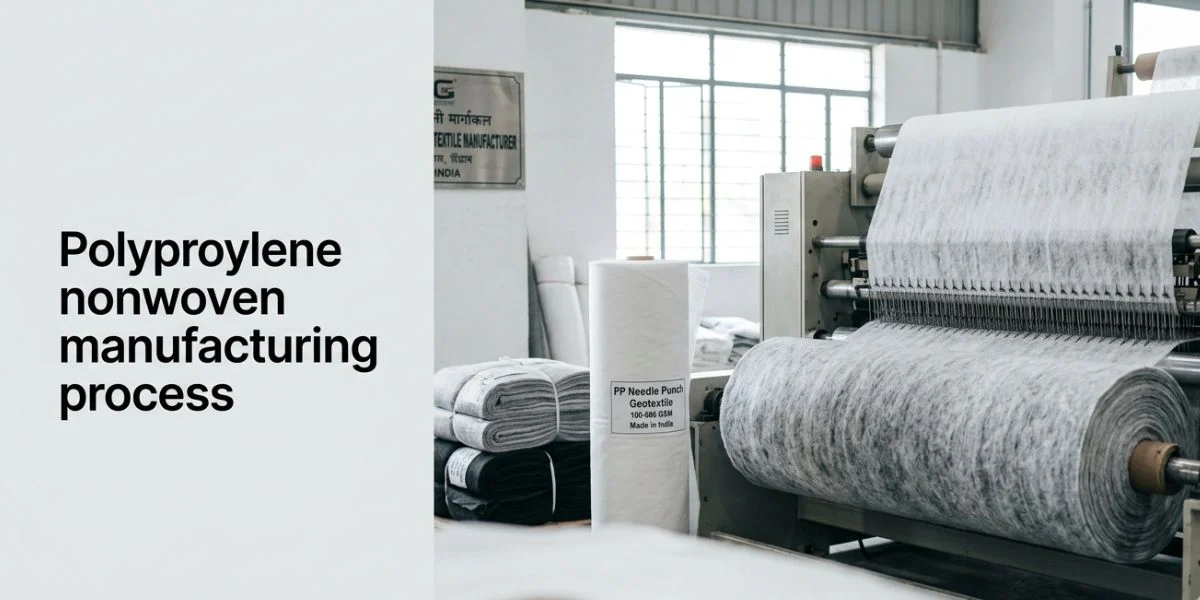
PP Needle Punch Geotextile Nonwoven — 100–600 GSM Manufacturer India
PP (polypropylene) needle punch geotextile nonwoven fabric is produced by mechanically needling staple polypropylene fibres into a dense, high-strength textile used in civil engineering, road construction, railway embankments, drainage systems, and slope erosion control. With tensile strength up to 1,200 N/5cm and CBR puncture resistance up to 10,000 N, PP needle punch geotextile meets IS 14324, ASTM D4595, and EN ISO 10319 specifications required by Indian infrastructure projects.
Browse our full range: View all nonwoven fabric products — spunlace, spunbond, SMS, bico — with GSM, width and certification options. B2B MOQ from 500 kg.
Technical Specifications
| Property | Specification |
|---|---|
| GSM range | 100–600 GSM |
| Fibre | 100% polypropylene staple |
| Width | 2–6 m |
| Tensile MD | 200–1,200 N/5cm (ASTM D4595) |
| CBR puncture | 1,500–10,000 N (ASTM D6241) |
| Water permeability (k₉₀) | 10–100 mm/s |
| Standard compliance | IS 14324, ASTM D4595, EN ISO 10319 |
| MOQ | 1,000 kg |
Applications
Road base separation (NH, state highways), railway subgrade stabilisation, slope erosion protection, drainage filtration, retaining wall reinforcement, landfill liner protection, river bank stabilisation.
Why Favourite Fab
Factory-direct manufacturer, Agra India. IS 14324 compliant grades with third-party test certificates for government tenders. Wide rolls (4–6m) minimise site seam frequency. Export to Middle East, Africa, Southeast Asia for infrastructure projects.
FAQ
What GSM PP geotextile is required for NH road construction?
NHAI specifications typically require 150–200 GSM PP geotextile for road base separation with tensile ≥20 kN/m. State highway projects: 100–150 GSM. Railway embankment subgrade: 200–300 GSM. Always verify with project specification — requirements vary by traffic load and subgrade condition.
Does PP geotextile meet IS 14324?
Yes — our PP needle punch geotextile is tested per IS 14324 (geosynthetics for road applications). Third-party NABL-accredited test certificate available for tender submission. Specify IS 14324 compliance at time of order.
What roll width is available for geotextile?
2m, 4m, 5m, and 6m width. 5–6m wide rolls recommended for large road projects to reduce seam frequency. Roll length 50–200m per roll depending on GSM.
Full range: spunbond nonwoven fabric manufacturer India. Related: high GSM PET nonwoven fabric geotextile.
B2B Applications & End-Uses
PP needle-punch geotextile nonwoven from Favourite Fab in the 100\u2013600 GSM range covers the primary civil engineering and infrastructure applications where mechanical separation, filtration, and drainage functions are required without chemical additives or binder systems. Road construction contractors use 150\u2013250 GSM grades as subgrade separation layers between native soil and aggregate base course \u2014 the needle-punched structure prevents fine particle migration upward while allowing pore water drainage, extending pavement service life.
Embankment reinforcement and slope stabilisation projects specify heavier grades \u2014 typically 300\u2013500 GSM \u2014 where higher grab tensile strength and puncture resistance are needed to withstand installation loads and long-term stress from overburden. Pond liner protection applications place geotextile above and below the primary liner membrane; needle-punch nonwoven’s conformability around irregular stone surfaces provides more consistent cushioning than woven alternatives at equivalent mass per unit area.
Railway ballast filtration projects, coastal erosion control installations, and landfill leachate collection systems are further segments where needle-punch PP geotextile is the specified material. Infrastructure procurement teams and civil engineering consultants working on projects governed by IS 16392 (India) or international standards can request compliance documentation and test data from our technical team at the inquiry stage.
Certifications & Quality Assurance
Favourite Fab manufactures needle-punch PP geotextile to IS 16392 and tests finished rolls against ASTM test methods including: ASTM D4632 (grab tensile strength and elongation), ASTM D4833 (index puncture resistance), ASTM D4751 (apparent opening size / AOS), and ASTM D4491 (permittivity and transmissivity). Test reports are issued per production batch and provided to buyers for project specification compliance documentation.
Raw material traceability \u2014 polypropylene fibre lot number, denier, and staple length \u2014 is maintained within our ISO 9001:2015 quality records for each geotextile production run. GSM verification is performed across the roll width at multiple points, and rolls outside the specified GSM tolerance are quarantined for review before despatch. Width, roll length, and core specifications are confirmed against the purchase order before packaging and labelling.
More Questions Answered
What GSM needle-punch geotextile is appropriate for road subgrade separation on a low-volume rural road?
For low-volume rural roads with moderate subgrade CBR values, 150\u2013200 GSM needle-punch PP geotextile is typically specified for subgrade separation. The IS 16392 standard provides GSM-linked minimum performance requirements for different application classes. Where subgrade is particularly weak (CBR below 3%) or where large angular aggregate is placed directly on the fabric, 250\u2013300 GSM is recommended to improve puncture resistance during installation. Favourite Fab can supply test data for any GSM within the 100\u2013600 range to support your project specification review.
How does needle-punch bonding differ from spunbond in geotextile applications?
Needle-punch geotextile is produced by mechanically entangling staple fibres using barbed needles \u2014 no heat bonding or chemical binder is involved. This process creates a three-dimensional, isotropic fibre network with high void content and excellent in-plane drainage capacity. Spunbond nonwoven uses continuous filaments thermally bonded at crossover points, producing a thinner, smoother, and dimensionally stiffer fabric better suited to lightweight separation and packaging applications. For geotechnical applications requiring high void ratio, conformability to uneven surfaces, and resistance to long-term compression, needle-punch construction is the standard industry choice.

Gaurav Garg
I'm Gaurav Garg, CEO of Favourite Fab, a company on a mission to revolutionize the nonwoven industry with sustainable practices. We work hand-in-hand with manufacturers and suppliers who share our commitment to eco-friendly production. With a deep interest in textile innovation, I'm passionate about educating consumers about sustainable material options and their potential to transform the nonwoven landscape.


