

Car Interior Lining Nonwoven Fabric — Flame Retardant Grade India
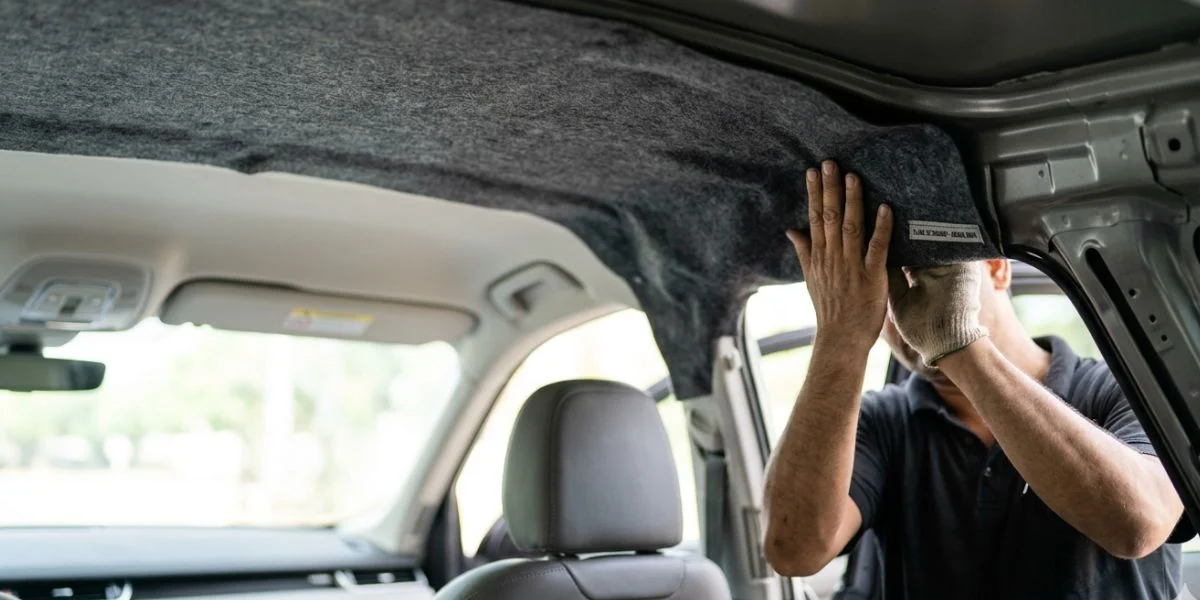
Car interior lining nonwoven fabric covers visible interior surfaces — door panels, trunk liners, headliners, pillar trim covers, and parcel shelves — providing an aesthetically uniform, textile-like finish over structural substrates. Interior lining nonwoven must meet automotive aesthetic requirements (low fuzzing, colour fastness, resistance to UV and humidity) while complying with FMVSS 302 or ISO 3795 flame retardancy. Favourite Fab supplies needle punch and thermally bonded nonwoven in 150–400 GSM for automotive interior applications.
Browse our full range: View all nonwoven fabric products — spunlace, spunbond, SMS, bico — with GSM, width and certification options. B2B MOQ from 500 kg.
Specifications
| Property | Specification |
|---|---|
| GSM | 150–400 GSM |
| Fibre | PET needle punch, PP thermally bonded |
| Flame retardancy | FMVSS 302: ≤100 mm/min horizontal burn |
| Colour fastness | Grade 4–5 (ISO 105-B02 xenon arc) |
| Fuzzing resistance | Grade 4 (Martindale 5,000 cycles) |
| Width | 160–260 cm |
| MOQ | 500 kg |
FAQ
What surface finish options are available for interior lining nonwoven?
Velour-surface (raised loop finish for plush appearance), flat calendar-finish (smooth backing), embossed patterns, and custom backing laminates (PE foam, PP foam, woven scrim). Specify surface finish and backing requirements at time of order.
What colour options are available?
Standard: charcoal grey, black, dark grey, beige. Custom masterbatch colours with minimum 2,000 kg per colour. UV-stable pigments ensure Grade 4+ colour fastness for automotive interior exposure.
Full range: spunbond nonwoven fabric manufacturer India. Related: automotive acoustic insulation nonwoven fabric India.
B2B Applications & End-Uses
Automotive OEM interior trim supply chains operate under some of the most demanding material qualification processes in the nonwoven industry. Tier-1 and Tier-2 automotive suppliers sourcing nonwoven for vehicle interior components must satisfy simultaneous requirements across flame retardancy, VOC emissions, dimensional stability, and acoustic performance — in addition to the cost and supply continuity demands inherent in automotive programme sourcing. Favourite Fab’s flame-retardant needle-punched and thermally bonded nonwovens address this specification cluster for Indian and export automotive supply chains.
Roof lining (headliner) substrate is one of the highest-volume automotive interior nonwoven applications. The headliner construction typically involves a nonwoven facing fabric laminated to a thermoformed foam or fibreglass core. The facing nonwoven — usually 100–200 GSM PET-based — must meet FMVSS 302 (US Federal Motor Vehicle Safety Standard for flammability) and ECE R118 (European regulation) simultaneously for vehicles destined for multiple export markets. IS 15061 (Indian standard for automotive interior materials) applies to vehicles produced and sold domestically. Favourite Fab maintains FR grade production with documented compliance data against all three standards, enabling customers to qualify a single fabric for multi-market vehicle programmes.
Door panel backing and trunk lining applications use heavier nonwoven constructions (200–400 GSM), typically needle-punched PET with FR additive, providing both structural substrate function and sound absorption contribution. The noise, vibration, and harshness (NVH) engineering teams at automotive OEMs increasingly specify acoustic absorption coefficient requirements (ISO 10534-2 impedance tube method) for these components. Favourite Fab can provide sound absorption coefficient test data (typically αw 0.3–0.7 at 1,000–4,000 Hz depending on GSM and construction) to support NVH validation.
Underbody shield and wheel arch liner applications require nonwoven that withstands thermal cycling, road debris impact, and exposure to road spray — including road salt in winter climates. Heavy needle-punched constructions (400–600 GSM) in stabilised PET, sometimes with PP backing for stiffness, are used here. FR requirements for underbody components vary by OEM specification but are increasingly mandated in EV programmes due to proximity to battery pack thermal management systems.
Certifications & Quality Assurance
Automotive-grade nonwoven is tested against FMVSS 302 (horizontal burn rate ≤100 mm/min), ECE R118 (horizontal and vertical burn), and IS 15061 for Indian market compliance. Test reports are issued per production lot by accredited third-party laboratories and are available for Tier-1 supplier qualification packages. VOC emission testing per VDA 275 (formaldehyde) and VDA 278 (organic emissions by TD-GC/MS) is conducted for cabin-facing components where interior air quality standards apply.
Tensile strength, elongation, peel strength (for laminated constructions), and GSM uniformity are covered in standard COA. For acoustic components, optional sound absorption coefficient testing per ISO 10534-2 can be arranged. Colour fastness testing (ISO 105-B02 light fastness, ISO 105-X12 rubbing) is conducted for visible interior facing fabrics. All automotive-grade production is traceable to raw material lot level for OEM programme audit requirements.
More Questions Answered
Does Favourite Fab supply nonwoven that meets both FMVSS 302 and ECE R118 simultaneously?
Yes. FR-grade PET nonwoven production is formulated and tested to comply with both FMVSS 302 (burn rate ≤100 mm/min horizontal) and ECE R118 (horizontal and vertical burn rate limits). Simultaneous compliance test reports from accredited laboratories are available for vehicle programmes targeting both North American and European markets from the same production facility. Specific test report availability should be confirmed with our technical sales team for the GSM grade required.
What is the typical lead time for FR-grade automotive nonwoven from Favourite Fab?
Standard FR-grade nonwoven for automotive applications is produced against a manufacturing schedule with lead times that depend on order volume, GSM specification, and current production loading. For programme sourcing with planned volume requirements, Favourite Fab can discuss blanket order arrangements with scheduled release to support automotive supply chain just-in-time requirements. Contact our industrial sales team with programme volume forecasts for lead time and pricing discussion.
Is recycled PET (rPET) available for automotive nonwoven in line with OEM sustainability mandates?
Recycled PET content nonwoven is available in selected constructions for automotive customers with OEM sustainability requirements or scope 3 emissions reduction commitments. rPET-based nonwoven undergoes the same FR treatment and compliance testing as virgin PET grades. Material sustainability documentation including recycled content percentage and GRS (Global Recycled Standard) certification status can be provided for OEM sustainability programme reporting. Minimum order volumes and lead times for rPET grades differ from standard virgin PET production.

Gaurav Garg
I'm Gaurav Garg, CEO of Favourite Fab, a company on a mission to revolutionize the nonwoven industry with sustainable practices. We work hand-in-hand with manufacturers and suppliers who share our commitment to eco-friendly production. With a deep interest in textile innovation, I'm passionate about educating consumers about sustainable material options and their potential to transform the nonwoven landscape.


