

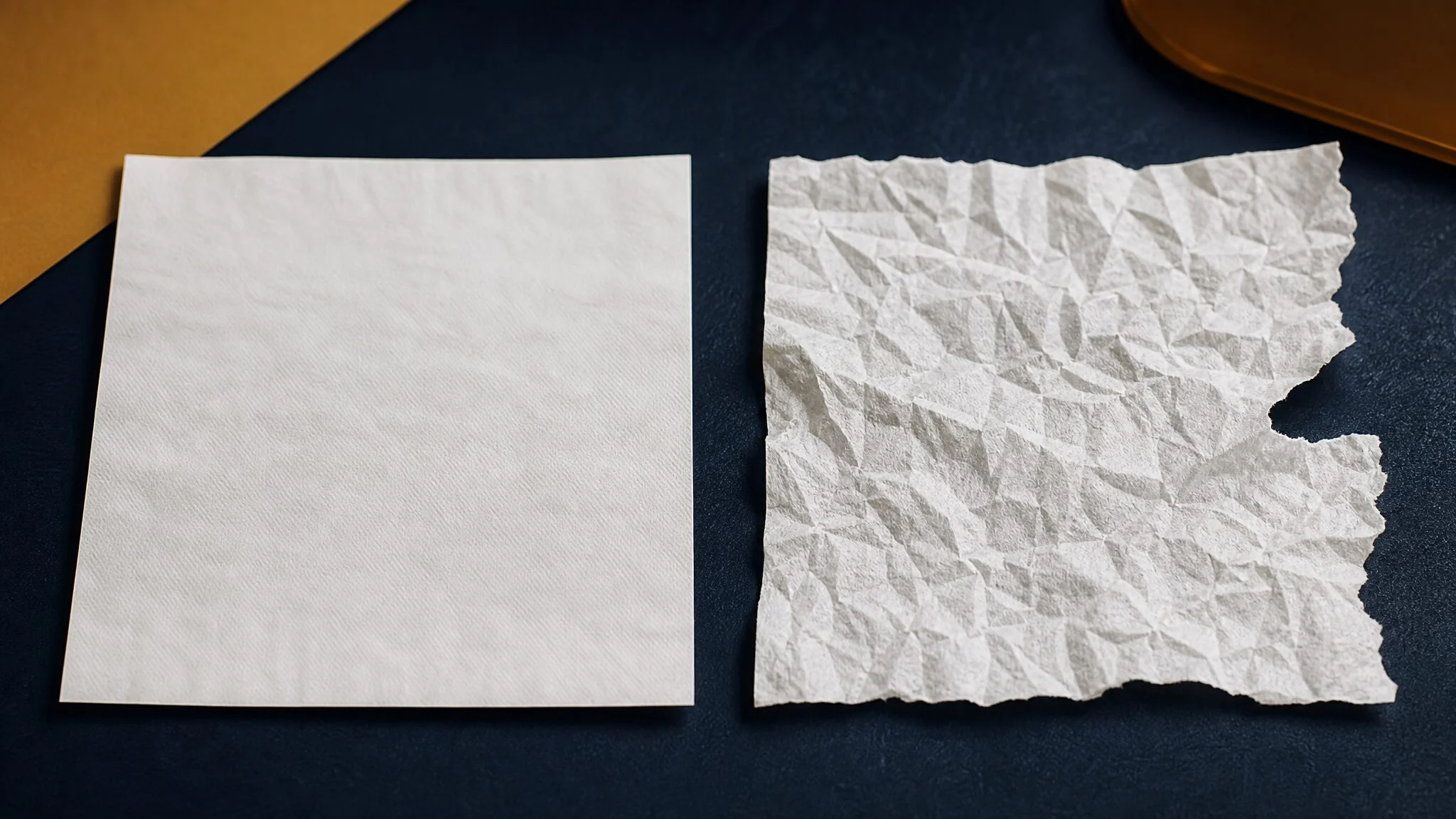
Carrier Tissue vs Normal Tissue Paper for Sanitary Napkin Core Wrap
Carrier tissue is a 13–15 GSM virgin wood-pulp wrap engineered for wet-strength and pinhole resistance. Normal tissue paper — the kind made for facial or toilet-tissue use — carries no wet-strength treatment and fails on a converting line. The two are not interchangeable, and confusing them is a common sourcing mistake. Request a carrier tissue sample to see the difference on your own line.
perforated nonwoven — skin contact
acquisition & distribution layer
13–15 GSM
SAP + fluff pulp
13–15 GSM
PE film — leak barrier
Carrier tissue wraps the SAP core on both faces — it holds the core together during high-speed converting and blocks SAP granules from pinholing through to the topsheet or backsheet.
Why sanitary napkin manufacturers compare these two materials
Every sanitary napkin core needs a wrap layer between the SAP/fluff-pulp core and the topsheet/backsheet. That wrap has three jobs: hold the core together during high-speed converting, stop SAP granules migrating through to cause strike-through or pinholing, and survive both dry handling and wet-load without tearing on the line. Carrier tissue paper does this because it is 100% virgin wood pulp, specifically wet-strength-treated for this application. Normal tissue paper — the grade used for facial or toilet tissue — is not engineered for this job: it has no added wet-strength resin, so it disintegrates under SAP moisture load and tears during high-speed unwind, causing line stoppages and core-integrity failures. Some buyers get quoted “tissue paper” at a lower price without being told it’s the wrong grade — this page covers what actually separates the two.
Carrier tissue vs normal tissue paper — comparison table
| Parameter | Carrier Tissue Paper | Normal Tissue Paper |
|---|---|---|
| Base material | 100% virgin wood pulp, wet-strength treated | Recycled/virgin pulp, no wet-strength treatment |
| GSM range (core-wrap use) | 13–15 g/m² | Typically 12–20 g/m², but not rated for this use |
| Wet/dry strength for runnability | High — engineered specifically for wet-strength at low weight | Low — disintegrates on wet contact, no added resin |
| Pinhole/strike-through resistance | Strong barrier via pulp fiber density | Fails — tears under SAP swell, causes strike-through |
| Suitable for sanitary napkin core wrap? | Yes — industry standard | No — not engineered for this application |
| Cost profile | Import + logistics cost built in | Lower unit cost, but causes line failures/rejects that erase the saving |
| Sourcing | Imported by Favourite Fab, MOQ 1000 kg | Widely available — not stocked by Favourite Fab for this use |
| Best-fit use case | Any sanitary napkin or diaper core-wrap application | Facial/toilet tissue only — not recommended for core wrap at any scale |
Carrier tissue technical data — sanitary pad grade
| Property | Sanitary pad grade | Test method |
|---|---|---|
| Basis weight (GSM) | 13–15 g/m² | EDANA WSP 130.1 / ISO 9073-1 |
| Composition | 100% virgin wood pulp | Furnish declaration |
| Wet-strength treatment | Yes — wet-strength resin for hygiene-core duty | Wet tensile (MD), ISO 12625-5 |
| Tensile strength | MD/CD rated for high-speed unwind | EDANA WSP 110.4 / ISO 9073-3 |
| Function in pad | Core wrap — top & bottom face of SAP/fluff core | — |
| Primary job | Pinhole / strike-through resistance under SAP swell | — |
| Minimum order (MOQ) | 1000 kg | — |
| Sourcing | Imported & quality-verified by Favourite Fab | — |
Test-method references are the recognised EDANA/ISO standards for nonwoven and tissue basis weight, tensile, and wet tensile. Confirm exact per-lot values against your incoming-QC spec sheet — see the full quality checklist.
Why normal tissue paper fails as a sanitary napkin core wrap
Normal tissue paper is engineered for softness and absorbency in a single dry pass, not for repeated wet-load contact under compression. It carries no wet-strength resin, so once the SAP core swells with fluid, the tissue fibers separate and the wrap tears. On a converting line, this shows up as web breaks, SAP migration into the topsheet (strike-through), and inconsistent pad thickness. Any per-kg cost saving from using normal tissue is erased by line downtime, rework, and rejected output.
How to tell the two apart before you order
GSM alone doesn’t tell you whether a tissue is wet-strength rated — a 15 GSM normal tissue and a 15 GSM carrier tissue can look identical on a spec sheet. Ask the supplier directly whether the tissue is wet-strength treated for hygiene-core applications, and ask for a wet-tensile test result, not just a dry-tensile number. If a buyer’s current supplier is quoting “tissue paper” without confirming this, that’s the first thing to verify — see the carrier tissue quality checklist for the full list of what to ask before ordering.
The single measurable property that separates the two grades is wet tensile strength, tested under ISO 12625-5. Normal tissue paper registers near-zero wet tensile — once it is saturated it pulls apart in the hand — whereas a wet-strength-treated carrier tissue retains a defined share of its dry strength when wet, which is exactly what keeps the web intact as the SAP core swells on line. When you read a supplier’s spec sheet, look past the headline figures: a quote that lists only a dry-tensile value, with no wet-tensile row and no ISO 12625-5 reference, is a red flag that the grade is untreated. Basis weight is equally easy to misread. It is measured to EDANA WSP 130.1, but a 15 GSM number on its own tells you only how much fibre sits per square metre — it says nothing about wet-strength resin content. Two rolls can match on basis weight and behave in opposite ways the moment they meet moisture, so treat the wet-tensile line, not the GSM, as the deciding spec.
Applications
- Sanitary napkin core wrap — the direct comparison covered on this page
- Baby diaper core wrap — same wet-strength and pinhole-resistance requirement applies
- Adult incontinence products — core-wrap material choice follows the same wet-strength and runnability criteria as sanitary napkins
Pricing & MOQ
Carrier tissue is priced on an import-plus-logistics basis with a 1000 kg MOQ. Favourite Fab does not stock normal tissue paper for core-wrap use, since it does not meet the wet-strength requirement. For a quote on 13–15 GSM carrier tissue at your required quantity, contact Favourite Fab’s sales team.
FAQs
Can normal tissue paper be used instead of carrier tissue?
No. Normal tissue paper has no wet-strength treatment, so it tears once the SAP core absorbs moisture — causing web breaks, strike-through, and rejected pads on a converting line. Any cost saving on the raw material is offset by line downtime and rework. Use wet-strength-rated carrier tissue (13–15 GSM) instead.
How is carrier tissue different from normal tissue paper if the GSM is the same?
GSM measures weight per area, not wet-strength. Carrier tissue is specifically treated with a wet-strength resin during manufacturing; normal tissue paper is not. Two tissues at the same GSM can behave completely differently once wet — always confirm wet-strength treatment, not just GSM, before ordering.
What happens if a converting line runs normal tissue instead of carrier tissue by mistake?
The tissue tears under SAP moisture load during production, causing web breaks, SAP strike-through into the topsheet, and inconsistent core thickness — leading to line stoppages and rejected output.
Does Favourite Fab manufacture or import carrier tissue?
Favourite Fab imports carrier tissue paper (13–15 GSM, MOQ 1000 kg) as a supplier — it does not manufacture this specific product.
What MOQ applies to carrier tissue orders?
1000 kg. Request a sample first to verify wet-strength and runnability on your line before placing a bulk order.
For the full three-way component map — carrier tissue, airlaid, wrapping tissue — see Tissue Paper for Sanitary Napkins: Types, GSM & How to Choose.

Gaurav Garg
I'm Gaurav Garg, CEO of Favourite Fab, a company on a mission to revolutionize the nonwoven industry with sustainable practices. We work hand-in-hand with manufacturers and suppliers who share our commitment to eco-friendly production. With a deep interest in textile innovation, I'm passionate about educating consumers about sustainable material options and their potential to transform the nonwoven landscape.


