

Tissue Paper for Sanitary Napkins: Types, GSM & How to Choose (2026)
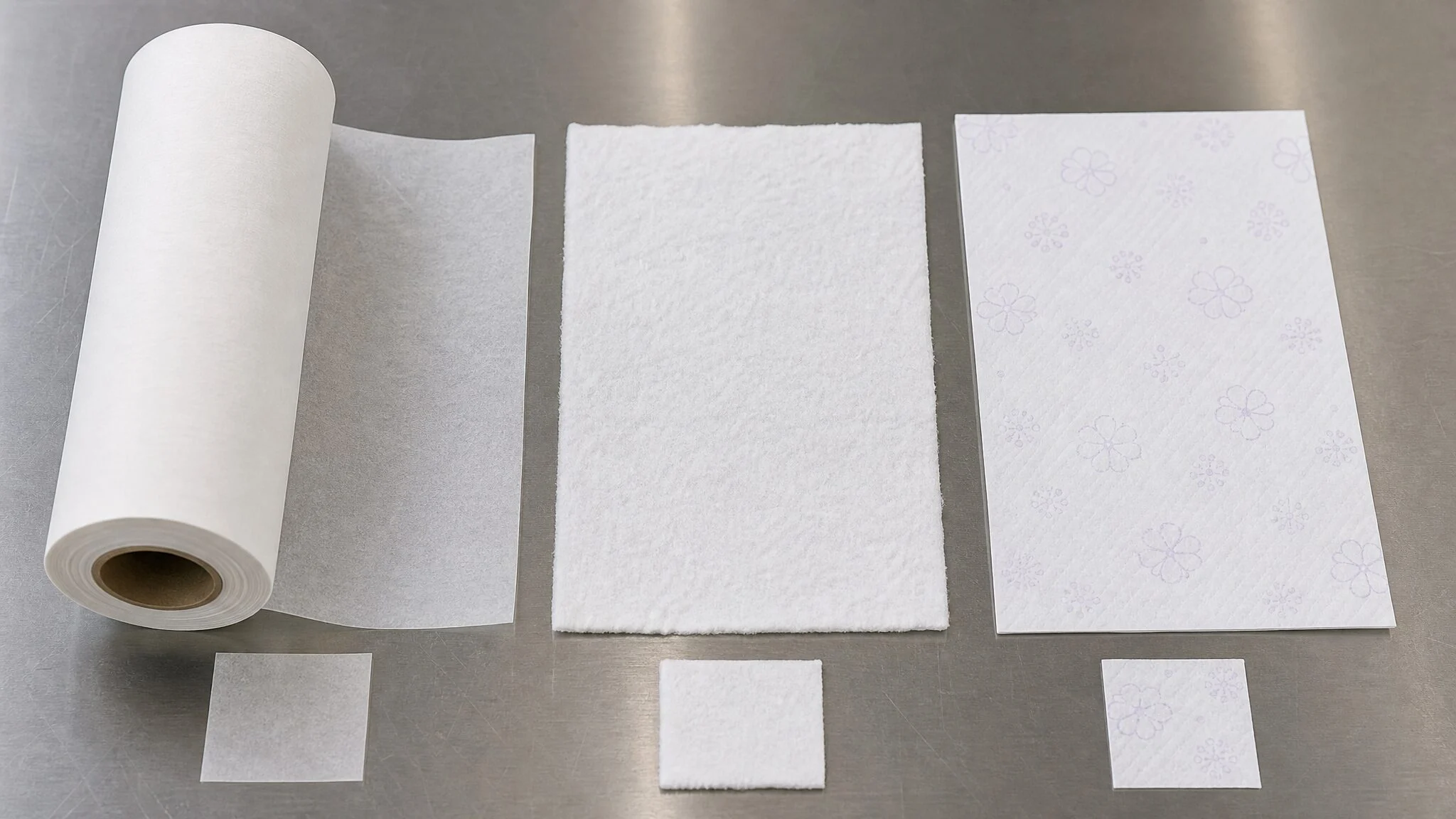
Tissue paper for sanitary napkins is not one material — buyers use this phrase for at least three different components: carrier tissue (core wrap), airlaid tissue (absorbent core sheet), and wrapping tissue (individual pad wrap). Each does a different job, sits in a different layer, and is bought against a different spec. This guide maps all three so you order the right one the first time. Talk to our sourcing team if you’re not sure which tissue your line needs.
The three “tissue paper” components in a sanitary napkin — quick map
| Component | What it does | Typical GSM | Where it sits |
|---|---|---|---|
| Carrier tissue | Wraps SAP/fluff core, stops pinholing & strike-through | 13–15 GSM | Both faces of absorbent core |
| Airlaid tissue / airlaid paper | Bulkier absorbent sheet — sometimes the core itself, sometimes an ADL component | 40–150+ GSM | Core or acquisition layer |
| Wrapping tissue / individual wrap | Outer pad packaging before poly-bagging | 17–25 GSM | Outside the folded pad |
Most buyer confusion starts here: a spec sheet that says “tissue paper” without naming which of these three is meant leads to wrong-GSM orders and line stoppages. Always confirm which component you’re sourcing before requesting samples.
Carrier tissue — the core-wrap tissue (most common “sanitary napkin tissue paper” search)
When most B2B buyers search “tissue paper for sanitary napkins,” they mean carrier tissue — the thin, 100% virgin wood-pulp layer that wraps the SAP-fluff absorbent core on both faces. Favourite Fab supplies this at 13–15 GSM, wet-strength treated, imported and quality-verified. Full spec, GSM table, and buyer FAQ: Carrier Tissue Paper for Sanitary Napkins — Complete B2B Buying Guide. For the mechanics of why this layer exists, see What Is Carrier Tissue in a Sanitary Napkin?
Airlaid tissue — when “tissue paper” means the absorbent sheet itself
Some buyers use “tissue paper” loosely for airlaid paper — a thicker, higher-GSM nonwoven-tissue hybrid that can function as the absorbent core itself or as part of the acquisition/distribution layer. Airlaid is a structurally different product from carrier tissue: it’s bulkier, denser, and engineered for absorbency rather than wrap strength. See Favourite Fab’s airlaid nonwoven fabric for sanitary pads range if this is what your line needs. Don’t order carrier tissue GSM (13–15) expecting airlaid absorbency — the two are not interchangeable, a distinction covered in depth in Carrier Tissue vs Normal Tissue Paper.
Wrapping tissue — outer pad packaging
A third, unrelated use of “tissue paper” in this industry is the individual-pad wrapping tissue used before poly-bag packaging — lighter GSM (17–25), printed or plain, with no absorbency function. This is a packaging-line component, not a core material, and buyers sourcing raw materials for the absorbent core should not confuse it with carrier or airlaid tissue.
How to choose the right tissue paper for your sanitary napkin line
- Identify the layer first. Are you replacing a core wrap (carrier tissue), an absorbent core/ADL (airlaid), or outer packaging (wrapping tissue)? Get this confirmed before requesting quotes.
- Match GSM to function, not price. A cheaper, lower-GSM carrier tissue that fails wet-strength testing costs more in downstream leakage complaints than the per-kg saving.
- Ask for wet-tensile data, not just basis weight. GSM alone doesn’t predict SAP-leak resistance — wet strength under ISO 12625-5 does. See the full carrier tissue quality checklist before placing a bulk order.
- Confirm HSN/import documentation if sourcing imported tissue — see Carrier Tissue Paper HSN Code & Import Guide.
- Consider the SMS-nonwoven alternative for low-GSM core-wrap applications — Favourite Fab’s own SSS hydrophilic nonwoven is used by some manufacturers under 12 GSM equivalent duty.
Tissue paper for baby diapers — same components, different scale
Baby diapers use the same carrier-tissue core-wrap principle as sanitary napkins, at similar or slightly higher GSM depending on core size. See Carrier Tissue Paper for Baby Diapers: GSM & Core-Wrap Guide for diaper-specific spec guidance.
Sourcing tissue paper for sanitary napkin manufacturing
Favourite Fab supplies carrier tissue paper (13–15 GSM, imported, quality-verified, MOQ 1000 kg) alongside the nonwoven fabric components used in the same core — spunbond, spunlace, SMS, and airlaid. Buyers consolidating their bill-of-materials with a single vetted supplier typically start with carrier tissue and topsheet nonwoven together. See the full list of carrier tissue paper manufacturers & suppliers in India for a comparison view, or view the carrier tissue product page directly.
FAQs
Q1: What is tissue paper called in a sanitary napkin?
A1: The core-wrap layer is called carrier tissue. It should not be confused with airlaid paper (a bulkier absorbent sheet) or wrapping tissue (outer pad packaging) — all three are sometimes loosely called “tissue paper.”
Q2: What GSM tissue paper is used for sanitary napkins?
A2: Carrier tissue for the core wrap is typically 13–15 GSM. Airlaid tissue used as an absorbent sheet runs much higher, 40–150+ GSM, depending on design.
Q3: Is carrier tissue the same as regular tissue paper?
A3: No. Carrier tissue is wet-strength treated and engineered for core-wrap duty under SAP swelling pressure — ordinary tissue paper is not built to hold that load without tearing.
Q4: Can I buy tissue paper and nonwoven fabric from the same supplier?
A4: Yes. Favourite Fab supplies carrier tissue paper alongside spunbond, spunlace, SMS, and airlaid nonwoven fabric for the same sanitary napkin or diaper core — contact sales to consolidate your BOM.
For the complete carrier tissue buying guide, spec tables, and supplier vetting criteria, see Carrier Tissue Paper for Sanitary Napkins: Complete B2B Buying Guide.

Gaurav Garg
I'm Gaurav Garg, CEO of Favourite Fab, a company on a mission to revolutionize the nonwoven industry with sustainable practices. We work hand-in-hand with manufacturers and suppliers who share our commitment to eco-friendly production. With a deep interest in textile innovation, I'm passionate about educating consumers about sustainable material options and their potential to transform the nonwoven landscape.


