

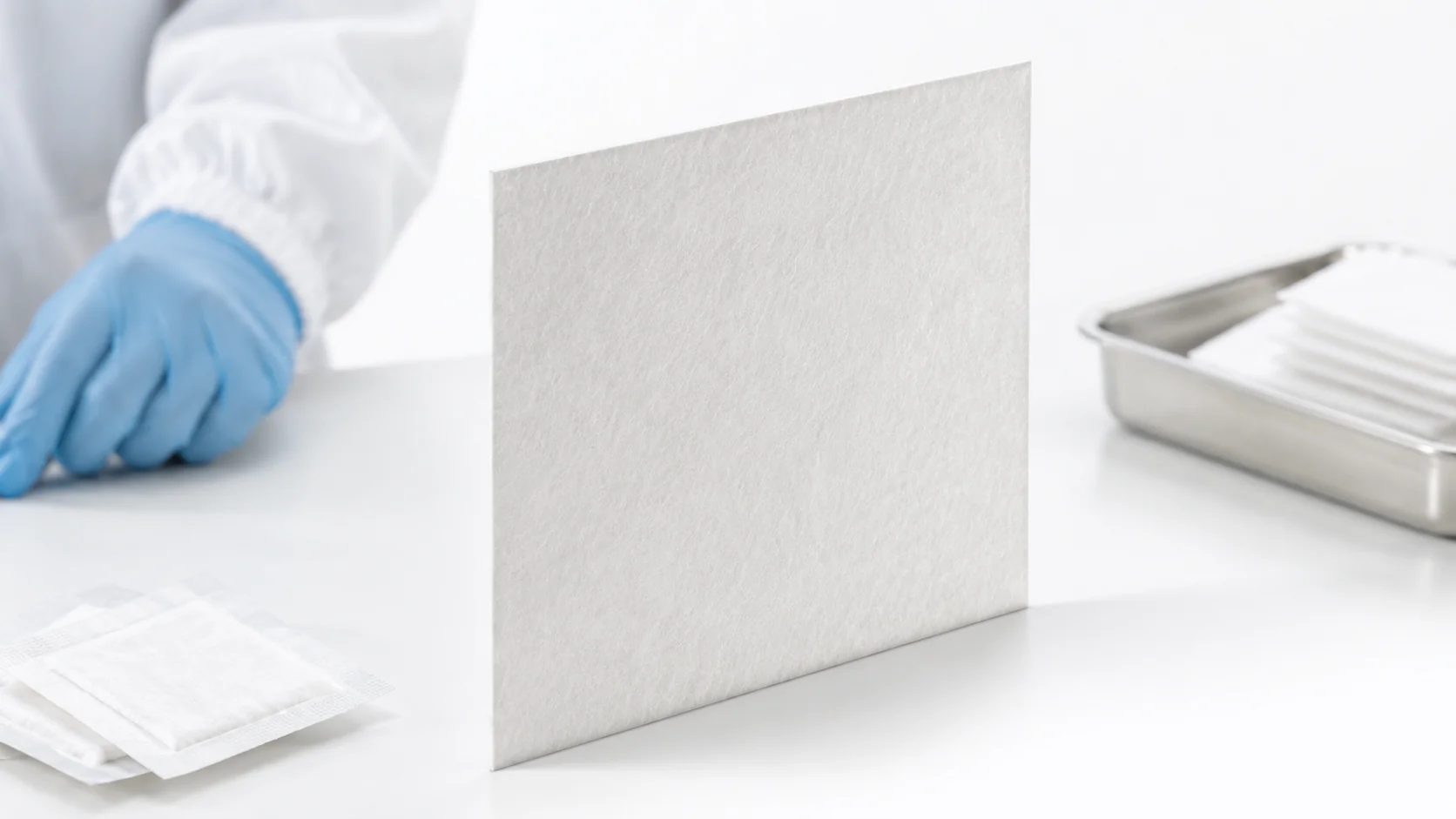
Chemically Stiffened Nonwoven Fabric for Alcohol Swabs, Cleanroom and Industrial Use in India
Chemically stiffened nonwoven fabric alcohol swab cleanroom India is a critical specification for manufacturers who need controlled rigidity, dimensional stability and consistent substrate performance. Favourite Fab supplies binder-treated stiffened nonwoven from its ISO-certified facility in Agra, India — delivering the precise stiffness level your application demands without sacrificing the absorbency or lint control your process requires.
Standard untreated nonwoven is soft and conformable. For alcohol swab substrates, cleanroom wipes, medical prep pads and industrial applicators, a defined stiffness level is essential for machine processing, dispensing and end-use function. This guide covers the binder treatment spectrum, key specifications and application selection criteria.
Understanding Chemical Stiffening: The Binder Treatment Spectrum
Chemical stiffening applies a polymer binder — typically acrylic, styrene-butadiene or polyvinyl acetate — to the nonwoven substrate via pad-dry-cure, saturation or print bonding. Binder add-on level (expressed as % by weight) controls the rigidity outcome. More binder increases stiffness but reduces drape and may affect absorbency.
Manufacturers must balance rigidity (needed for machine handling and consistent application) against drape and absorbency (needed for effective fluid delivery or cleaning action). The right binder level depends on your dispensing equipment, end-use format and regulatory requirements.
Detailed Specification Comparison
| Parameter | Untreated Nonwoven | Light Binder (5–10%) | Medium Binder (15–25%) | Full Saturation (30–45%) |
|---|---|---|---|---|
| Binder Add-On (%) | 0 | 5–10% | 15–25% | 30–45% |
| Handle / Rigidity | Very soft, conformable | Slight body — improved hand | Firm — good machine processing | Board-like rigidity |
| Absorbency Rate | Fast — unimpeded capillary action | Good — minor reduction | Moderate — binder partially blocks pores | Low — binder fills pore structure |
| Lint Level | Moderate — loose fibres possible | Reduced | Low | Very low — fibres fully bound |
| Dimensional Stability | Low — stretches and distorts | Improved | Good — suitable for die-cutting | Excellent — stable to ±0.5mm |
| Typical Application | Soft wipes, filtration webs | Dry wipes, light applicators | Alcohol swabs, prep pads | Cleanroom wipers, industrial applicators |
Which Grade to Choose and When
For alcohol swab and prep pad manufacture, medium binder (15–25% add-on) is the standard specification. This level provides enough rigidity for high-speed rotary die-cutting and individual sachet filling, while maintaining the absorbency needed for consistent IPA saturation and skin contact performance.
For cleanroom wipes, medium to full saturation grades are preferred. Cleanroom environments require minimal particle and lint generation. Higher binder levels lock fibres in place and reduce particle shed. Confirm compatibility with your cleanroom classification and chemical exposure profile.
For industrial applicators and dispensing substrates, full saturation gives dimensional precision for automated dispensing systems. The rigid substrate feeds consistently through dispensers and maintains shape under pressure.
For dry wipes and general hygiene, light binder treatment provides improved body and reduced lint while preserving softness and absorbency.
See our full spunlace range at spunlace non woven fabric. For cleanroom and electronics manufacturing applications, visit nonwoven fabric electronics cleanroom. For colour-coded stiffened grades, see masterbatch colored nonwoven fabric.
Wet wipe manufacturers can review our dedicated spunlace nonwoven fabric for wet wipes product range.
Why Source From Favourite Fab
- MOQ-friendly — chemically stiffened grades available for small-batch development and large production runs
- Export-ready — ships to 50+ countries with full COA and binder chemistry documentation
- ISO certified manufacturing facility in Agra, India
- 10+ years supplying hygiene and medical industry OEMs
- Custom binder levels, GSM and width available on request — we match your process requirements
Pricing and MOQ
Pricing for chemically stiffened nonwoven depends on base fabric GSM, binder type (acrylic, SBR, PVAc), add-on percentage and order volume. Higher binder add-on levels carry incremental chemical cost. We offer competitive wholesale pricing with no hidden conversion charges.
Sample rolls at your specified stiffness level are available before production commitment. Contact sale@favouritehub.com with your target specification and dispensing equipment details.
How to Order
- Send your stiffness requirement, GSM, width and end-use application to sale@favouritehub.com
- Receive a sample and quote within 48 hours
- Confirm sample approval and production begins — standard lead time 10–14 days ex-factory
Frequently Asked Questions
Q: What binder types does Favourite Fab use for chemical stiffening?
A: We offer acrylic binder (most common, flexible and durable), styrene-butadiene rubber (SBR, higher rigidity) and polyvinyl acetate (PVAc, good stiffness with moderate cost). Binder selection depends on your end use, chemical resistance requirement and regulatory environment.
Q: Is chemically stiffened nonwoven suitable for alcohol swab substrates?
A: Yes. Medium binder nonwoven at 15–25% add-on is the standard substrate for alcohol prep pads and swabs. It provides the body needed for high-speed die-cutting and sachet filling while maintaining IPA absorption capacity for effective skin antisepsis.
Q: Does the binder affect the fabric’s OEKO-TEX or skin safety status?
A: Binder chemistry must be selected carefully for skin-contact applications. Favourite Fab uses binders that comply with OEKO-TEX Standard 100 requirements for direct skin contact at specified add-on levels. Full binder safety data is available on request.
Q: Can Favourite Fab supply custom stiffness levels between the standard tiers?
A: Yes. We can target specific Gurley stiffness values or handle descriptors based on your requirement. Send us your existing material’s stiffness spec or a reference sample and we will develop a matching grade.
Q: What GSM base fabrics are available for chemical stiffening?
A: We treat base fabrics from 25 GSM to 80 GSM for most stiffening applications. The most common swab and wipe substrates range from 35–55 GSM. Contact us with your target GSM and we will confirm availability and lead time.
Contact Favourite Fab
Email: sale@favouritehub.com
WhatsApp: +91-8800775462
Send your stiffness specification and application details today for a same-day quote on chemically stiffened nonwoven fabric.

Gaurav Garg
I'm Gaurav Garg, CEO of Favourite Fab, a company on a mission to revolutionize the nonwoven industry with sustainable practices. We work hand-in-hand with manufacturers and suppliers who share our commitment to eco-friendly production. With a deep interest in textile innovation, I'm passionate about educating consumers about sustainable material options and their potential to transform the nonwoven landscape.


