

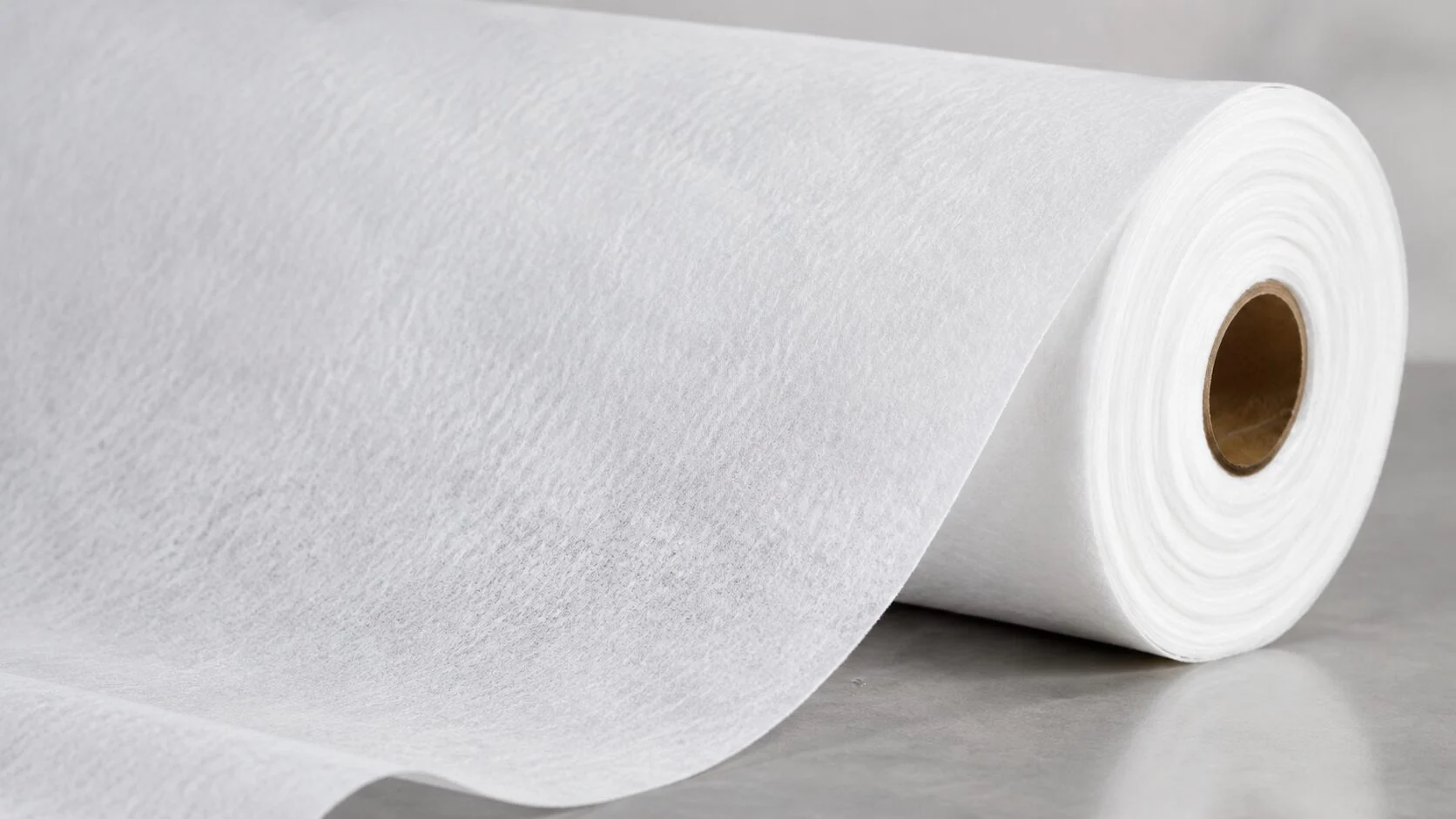
Spunlace Non Woven Fabric Manufacturer India — Favourite Fab is a B2B supplier of spunlace (hydroentangled) nonwoven fabric to wet wipe converters, cosmetic mask manufacturers, medical disposable producers, and household cleaning brands across India and export markets. Our spunlace non woven fabric is engineered for softness, absorbency, and tear strength — ideal for baby wipes, facial masks, surgical drapes, and industrial wipes. We supply rolls in 30-100 GSM ranges, widths up to 3.2m, with viscose/polyester blends customized to your end-use. MOQ from 500 kg, lead time 10-18 days from Agra.
What is Spunlace Non Woven Fabric?
Spunlace non woven fabric (also called hydroentangled nonwoven) is produced by entangling staple fibers using high-pressure water jets, without any thermal or chemical bonding. The result is a soft, drapable, lint-free fabric with excellent moisture retention and skin-friendly handle. Spunlace is the preferred substrate for wet wipes (baby, cosmetic, household, industrial), facial sheet masks, surgical drapes, hospital bedsheets, and personal care textiles. Common fiber blends include 100% viscose, 100% polyester, viscose/polyester (50/50, 70/30, 80/20), cotton/PET, lyocell/PET, and bamboo/PET. Spunlace fabric does not require chemical binders, making it skin-safe and FDA/EU-compliant for direct contact applications. Favourite Fab supplies plain spunlace, embossed (dot, mesh, pearl, cross), and apertured spunlace formats.
How Spunlace Non Woven Fabric is Manufactured
Spunlace manufacturing is a three-stage process that converts staple fibers into hydroentangled fabric without binders or thermal calendaring:
- Fiber preparation and blending: Bales of viscose, polyester, lyocell, or cotton are opened, blended in fixed ratios (e.g., 70% viscose / 30% PET), and fed to a chute feeder.
- Carding: Blended fibers pass through carding machines that align them into a uniform parallel web. For improved isotropy, two carding stations are used in cross-lap or parallel-lay configuration.
- Web formation: The carded web is laid on a moving conveyor — parallel-laid for high MD strength, cross-laid for balanced MD/CD strength, or air-laid for random isotropy.
- Pre-wetting: The dry web is sprayed with deionized water to consolidate fibers and prevent fly-off in the entanglement zone.
- Hydroentanglement: Multiple manifolds with rows of capillary jets (0.12 mm diameter) spray water at 60-250 bar pressure onto the web from both sides. Water jets penetrate the web, deflect off a backing screen or drum, and entangle individual fibers around each other, creating mechanical bonds at every fiber crossover.
- Pattern formation: If embossed or apertured fabric is required, the entanglement drum is engraved with a pattern (dot, mesh, pearl, honeycomb), which is transferred onto the fabric.
- Drying: The wet web (containing 200-400% water) passes through through-air dryers or drum dryers at 110-140°C until fully dried.
- Slitting and winding: The dried fabric is slit to customer width and wound into master rolls of 1,500-5,000 meters.
Quality is monitored by online basis-weight sensors, water-pressure feedback loops, and in-line camera systems for defect detection. Favourite Fab partner mills use Andritz Perfojet and Trützschler Aquajet hydroentanglement lines.
Specifications & Standards
| Parameter | Specification |
|---|---|
| GSM range | 30-100 GSM (40, 45, 50, 55, 60, 65, 70, 80 standard) |
| Width | 1.6m, 2.4m, 3.2m; slit widths from 80mm |
| Fiber composition | 100% viscose, 100% PET, viscose/PET 50/50, 70/30, 80/20, lyocell/PET, cotton/PET, bamboo/PET |
| Tensile strength | MD: 25-90 N/5cm, CD: 15-70 N/5cm (depends on web type and GSM) |
| Treatment | Hydrophilic (default), embossed (dot/mesh/pearl/cross), apertured, antibacterial |
| Color | White (standard), printed/dyed on request |
| Certifications | ISO 9001, OEKO-TEX 100, FDA 21 CFR 175.105 (food contact), EDANA wipes guidelines |
| HSN code | 5603.92 / 5603.93 |
| MOQ | 500 kg per SKU (1,000 kg for custom blends) |
| Lead time | 10-18 days standard, 25 days custom embossing |
Applications & End Uses
- Wet wipes: Baby wipes, cosmetic make-up wipes, hand and face wipes, household cleaning wipes, and disinfectant wipes. Spunlace is the dominant substrate in the wet wipes industry due to its softness and lint-free performance.
- Facial sheet masks: Cosmetic masks made from 100% lyocell, cotton, bamboo, or biocellulose spunlace (40-80 GSM) for skincare brands. Embossed and apertured versions enhance serum retention.
- Medical and surgical: Disposable surgical drapes, hospital bedsheets, patient gowns, wound care dressings, and absorbent pads.
- Industrial wipes: Heavy-duty cleaning wipes for automotive, manufacturing, electronics, and food-processing environments. High-absorbency variants for oil and solvent.
- Personal care textiles: Disposable pillowcases, salon towels, spa headbands, and beauty applicators.
- Apparel and home textiles: Disposable bedsheets for hotels and airlines, table linens, and decorative liners.
- Filtration and specialty: Coffee filters, tea bag substrates, and laboratory wipes.
Why Source Spunlace Non Woven Fabric from Favourite Fab
- Direct manufacturer relationships: We work with India’s top spunlace mills, passing competitive wholesale pricing directly to converters.
- MOQ-friendly: 500 kg per SKU for standard blends, ideal for new wipe brands and converter trials.
- ISO 9001 and OEKO-TEX certified: Skin-contact safe, fully traceable production, third-party tested.
- Custom blends and finishes: Viscose/PET ratios, embossing patterns, apertures, antibacterial treatments — fully tailored.
- Export-ready: Compliant with EU EDANA, US FDA, and EAC certifications for global wipe markets. FOB Mundra/JNPT.
- 24-hour quote turnaround: Sample swatches couriered within 48 hours via WhatsApp +91-8800775462 or sale@favouritehub.com.
Comparison with Other Nonwovens
| Property | Spunlace | Spunbond | Air-laid | Wet-laid |
|---|---|---|---|---|
| Softness | Very High | Medium | High | Medium |
| Absorbency | Very High | Low | Very High | High |
| Strength | Medium | High | Low | Medium |
| Best use | Wipes, masks | Hygiene covers | Absorbent cores | Tea bags |
Quality Testing & Certifications
- ISO 9001:2015 quality management system
- OEKO-TEX Standard 100 (skin-contact certified)
- FDA 21 CFR 175.105 (indirect food contact for food-service wipes)
- EDANA NWSP standards: 110.4 (basis weight), 110.5 (thickness), 110.6 (tensile)
- In-house QC: GSM, tensile MD/CD, water absorbency (ISO 9073-6), liquid strike-through, lint particle count
- Third-party certification on request (SGS, Intertek, TUV)
- Batch-level Certificate of Analysis (COA) and MSDS with every shipment
Pricing, MOQ & Lead Time
Spunlace fabric is priced per kilogram, with the rate driven by fiber blend (viscose-heavy blends cost more than PET-heavy), GSM, embossing complexity, and order volume. We offer competitive wholesale pricing aligned with global viscose and PET staple fiber benchmarks. MOQ is 500 kg per SKU for standard 50/50 and 70/30 viscose/PET; 1,000 kg for premium blends like lyocell/PET, bamboo/PET, or cotton/PET. Standard lead time is 10-18 days from PO; custom embossing patterns add 7-10 days for engraving roll preparation. Payment terms: 30% advance + 70% on BL copy for first orders; LC at sight or 30-day credit available for repeat customers. We ship FOB Mundra or JNPT for exports and ex-Agra for domestic. For binding quotes with current per-kg pricing, sample requests, and shipping options, reach our team at sale@favouritehub.com or WhatsApp +91-8800775462.
Related Process Guides — Spunlace
Explore detailed manufacturing and material guides connected to spunlace nonwoven fabric production.
- Wetlaid spunlace composite
- PET-PA splittable bico spunlace
- Apertured topsheet
- Sontara replacement spunlace
Frequently Asked Questions
What fiber blend is best for baby wipes?
The most common baby wipe blend is 70% viscose / 30% polyester at 50-60 GSM. The viscose provides softness and absorbency; the polyester provides wet strength. For premium organic brands, 100% lyocell or bamboo/PET 80/20 is preferred.
What is embossed spunlace?
Embossed spunlace has a 3D surface pattern (dot, mesh, pearl, cross, honeycomb) created by hydroentangling on a patterned drum. Embossing increases bulk, improves serum retention in masks, and gives a premium tactile feel.
Is spunlace fabric biodegradable?
100% viscose, lyocell, cotton, and bamboo spunlace is fully biodegradable in industrial composting and most home-compost conditions. Polyester-blended spunlace is partially biodegradable in proportion to the natural-fiber content.
Can you supply flushable spunlace for wipes?
Yes — we supply flushable spunlace based on 100% wood-pulp viscose or lyocell, compliant with the INDA/EDANA flushability guidelines (GD4). Used for moist toilet tissue applications.
What is the typical lead time for cosmetic mask substrate?
Standard cotton/PET 80/20 or 100% lyocell mask substrate ships in 12-15 days. Custom embossing for branded masks adds 7-10 days for tooling.
Do you offer printed spunlace?
Yes, we offer flexographic and rotary screen printing on spunlace for branded wipe pouches and household wipes. MOQ is 2,000 kg per design.
What is the HSN code for spunlace fabric?
Spunlace falls under HSN 5603.92 (35-150 GSM, manmade) or 5603.93 depending on composition. GST is 12% on standard grades.
Related Resources

Gaurav Garg
I'm Gaurav Garg, CEO of Favourite Fab, a company on a mission to revolutionize the nonwoven industry with sustainable practices. We work hand-in-hand with manufacturers and suppliers who share our commitment to eco-friendly production. With a deep interest in textile innovation, I'm passionate about educating consumers about sustainable material options and their potential to transform the nonwoven landscape.


