

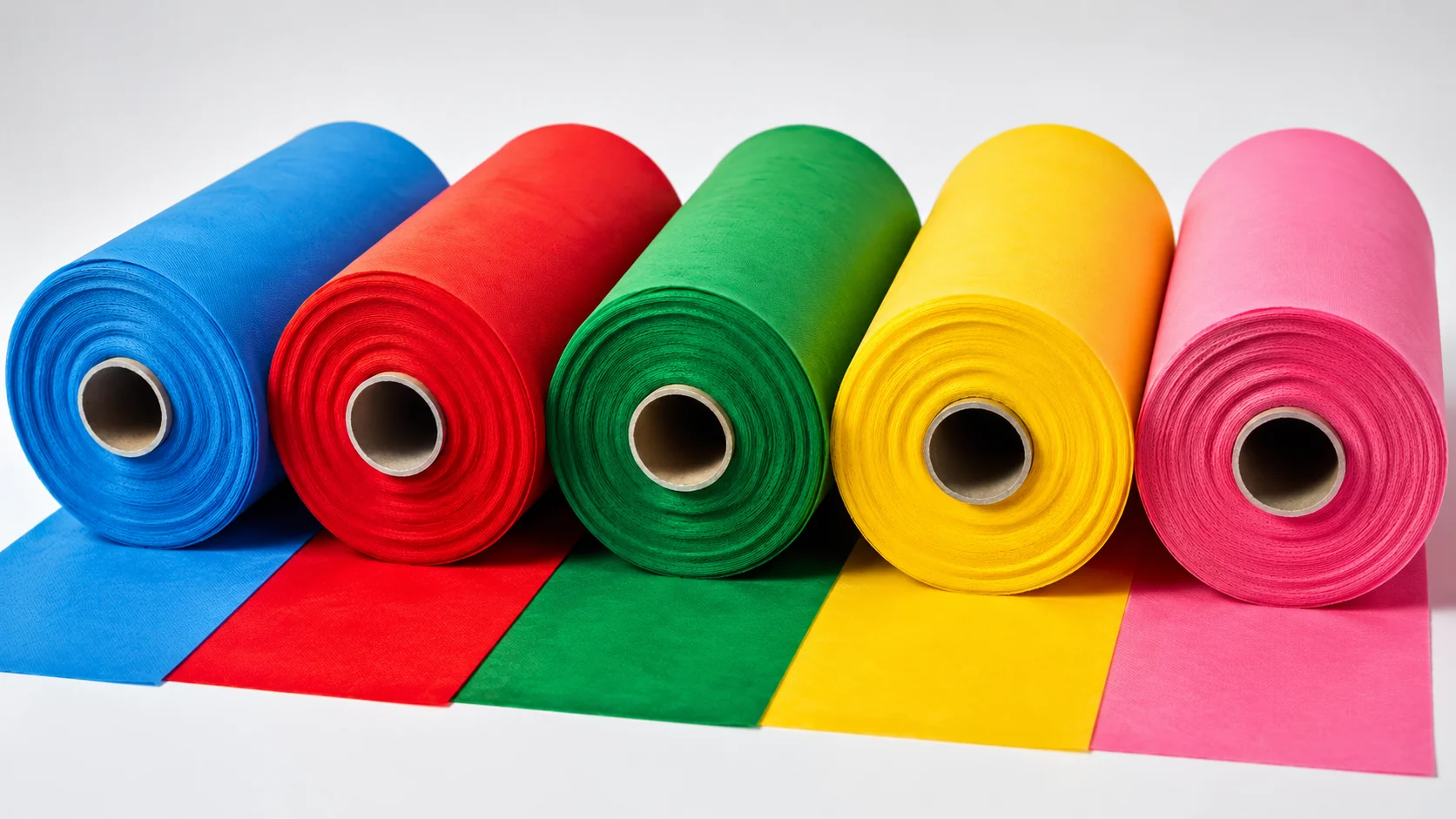
Masterbatch Colored Nonwoven Fabric: Migration-Resistant Dye Solutions for Manufacturers in India
Masterbatch colored nonwoven fabric migration resistant dye India is the preferred choice for hygiene, medical and industrial manufacturers who need consistent, safe colour without surface-dye bleed. Favourite Fab supplies masterbatch-pigmented nonwoven from its ISO-certified facility in Agra, India — giving OEMs and converters a reliable upstream source for coloured spunbond and thermobond fabrics.
Surface-dyed fabrics carry dye migration risk — pigment can transfer to skin, machinery or adjacent materials. Masterbatch colouring integrates pigment directly into the polymer melt before extrusion, eliminating migration at source. This guide explains the technology, key specifications and selection criteria for manufacturers specifying coloured nonwoven fabric.
Understanding Masterbatch Colouring: How It Differs from Surface Dyeing
In surface dyeing, pigment or dye is applied to the finished fabric via padding, printing or coating. The pigment sits on the fibre surface and is bonded with a carrier. This process is faster and lower-cost but carries inherent migration risk — especially in humid environments, under mechanical pressure or when in contact with skin.
In masterbatch colouring, concentrated pigment particles are pre-compounded into a polymer carrier. This masterbatch is blended with the base resin before melt-spinning. The pigment is encapsulated within every filament from the core outward. Migration is eliminated because there is no surface-applied dye — colour is part of the fibre structure itself.
Detailed Specification Comparison
| Parameter | Masterbatch Coloured Nonwoven | Surface-Dyed Nonwoven |
|---|---|---|
| Pigment Location | Integrated throughout fibre cross-section | Applied to fabric surface post-extrusion |
| Migration Risk | Negligible — pigment is polymer-bound | Moderate to high — surface dye can transfer |
| Wash / Wet Fastness | Excellent — colour survives sterilisation cycles | Variable — may fade or bleed under moisture |
| Colour Uniformity (CV%) | Low variation — ≤2% CV across web | Higher variation — edge-to-edge inconsistency possible |
| Suitable for Skin Contact | Yes — with appropriate pigment selection | Requires additional testing — migration risk |
| Colour Consistency Lot-to-Lot | High — masterbatch ratio is controlled | Variable — dye bath concentration can shift |
| Available Colours | Custom — any RAL/Pantone matched | Wider palette — faster turnaround for standard shades |
| Lead Time for Custom Colour | 7–14 days (masterbatch compounding) | 3–7 days (post-production dyeing) |
| Cost | Moderate premium for custom masterbatch | Lower for standard colours, higher for specialty |
Which Grade to Choose and When
Specify masterbatch coloured nonwoven when:
- Your product contacts skin — sanitary pad wings, diaper outer covers, medical drapes
- You operate in markets with strict chemical safety requirements — EU REACH, OEKO-TEX
- Colour consistency across production lots is critical for brand compliance
- Your product undergoes sterilisation or wet processing after manufacture
- You need to pass migration testing as part of medical device or cosmetic product registration
Surface-dyed nonwoven may be acceptable for:
- Non-skin-contact industrial applications where migration testing is not required
- Short-run promotional or seasonal colours with fast turnaround needs
- Outer packaging layers not in direct contact with the end product
For coloured spunbond applications, also see our spunbond non woven fabric range. Compare technology options in our bicomponent vs monocomponent nonwoven guide. For chemically treated grades, read about chemically stiffened nonwoven fabric.
Surgical gown manufacturers should review our spunbond nonwoven for surgical gowns for colour-coded grade options.
Why Source From Favourite Fab
- MOQ-friendly — masterbatch custom colours available from small development runs
- Export-ready — ships to 50+ countries with COA and shade approval sample
- ISO certified manufacturing facility in Agra, India
- 10+ years supplying hygiene and medical industry OEMs with coloured fabrics
- Custom specifications available — GSM, denier, colour match to your Pantone/RAL reference
Pricing and MOQ
Pricing for masterbatch coloured nonwoven depends on colour complexity, GSM, order volume and masterbatch sourcing cost for specialty pigments. Standard colour palette options carry lower MOQ and faster lead time. Custom Pantone-matched colours require a development charge on the first run.
Contact our team with your colour reference, GSM requirement and estimated annual volume for an accurate quote.
How to Order
- Send your colour reference (Pantone/RAL or physical sample), GSM and application details to sale@favouritehub.com
- Receive a shade card and quote within 48 hours
- Confirm shade approval on production sample, then full order begins
Frequently Asked Questions
Q: What pigments does Favourite Fab use in masterbatch coloured nonwoven?
A: We use inorganic and organic pigments that comply with OEKO-TEX Standard 100 requirements. Pigment selection is based on end-use application and any migration testing requirements you specify. Full pigment documentation is available on request.
Q: Can Favourite Fab match a specific Pantone or RAL colour?
A: Yes. Send us your Pantone number, RAL code or a physical colour reference sample. We produce a development shade and send a lab dip for your approval before production. This process typically takes 7–10 days.
Q: Is masterbatch coloured nonwoven safe for skin contact in hygiene products?
A: Masterbatch coloured fabrics using approved, migration-tested pigments are suitable for skin-contact applications when properly specified. We recommend confirming pigment compliance against your product’s regulatory requirements. Favourite Fab can provide pigment safety data sheets to support your risk assessment.
Q: What GSM range is available for masterbatch coloured nonwoven?
A: We supply masterbatch coloured spunbond and thermobond nonwoven from 15 GSM to 100 GSM. Contact sale@favouritehub.com with your target specification and we will confirm feasibility and lead time.
Q: How consistent is the colour from roll to roll?
A: Masterbatch colouring delivers excellent lot-to-lot consistency because the pigment ratio is fixed at the compounding stage. Colour variation within a production run is typically ≤2% CV. We maintain shade retention records for repeat orders.
Contact Favourite Fab
Email: sale@favouritehub.com
WhatsApp: +91-8800775462
Send your colour reference and material specifications today for a same-day quote on masterbatch coloured nonwoven fabric.

Gaurav Garg
I'm Gaurav Garg, CEO of Favourite Fab, a company on a mission to revolutionize the nonwoven industry with sustainable practices. We work hand-in-hand with manufacturers and suppliers who share our commitment to eco-friendly production. With a deep interest in textile innovation, I'm passionate about educating consumers about sustainable material options and their potential to transform the nonwoven landscape.


