

How Meltblown Nonwoven Is Made — Filtration Grade India
Understanding how meltblown nonwoven is made helps procurement managers and product engineers source the right filtration grade material. Favourite Fab supplies meltblown nonwoven fabric as an upstream raw material to hygiene, medical, and industrial manufacturers across India and 50+ countries. If you need high-performance filtration substrate, this guide explains the process and what to specify.
What Is Meltblown Nonwoven Fabric
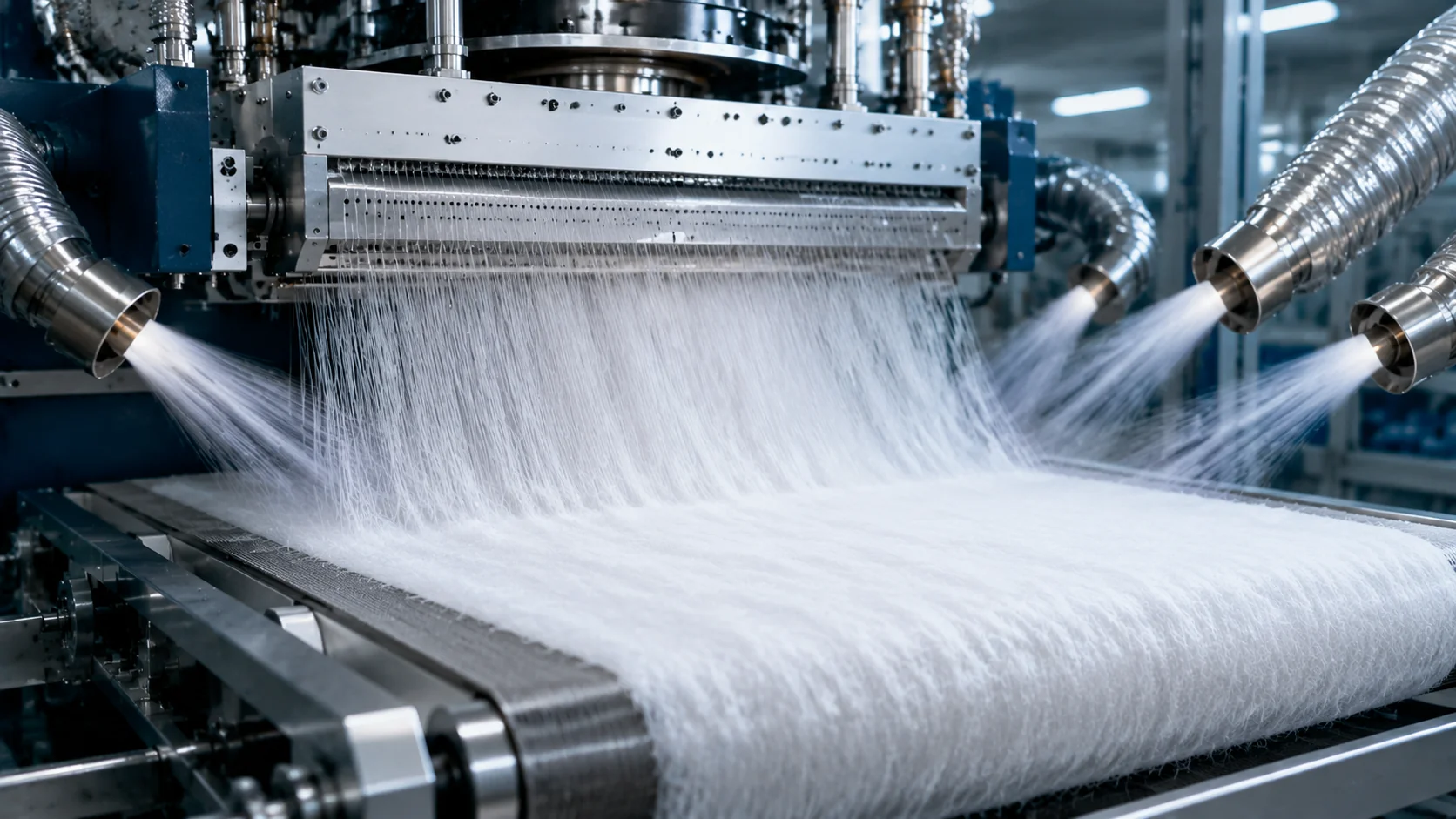
Meltblown nonwoven is a microfiber web formed by extruding molten polymer through fine die orifices. High-velocity hot air attenuates the melt streams into ultrafine fibres. These fibres self-bond as they cool and form a randomly oriented web.
The resulting fabric has fibres as fine as 0.5 microns in diameter. This ultra-fine structure creates a dense, tortuous path that filters particles, aerosols, and droplets efficiently. No adhesives or binders are used — the web bonds through thermal entanglement only.
Meltblown is the critical middle layer in SMS and SMMS composites. Its filtration efficiency depends on basis weight, fibre diameter, and electrostatic charge applied during production.
How Meltblown Nonwoven Is Made — Step by Step
The meltblown process converts raw polymer pellets into a finished filtration web in a single continuous pass. Each stage controls final fibre properties and web uniformity.
Meltblown Nonwoven — Specifications and Options
Favourite Fab supplies meltblown fabric in a range of basis weights and polymer grades. Specifications below cover standard filtration and hygiene grades available for order.
| Parameter | Specification | Detail |
|---|---|---|
| Polymer | Polypropylene (PP) | MFI 800–1500 g/10 min; PET grade on request |
| Basis Weight | 10–100 gsm | Standard filtration: 20–30 gsm; Barrier: 40–60 gsm |
| Fibre Diameter | 0.5–5 microns | Mean fibre dia ~2 μm for BFE ≥95% |
| Filtration Efficiency (BFE) | ≥95% to ≥99% | Electrostatically charged grade available |
| Roll Width | 1,600 mm standard | Slit widths from 200 mm on request |
| Roll Length | 1,000–3,000 m per roll | Core ID: 76 mm or 152 mm |
| Electrostatic Charge | Corona or hydrocharging | Charge decay standard for mask-grade material |
| Colour | White (standard) | Blue, green on bulk order |
Applications in Hygiene and Medical Manufacturing
Meltblown nonwoven is the filtration core of many hygiene and medical products. Manufacturers source this raw material and combine it with spunbond layers to build finished products.
- Surgical face masks (ASTM F2100 / EN 14683): meltblown middle layer delivers BFE and PFE protection. See our spunbond for face masks for outer shell pairing.
- N95 and FFP2 respirators: electrostatically charged meltblown achieves ≥95% NaCl filtration efficiency.
- Surgical gowns and drapes: meltblown barrier layer in SMMS composites blocks fluids and microorganisms.
- Sanitary napkin acquisition layers: low-basis-weight meltblown improves fluid distribution uniformity.
- Industrial air filtration: pleatable meltblown in HVAC and cleanroom panels.
- Liquid filtration: depth filter media for pharmaceutical and beverage applications.
How meltblown nonwoven is made directly affects filtration performance. Specifying the correct basis weight, fibre diameter, and charge level ensures your finished product meets certification requirements.
SMS and Composite Structure Context
Meltblown is rarely used as a standalone fabric. It forms the M-layer in SMS composite nonwoven — sandwiched between two spunbond layers for mechanical strength. For ultra-fine applications, see also solution blow spinning nonwoven, which achieves sub-micron fibre diameters for specialised filtration.
The parent category for all meltblown-related products is our meltblown nonwoven manufacturer India page, where you can compare grades and request bulk samples.
How meltblown nonwoven is made at filtration grade requires precise control of die temperature, air pressure, collector distance, and post-treatment charging. Favourite Fab maintains these parameters within tight tolerances across every production run.
Why Source From Favourite Fab
- MOQ-friendly — suitable for small and large manufacturers
- Export-ready — ships raw materials to 50+ countries
- ISO certified manufacturing facility
- 10+ years supplying the hygiene and medical industry
- Custom specifications available on request
Pricing and MOQ
Pricing for meltblown nonwoven depends on basis weight, polymer grade, and order volume. Filtration-grade electrostatically charged material is priced at a premium over standard grades. Favourite Fab offers competitive wholesale pricing with no hidden charges.
Minimum order quantity is negotiable for first-time buyers. Regular customers receive priority scheduling and volume pricing. Contact the sales team with your required GSM, width, and monthly volume to receive a precise quote.
How to Order
- Send your material requirements to sale@favouritehub.com
- Receive a quote and sample within 48 hours
- Confirm order and production begins
Frequently Asked Questions
How meltblown nonwoven is made differently for filtration vs hygiene grade?
Filtration grade uses finer die orifices (0.1–0.2 mm), higher melt temperature, and electrostatic post-treatment to achieve BFE ≥95%. Hygiene grade uses coarser fibres at lower basis weight for acquisition and distribution layers in sanitary products. Both grades are produced on the same meltblown line with different process parameters.
What polymer is used in meltblown nonwoven for face masks?
Polypropylene with melt flow index (MFI) of 800–1500 g/10 min is the standard polymer for mask-grade meltblown. High MFI PP flows easily through fine die orifices, enabling very thin, uniform fibres. PET meltblown is available for applications requiring higher temperature resistance.
What is the minimum order quantity for meltblown fabric from Favourite Fab?
MOQ varies by grade and width. Standard grades typically start at 500 kg per order. Electrostatic-charged filtration grades may have higher MOQ due to process setup. Contact sale@favouritehub.com with your specifications for an exact MOQ and lead time.
Does meltblown nonwoven lose filtration efficiency over time?
Electrostatically charged meltblown can experience charge decay, especially when stored in humid conditions or exposed to isopropyl alcohol. Charge decay reduces filtration efficiency below rated BFE levels. Properly stored material maintains charge for 18–24 months. Non-charged mechanical filtration grades are unaffected by storage conditions.
Can Favourite Fab supply meltblown nonwoven with custom basis weight?
Yes. Favourite Fab supplies meltblown in any basis weight between 10 and 100 gsm based on customer specification. Custom widths, roll lengths, and core sizes are also available. Share your technical data sheet or sample requirements with the sales team for a development quote.
Is meltblown nonwoven suitable for export shipment?
Yes. Meltblown rolls are packaged in moisture-barrier polyethylene bags and palletised for sea freight or air freight. Favourite Fab manages export documentation including Certificate of Origin and test reports. The facility ships to customers in Southeast Asia, the Middle East, Africa, and Europe regularly.
Contact Favourite Fab
Email: sale@favouritehub.com
WhatsApp: +91-8800775462
Send your material specifications today for a same-day quote.

Gaurav Garg
I'm Gaurav Garg, CEO of Favourite Fab, a company on a mission to revolutionize the nonwoven industry with sustainable practices. We work hand-in-hand with manufacturers and suppliers who share our commitment to eco-friendly production. With a deep interest in textile innovation, I'm passionate about educating consumers about sustainable material options and their potential to transform the nonwoven landscape.


