

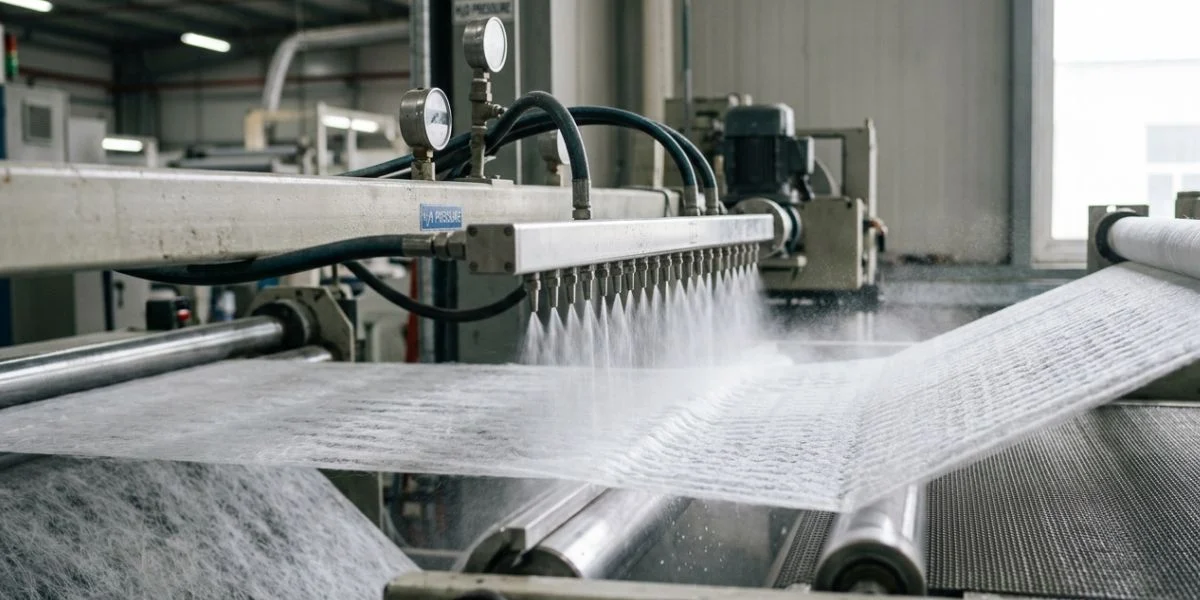
Hydroentanglement Process in Nonwoven Fabric — Technical Explanation
Hydroentanglement (HE) — the technology behind spunlace nonwoven — uses fine, high-velocity water jets to mechanically entangle fibres into a coherent fabric without chemical binders. It is the most technically sophisticated nonwoven bonding method, capable of producing fabrics with cloth-like aesthetics impossible with thermal or chemical bonding.
Browse our full range: View all nonwoven fabric products — spunlace, spunbond, SMS, bico — with GSM, width and certification options. B2B MOQ from 500 kg.
The Physics of Hydroentanglement
Water jets exit 0.08–0.15mm nozzle orifices at 50–300 bar pressure, creating high-velocity streams (100–300 m/s). These jets penetrate the fibre web, imparting kinetic energy that rotates and displaces fibres — wrapping them around adjacent fibres to create mechanical interlocking. The jet then exits through a perforated conveyor drum, carrying water away from the web.
Process Equipment
| Component | Function | Key Parameter |
|---|---|---|
| Jet strip | Contains nozzle orifices (0.08–0.15mm) | Orifice diameter (finer = softer) |
| High-pressure pump | Generates 50–300 bar water pressure | Pressure (higher = stronger bond) |
| Drum/flat belt | Supports web under jet impact | Perforation pattern (affects texture) |
| Suction system | Removes water from web after jets | Suction pressure |
| Through-air dryer | Removes residual moisture | Temperature 130–160°C |
FAQ
How many hydroentanglement passes does spunlace receive?
Standard spunlace: 3–6 passes (alternating top and bottom jets). Each pass increases fibre entanglement. More passes = stronger, more uniform fabric = higher cost. Premium grades may use 6–8 passes for maximum uniformity and strength.
Does hydroentanglement damage fibres?
At correct pressure for the fibre type, no. Excessive pressure can cut viscose fibres (cellulose is weaker wet). Polyester withstands higher jet pressures. Optimising jet pressure per fibre type and GSM is a key process skill.
Full range: spunlace nonwoven fabric. Related: spunlace nonwoven manufacturing process.
B2B Applications & End-Uses
Hydroentanglement (spunlace) is the nonwoven bonding process that produces fabrics closest in hand, drape, and absorbency to woven and knitted textiles — a combination of properties that makes spunlace the preferred substrate for applications where skin contact comfort, high liquid absorption, and low lint generation are simultaneously required. Understanding the process-property relationship allows procurement engineers and product development teams to specify spunlace grades with confidence and communicate meaningfully with manufacturing partners about achievable performance windows.
Single-use medical drapes, surgical packs, and sterile wrap are the highest-specification spunlace end-use. The linting behaviour of the substrate during surgery — measured by particle count under standardised conditions — is a critical safety parameter; spunlace, lacking the chemical binders of resin-bonded nonwoven and the loose surface fibres of lightly needle-punched fabric, generates fewer airborne particles during use. EN 13795 (surgical drapes and gowns) specifies both wet and dry linting limits, and spunlace in the 40–80 GSM range consistently meets or exceeds these thresholds.
Industrial wipes for precision cleaning — electronics assembly, optical component cleaning, pharmaceutical cleanroom surface decontamination — require nonwoven that absorbs solvent or cleaning agent rapidly, releases minimal lint onto cleaned surfaces, and provides sufficient mechanical integrity to be used under wiping pressure without tearing or pilling. Spunlace in 50–80 GSM grades in polyester or polyester-viscose blends is the global standard for ISO Class 5–7 cleanroom wipers. The hydroentanglement process, by entangling fibres without binders, eliminates the risk of resin migration into solvents loaded into the wiper — a critical concern for pharmaceutical and semiconductor cleanroom applications.
Cosmetic and personal care wipes — facial cleansing wipes, baby wipes, makeup removal pads — represent the largest volume application globally. Viscose-polyester blends in 40–80 GSM with characteristic soft hand and high wet tensile retention are standard. Feminine hygiene topsheet alternatives and speciality applications including dry wipes for tabletop dispensers, lens cleaning substrates, and food service preparation wipes complete the application spectrum sourced from Favourite Fab’s spunlace production capacity.
Certifications & Quality Assurance
Spunlace nonwoven is characterised by a distinct test matrix that reflects its unique functional profile. Absorbency (water holding capacity and strike-through rate) is measured per EDANA ERT 10.4 (water absorption) and EN ISO 9073-17. Wet tensile strength — critical because spunlace is almost always used in a wet or solvent-saturated state — is tested per EDANA ERT 20.2 under conditioned wet state, with wet:dry tensile ratio reported to indicate structural integrity during use.
Lint generation is quantified per EN 13795 linting test protocol (Helmke drum method) for medical grade specification, and by Wipe Test (particle count on cleaned surface) for cleanroom wiper qualification. Fibre composition (viscose content, polyester content, cotton content) is verified by prescribed dissolution test per ISO 1833 series to confirm blend ratios stated on the specification sheet. For baby wipe and cosmetic wipe applications, OEKO-TEX Standard 100 Class I certification confirms freedom from harmful substances in skin-contact use.
Process-parameter records (jet pressure, belt speed, fibre web formation parameters) are retained for each production lot, enabling root-cause investigation of any field performance deviation. Custom GSM, fibre blend, surface pattern (apertures, 3D emboss), and width can be produced against validated specifications for customers with established product designs requiring manufacturing-matched sourcing.
More Questions Answered
What fibre blends are available in Favourite Fab’s spunlace production, and how does blend ratio affect absorbency?
Standard production blends include 100% viscose (highest absorbency, softest hand), 70:30 viscose:polyester (balanced absorbency and wet tensile strength — the most common industrial wipe specification), 50:50 viscose:polyester (higher tensile, lower absorbency — preferred for rigorous wiping applications), and 100% polyester (chemical-resistant, low-extractables for harsh solvent wiping). Viscose content drives water absorption capacity — each 10% increase in viscose fraction adds approximately 8–12% to water holding capacity by weight. Polyester content drives wet tensile strength retention. Cotton-core spunlace (cotton web hydroentangled onto polyester scrim) is available as a premium natural-fibre alternative for cosmetic wipe applications.
How does hydroentanglement differ from needle-punching in terms of the fabrics it can produce and the applications each serves best?
Needle-punching uses barbed needles to mechanically entangle fibres, which physically damages individual fibres and creates a denser, more felt-like structure with higher stiffness and lower absorbency — suited to geotextile, filtration media, carpet backing, and insulation applications where mechanical robustness and dimensional stability outweigh softness requirements. Hydroentanglement uses high-pressure water jets that entangle fibres without fibre damage, producing a softer, more open structure with high absorbency and better drape — suited to wipes, medical disposables, and hygiene products. Needle-punch can process heavier GSM ranges (up to 2,000+ GSM) and coarser fibres (including glass fibre) that water-jet bonding cannot handle; hydroentanglement produces finer, more homogeneous fabrics at lower GSM (30–200 GSM) with better surface aesthetics.

Gaurav Garg
I'm Gaurav Garg, CEO of Favourite Fab, a company on a mission to revolutionize the nonwoven industry with sustainable practices. We work hand-in-hand with manufacturers and suppliers who share our commitment to eco-friendly production. With a deep interest in textile innovation, I'm passionate about educating consumers about sustainable material options and their potential to transform the nonwoven landscape.


