

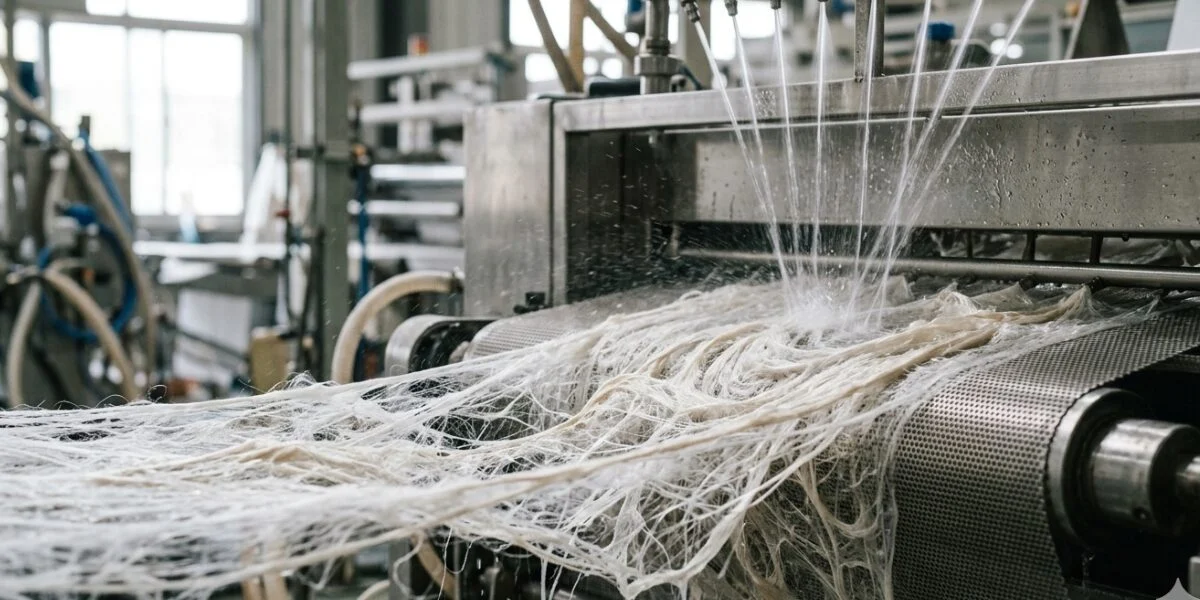
Spunlace Nonwoven Manufacturing Process — Hydroentanglement Explained
The spunlace manufacturing process uses high-pressure water jets to mechanically entangle fibres into a coherent fabric — without chemical binders or thermal bonding. Understanding this process helps B2B buyers appreciate quality factors, GSM control, and the production constraints that determine lead times and MOQs.
Browse our full range: View all nonwoven fabric products — spunlace, spunbond, SMS, bico — with GSM, width and certification options. B2B MOQ from 500 kg.
Process Steps
- Raw material preparation — Fibres (viscose, polyester, cotton) opened in bale openers, blended to specification ratio, and fed to carding machines.
- Web formation — Carding machines align fibres into a uniform web. Parallel-laid (standard) or cross-lapped (isotropic) web formation selected based on required MD/CD ratio.
- Pre-wetting — Web passed through low-pressure water spray to remove trapped air and prepare fibres for entanglement.
- Hydroentanglement (1st pass) — High-pressure water jets (100–300 bar) fire through the top of the web at 0.1mm nozzle orifices. Jets penetrate the web, entangle fibres, and exit through the perforated drum/conveyor below.
- Hydroentanglement (2nd–4th pass) — Web flipped and passed through additional hydroentanglement heads at progressively higher pressure. Multiple passes increase fibre entanglement and tensile strength.
- Surface treatment — Hydrophilic or hydrophobic finish applied via padding mangle if specified.
- Drying — Through-air dryers remove water at 130–160°C. Drum dryers used for higher GSM grades.
- Slitting and winding — Fabric slit to specified width and wound onto jumbo rolls. Roll weight 80–300 kg depending on GSM and length.
Key Process Parameters
| Parameter | Range | Effect |
|---|---|---|
| Water jet pressure | 50–300 bar | Higher pressure = stronger entanglement = higher tensile |
| Line speed | 50–200 m/min | Higher speed = lower dwell time = lower tensile (quality tradeoff) |
| Number of jet heads | 3–8 | More heads = more entanglement = better uniformity |
| Nozzle orifice | 0.08–0.15 mm | Finer nozzle = softer surface finish |
FAQ
What determines the GSM of spunlace nonwoven?
GSM is controlled by the weight of fibre fed into the carding machine per unit area of conveyor. More fibre per area = higher GSM. The process allows ±5% GSM tolerance at standard production speeds.
Why does spunlace have no chemical binders?
Hydroentanglement achieves bonding purely mechanically — water jet energy physically wraps and entangles fibres around each other. No adhesive or binder is needed. This makes spunlace binder-free, safer for skin-contact use, and easier to achieve OEKO-TEX certification.
What is the minimum and maximum GSM achievable in spunlace?
Commercial minimum: 20 GSM (below this, consistent web formation is difficult). Maximum: 150 GSM in single-layer. Heavier grades produced by laminating multiple spunlace layers. Favourite Fab standard range: 30–120 GSM.
Full range: spunlace nonwoven fabric. Related: what is spunlace nonwoven fabric.
Technical Specifications — Spunlace Hydroentanglement Process Parameters
| Process Parameter | Typical Range | Effect on Fabric Properties |
|---|---|---|
| Water Jet Pressure | 60–200 bar | Higher pressure → stronger entanglement, higher tensile strength |
| Nozzle Aperture Diameter | 0.1–0.3 mm | Smaller apertures → finer entanglement, better softness |
| Line Speed | 100–400 m/min | Higher speed → lower water energy per m², lighter GSM feasible |
| Number of Jet Heads | 4–8 heads per line | More heads → more bonding passes, higher strength and uniformity |
| Fibre Web Weight (Feed) | 20–150 GSM (web) → 20–120 GSM (finished) | Feed GSM determines finished fabric GSM range |
| Drum Pattern | Smooth / Apertured / 3D embossed | Determines surface texture and fluid-strike-through profile |
| Drying Temperature | 130–160°C | Lower temp preserves natural fibres; higher temp aids PP bonding |
| Water Recycling Rate | ≥ 95% | Closed-loop water system for environmental compliance |
B2B Applications & OEM Use-Cases
- Custom GSM Specification for Hygiene Converting Lines: OEMs operating high-speed pad and wipe converting lines use process parameter knowledge to specify spunlace substrate precisely. Understanding the relationship between jet pressure, line speed, and finished GSM allows procurement and technical teams to request consistent specifications from suppliers and validate incoming material against process parameters — reducing converting-line rejects caused by substrate variability.
- Surface Texture Engineering for Product Differentiation: Drum pattern selection during the hydroentanglement process determines whether the finished fabric has a smooth, apertured, or 3D-embossed surface. OEMs in premium hygiene and cosmetics specify aperture patterns or proprietary emboss designs to create product differentiation through tactile surface features — understanding this process parameter enables more precise supplier briefings and faster sample development cycles.
- Environmental Compliance & ESG Reporting: Manufacturers and procurement teams with sustainability reporting obligations need to understand that spunlace is intrinsically a low-chemical-use bonding process (water-jet versus chemical or thermal binders). The ≥95% water recycling rate achievable on modern spunlace lines supports supplier ESG data requests for Scope 3 emissions reporting and sustainable procurement audits.
Sourcing from Favourite Fab — MOQ, Lead Time & Customisation
Favourite Fab operates hydroentanglement (spunlace) production lines in Agra, India, with full parameter control for B2B OEM specification manufacturing.
- MOQ: 500 kg per specification
- Domestic Lead Time: 7–14 working days
- Export Lead Time: 21–30 working days
- Customisation: Fibre blend, GSM (20–120), width (1.6 m–3.2 m), surface texture (smooth/apertured/embossed), roll format
- Certifications: ISO 9001:2015 & OEKO-TEX Standard 100
Request a process capability document or custom specification development consultation from Favourite Fab’s technical sales team.
Frequently Asked Questions
What is the difference between spunlace and needle-punch nonwoven manufacturing?
Spunlace (hydroentanglement) bonds fibres using high-pressure water jets at 60–200 bar, producing soft, drapeable fabrics without chemical binders. Needle-punch bonding uses barbed needles that physically interlock fibres, producing heavier, stiffer fabrics suited for filtration and geotextile applications. Spunlace fabrics have superior softness and are preferred for skin-contact applications; needle-punch fabrics are preferred for structural applications requiring higher thickness and abrasion resistance at heavy GSM.
How does water jet pressure affect the finished fabric’s tensile strength?
Higher water jet pressure (up to 200 bar) increases the mechanical entanglement density of fibres in the web, raising MD and CD tensile strength. However, beyond an optimum pressure (typically 140–160 bar for most fibre types), excessive pressure can cut fibres rather than entangle them, reducing tensile strength and increasing lint. Favourite Fab’s process engineers optimise jet pressure for each fibre-blend and GSM specification to maximise strength without fibre damage.
Can Favourite Fab produce spunlace with a proprietary surface pattern for OEM branding?
Yes. Favourite Fab can manufacture patterned hydroentanglement drums with custom aperture designs or emboss patterns for OEM-exclusive surface textures. This requires a tooling investment for the drum pattern (quoted separately) and a minimum production commitment. Proprietary surface patterns help OEM brands create a distinctive tactile product identity that cannot be directly copied by competitors sourcing from standard-pattern suppliers.
📋 Related: Spunlace Nonwoven Fabric — Full Range & Specs | All Nonwoven Products from Favourite Fab

Gaurav Garg
I'm Gaurav Garg, CEO of Favourite Fab, a company on a mission to revolutionize the nonwoven industry with sustainable practices. We work hand-in-hand with manufacturers and suppliers who share our commitment to eco-friendly production. With a deep interest in textile innovation, I'm passionate about educating consumers about sustainable material options and their potential to transform the nonwoven landscape.


