

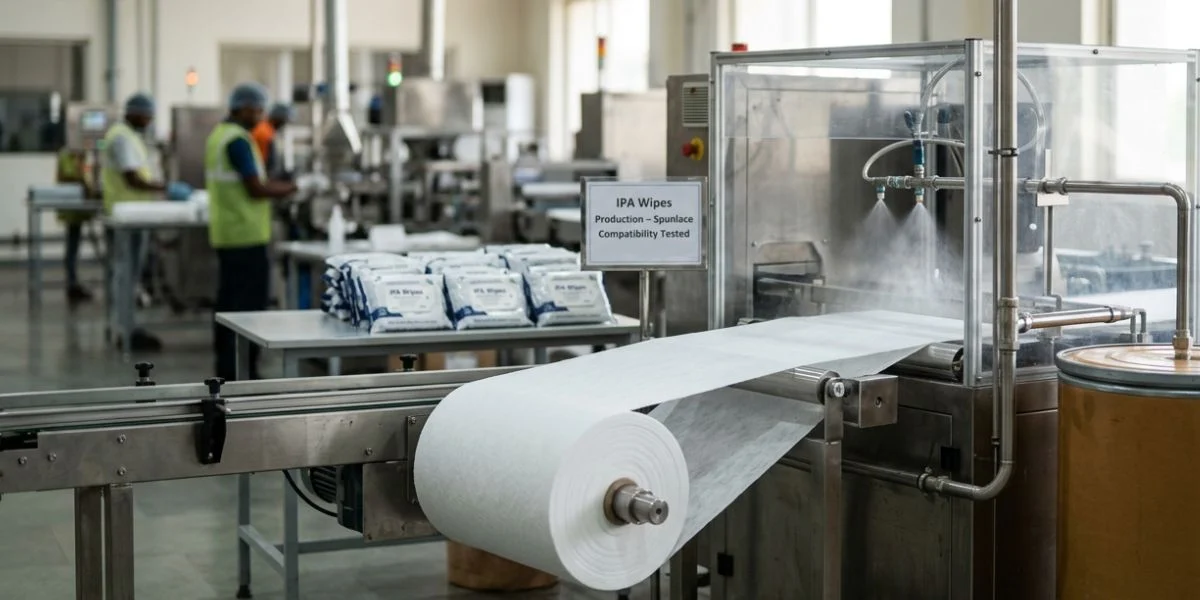
IPA Wipes Nonwoven Fabric — Isopropyl Alcohol Compatible Spunlace India
IPA wipes nonwoven fabric must withstand isopropyl alcohol (IPA) at 70–99.9% concentration without fibre degradation, dimensional change, or extract contamination. Polyester-dominant spunlace is the material of choice — polyester is chemically stable in IPA across all concentrations, while viscose degrades over time with high-IPA exposure. Favourite Fab supplies IPA-compatible polyester spunlace for pharmaceutical cleanroom wipes, electronics cleaning wipes, medical surface disinfection wipes, and laboratory use.
Technical Specifications
| Parameter | Specification |
|---|---|
| GSM | 50–80 GSM |
| Fibre | 100% polyester, polyester/viscose 70/30 |
| Width | 160–260 cm |
| IPA resistance | Stable in 70–99.9% IPA |
| Lint | <0.05 mg/cm² (INDA IST 160.1) |
| Tensile MD | 150–300 N/5cm |
| MOQ | 500 kg |
Applications
Pharmaceutical cleanroom wipes, electronics surface cleaning, medical device surface disinfection, laboratory bench wipes.
Why Source from Favourite Fab
Direct manufacturer, Agra India. Full range: medical nonwoven fabric. Related: spunlace nonwoven for disinfectant wipes.
- Factory direct — no distributor margin
- Custom slit widths 10 mm–260 cm, ±1 mm tolerance
- COA per batch — MVTR, tensile, heat seal, GSM
- Sample rolls dispatched 3–5 working days
- Export ready — FOB Nhava Sheva / ICD Tughlakabad
Frequently Asked Questions
Why must IPA wipe nonwoven be polyester-based?
IPA (isopropyl alcohol) degrades viscose cellulose fibres at concentrations above 50% over repeated exposure — reducing strength and releasing cellulose fragments that contaminate the cleaned surface. Polyester is chemically inert to IPA at all concentrations, making it the standard substrate for IPA-based disinfectant wipes.
What lint level is required for pharmaceutical IPA wipes?
ISO Class 5–7 cleanroom IPA wipes typically require <0.05 mg/cm² lint per INDA IST 160.1. Our 100% polyester spunlace achieves <0.03 mg/cm² — below pharmaceutical cleanroom limits for critical surface cleaning.
Can Favourite Fab supply pre-cut IPA wipe fabric in sheets?
We supply roll goods only. Sheet cutting, folding, and IPA saturation are performed by wipe converters on automated filling lines. We supply rolls in converter-compatible dimensions with consistent GSM and tensile strength for uninterrupted line operation.
B2B Applications & End-Uses
IPA-compatible spunlace nonwoven fabric is the critical substrate for wet wipes formulated with 70% isopropyl alcohol as the active biocidal agent. The performance of the wipe system depends not only on the IPA solution itself but on the fabric’s ability to retain structural integrity, tensile strength, and low particle generation throughout the saturation-to-application sequence, which may involve folding, dispensing, unfolding, and vigorous scrubbing motion on hard surfaces or equipment components.
Medical surface disinfection wipes used in hospitals, dental clinics, and diagnostic laboratories to decontaminate IV trolleys, examination tables, diagnostic equipment surfaces, and laboratory benches require a fabric that releases absorbed IPA solution at a controlled rate during wiping, cleaning the target surface without leaving residue. The wipe must not disintegrate under the mechanical stress of repeated wipe passes, which eliminates viscose-heavy blends that swell and lose tensile strength when saturated with high-concentration alcohol solutions.
Electronics cleaning wipe manufacturers producing precision cleaning products for optical lens surfaces, PCB contact areas, and touchscreen panels specify 100% PET spunlace for its dimensional stability, near-zero fibre shedding after IPA saturation, and very low ionic contamination profile. Pharmaceutical cleanroom operators in Grade B and Grade C environments use IPA wipes made from low-extractables spunlace for equipment cleaning validation procedures where extractable organic carbon limits are contractually defined in the cleaning validation protocol.
Certifications & Quality Assurance
Favourite Fab’s IPA-compatible spunlace grades are qualified using wet tensile retention testing: samples are saturated in 70% IPA solution for 60 minutes at ambient temperature, then immediately tested for tensile strength per EDANA ERT 20.2 in both machine and cross directions. A wet tensile retention of greater than 80% versus dry tensile is the minimum release criterion, confirming that the fabric maintains sufficient structural integrity to withstand vigorous surface wiping after saturation.
Total organic carbon (TOC) extractables are measured per ISO 10993-12 extraction methodology using 70% IPA as the extraction medium, with results reported in parts per million. Ionic contamination — including chloride, sulphate, sodium, and potassium — is quantified by ion chromatography on IPA extracts, with combined cation limits below 5 ppb for pharmaceutical-grade applications. Fibre shedding is assessed by liquid particle count of an IPA extraction per IEST-RP-CC004, relevant for cleanroom and electronics cleaning specifications.
ISO 9001:2015 quality management applies to all IPA-compatible spunlace production. Batch records include raw material fibre certificates, hydroentanglement parameters, and all quality test results. Biocompatibility assessment per ISO 10993-5 (cytotoxicity, extract method) is available for medical wipe manufacturers requiring evidence of biological safety for regulatory submissions.
More Questions Answered
Why is 100% polyester (PET) spunlace preferred over PET/viscose blends for IPA wipe applications?
Viscose (regenerated cellulose) fibres absorb liquid and swell when wetted, causing two performance problems in IPA wipe applications. First, swelling reduces the pore size of the fabric and impairs the controlled release of IPA solution during wiping, leading to uneven wetting of the target surface. Second, the swollen fibre structure has significantly lower wet tensile strength than the dry state — typically 40–60% retention — which means viscose-containing fabrics can shed fibres during vigorous scrubbing, depositing lint on the cleaned surface. For medical device and electronics applications where surface cleanliness is critical, fibre deposition from the wipe is a contamination source. 100% PET spunlace absorbs minimal moisture, maintains essentially its full tensile strength when saturated with IPA, and generates fewer particles during use. The trade-off is that PET has lower inherent absorbency than viscose, so PET IPA wipes typically require a higher saturation ratio (solution weight to fabric weight) to deliver equivalent fluid volume to the target surface. Favourite Fab can advise on the optimal saturation ratio for specific end-use wipe formats.
What certifications are required for IPA wipe fabric used in medical device cleaning applications in India?
For IPA cleaning wipes used on medical device surfaces in Indian healthcare facilities, the wipe fabric should be accompanied by a biocompatibility dossier that at minimum covers ISO 10993-5 cytotoxicity testing and ISO 10993-10 sensitisation testing on extractables obtained using the intended IPA formulation as the extraction medium. Where the wipe product is to be registered as a Class A medical device under the Medical Devices Rules 2017, the fabric raw material test data forms part of the technical file that supports the device registration application. CDSCO may require a risk analysis demonstrating that the fabric does not introduce chemical contaminants that could compromise device safety or cleaning validation. Favourite Fab can supply a complete raw material data package including fibre composition declaration, chemical processing aid residual data, and third-party biocompatibility test reports from accredited laboratories to support the device manufacturer’s regulatory submission. Contact the technical sales team to initiate the documentation request.
B2B Applications & End-Uses
IPA-compatible spunlace nonwoven fabric is the critical substrate for wet wipes formulated with 70% isopropyl alcohol as the active biocidal agent. The performance of the wipe system depends not only on the IPA solution itself but on the fabric’s ability to retain structural integrity, tensile strength, and low particle generation throughout the saturation-to-application sequence, which may involve folding, dispensing, unfolding, and vigorous scrubbing motion on hard surfaces or equipment components.
Medical surface disinfection wipes used in hospitals, dental clinics, and diagnostic laboratories to decontaminate IV trolleys, examination tables, diagnostic equipment surfaces, and laboratory benches require a fabric that releases absorbed IPA solution at a controlled rate during wiping, cleaning the target surface without leaving residue. The wipe must not disintegrate under the mechanical stress of repeated wipe passes, which eliminates viscose-heavy blends that swell and lose tensile strength when saturated with high-concentration alcohol solutions.
Electronics cleaning wipe manufacturers producing precision cleaning products for optical lens surfaces, PCB contact areas, and touchscreen panels specify 100% PET spunlace for its dimensional stability, near-zero fibre shedding after IPA saturation, and very low ionic contamination profile. Pharmaceutical cleanroom operators in Grade B and Grade C environments use IPA wipes made from low-extractables spunlace for equipment cleaning validation procedures where extractable organic carbon limits are contractually defined in the cleaning validation protocol.
Certifications & Quality Assurance
Favourite Fab’s IPA-compatible spunlace grades are qualified using wet tensile retention testing: samples are saturated in 70% IPA solution for 60 minutes at ambient temperature, then immediately tested for tensile strength per EDANA ERT 20.2 in both machine and cross directions. A wet tensile retention of greater than 80% versus dry tensile is the minimum release criterion, confirming that the fabric maintains sufficient structural integrity to withstand vigorous surface wiping after saturation.
Total organic carbon (TOC) extractables are measured per ISO 10993-12 extraction methodology using 70% IPA as the extraction medium, with results reported in parts per million. Ionic contamination — including chloride, sulphate, sodium, and potassium — is quantified by ion chromatography on IPA extracts, with combined cation limits below 5 ppb for pharmaceutical-grade applications. Fibre shedding is assessed by liquid particle count of an IPA extraction per IEST-RP-CC004, relevant for cleanroom and electronics cleaning specifications.
ISO 9001:2015 quality management applies to all IPA-compatible spunlace production. Batch records include raw material fibre certificates, hydroentanglement parameters, and all quality test results. Biocompatibility assessment per ISO 10993-5 (cytotoxicity, extract method) is available for medical wipe manufacturers requiring evidence of biological safety for regulatory submissions.
More Questions Answered
Why is 100% polyester (PET) spunlace preferred over PET/viscose blends for IPA wipe applications?
Viscose (regenerated cellulose) fibres absorb liquid and swell when wetted, causing two performance problems in IPA wipe applications. First, swelling reduces the pore size of the fabric and impairs the controlled release of IPA solution during wiping, leading to uneven wetting of the target surface. Second, the swollen fibre structure has significantly lower wet tensile strength than the dry state — typically 40–60% retention — which means viscose-containing fabrics can shed fibres during vigorous scrubbing, depositing lint on the cleaned surface. For medical device and electronics applications where surface cleanliness is critical, fibre deposition from the wipe is a contamination source. 100% PET spunlace absorbs minimal moisture, maintains essentially its full tensile strength when saturated with IPA, and generates fewer particles during use. The trade-off is that PET has lower inherent absorbency than viscose, so PET IPA wipes typically require a higher saturation ratio (solution weight to fabric weight) to deliver equivalent fluid volume to the target surface. Favourite Fab can advise on the optimal saturation ratio for specific end-use wipe formats.
What certifications are required for IPA wipe fabric used in medical device cleaning applications in India?
For IPA cleaning wipes used on medical device surfaces in Indian healthcare facilities, the wipe fabric should be accompanied by a biocompatibility dossier that at minimum covers ISO 10993-5 cytotoxicity testing and ISO 10993-10 sensitisation testing on extractables obtained using the intended IPA formulation as the extraction medium. Where the wipe product is to be registered as a Class A medical device under the Medical Devices Rules 2017, the fabric raw material test data forms part of the technical file that supports the device registration application. CDSCO may require a risk analysis demonstrating that the fabric does not introduce chemical contaminants that could compromise device safety or cleaning validation. Favourite Fab can supply a complete raw material data package including fibre composition declaration, chemical processing aid residual data, and third-party biocompatibility test reports from accredited laboratories to support the device manufacturer’s regulatory submission. Contact the technical sales team to initiate the documentation request.
📋 Related: Medical Nonwoven Fabric | All Products from Favourite Fab

Gaurav Garg
I'm Gaurav Garg, CEO of Favourite Fab, a company on a mission to revolutionize the nonwoven industry with sustainable practices. We work hand-in-hand with manufacturers and suppliers who share our commitment to eco-friendly production. With a deep interest in textile innovation, I'm passionate about educating consumers about sustainable material options and their potential to transform the nonwoven landscape.


