

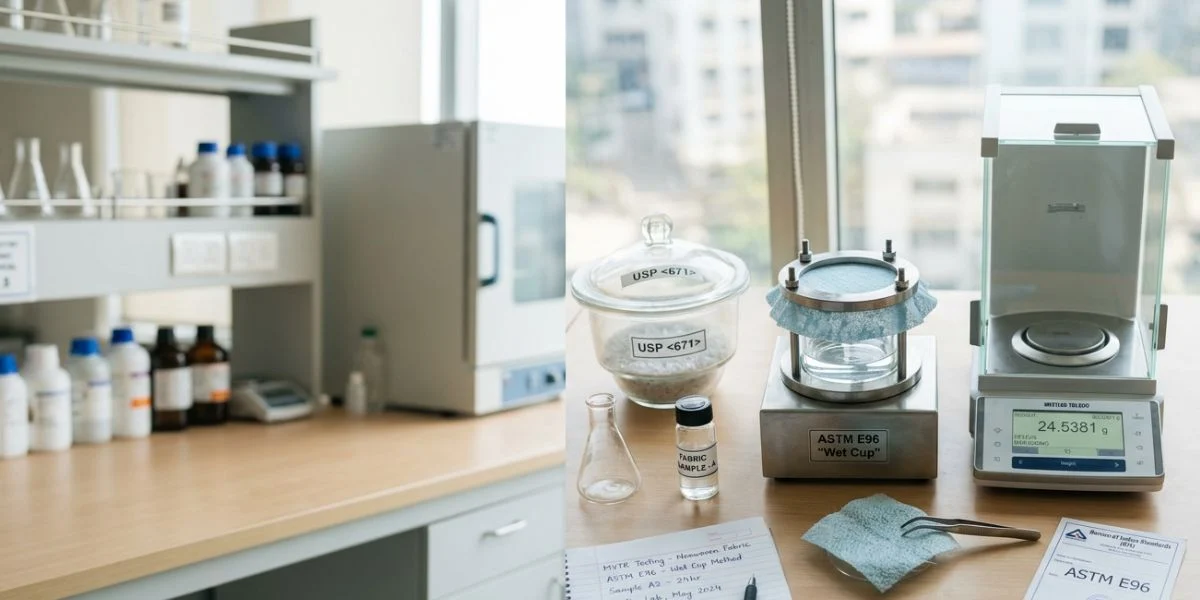
MVTR Testing Nonwoven Fabric — ASTM E96 & USP 671 Guide India
MVTR (Moisture Vapour Transmission Rate) is the critical performance parameter for desiccant pouch nonwoven and pharmaceutical packaging nonwoven — it determines how quickly moisture passes through the fabric to reach the desiccant material inside. Understanding MVTR test methods, reporting units, and acceptable ranges helps B2B buyers specify and compare nonwoven fabrics for desiccant applications correctly.
Browse our full range: View all nonwoven fabric products — spunlace, spunbond, SMS, bico — with GSM, width and certification options. B2B MOQ from 500 kg.
MVTR Test Methods
| Method | Standard | Conditions | Units |
|---|---|---|---|
| Desiccant method | ASTM E96 Procedure A | 38°C / 90% RH | g/m²/day |
| Water method | ASTM E96 Procedure B | 38°C / 90% RH (water side) | g/m²/day |
| Upright cup | ISO 2528 | 23°C / 85% RH | g/m²/day |
| Pharma specific | USP 671 | 40°C / 75% RH | mg/day per container |
Typical MVTR Ranges for Desiccant Nonwoven
| GSM | MVTR (ASTM E96 Proc A) | Application |
|---|---|---|
| 30 GSM PP spunbond | 1,500–3,000 g/m²/day | High-speed adsorption sachets |
| 40 GSM PP spunbond | 800–1,500 g/m²/day | Standard desiccant sachets |
| 60 GSM PP spunbond | 400–800 g/m²/day | Controlled adsorption rate sachets |
FAQ
Why does MVTR matter for desiccant pouch nonwoven?
MVTR determines how fast moisture reaches the desiccant. Too low MVTR: desiccant adsorption is limited by the fabric — reducing protection of the packaged product. Too high MVTR: desiccant exhausted quickly, especially in high-humidity environments. Match MVTR to desiccant performance requirements for your specific application and storage conditions.
What is USP 671 and how does it differ from ASTM E96?
USP 671 is a pharmaceutical container permeation standard measuring moisture transmission per container (mg/day) — not per area unit. Used for evaluating complete desiccant canister assemblies (nonwoven + desiccant + container) for drug packaging compliance. ASTM E96 tests the nonwoven material in isolation. Both are needed for pharma desiccant qualification.
Can Favourite Fab provide MVTR data for its nonwoven grades?
Yes. MVTR per ASTM E96 Procedure A (38°C/90%RH) reported on COA for all desiccant-grade nonwovens. Third-party NABL lab MVTR reports available for pharma grade supply.
Full range: desiccant nonwoven fabric. Related: pharmaceutical desiccant nonwoven fabric.
B2B Applications & End-Uses
MVTR-tested nonwoven fabric from Favourite Fab serves desiccant pouch manufacturers, silica gel sachet converters, pharmaceutical packaging fabricators, and active packaging producers who must demonstrate moisture vapour transmission compliance to their customers or to regulatory authorities. A desiccant pouch fabric that fails to transmit moisture vapour at the design rate extends the time-to-equilibrium inside the sealed container, leaving the packed product exposed to damaging humidity for longer than the system design intended.
Pharmaceutical bulk drug storage, API packaging, diagnostic kit manufacturing, and electronics component trays are application segments where MVTR specification is a procurement gate, not a preference. Buyers in these segments specify minimum MVTR values u2014 often above 3,000 g/mu00b2/day per ASTM E96 Method B u2014 in their material qualification documents. Favourite Fab provides MVTR test data on the Certificate of Analysis for every desiccant grade shipment, enabling buyers to pass this data downstream to their own customers without commissioning independent testing at each batch.
Food ingredient packaging converters producing moisture-control sachets for dried foods, confectionery, and nutraceuticals also require MVTR documentation for Hazard Analysis and Critical Control Point (HACCP) compliance records, and our COA data supports that documentation trail directly.
Certifications & Quality Assurance
Favourite Fab’s desiccant pouch nonwoven grades are tested for MVTR per ASTM E96 Method B u2014 upright cup configuration, 23u00b0C, 50% relative humidity u2014 using calibrated gravimetric equipment. USP 671 (packaging containers for moisture-sensitive articles) references MVTR as a critical attribute for pharmaceutical desiccant pouch materials, and our test methodology is aligned with that standard’s requirements.
Test frequency is defined per product grade in our quality plan: initial grade qualification, then per production campaign for high-specification grades, with retained samples available for dispute resolution. GSM variation across the roll width is controlled within u00b15% of nominal, as GSM directly influences MVTR u2014 thinner fabric transmits moisture faster, and batch-to-batch consistency ensures predictable desiccant performance in your sachet system. MVTR values, GSM, tensile, and width are all reported on the COA issued with each shipment.
More Questions Answered
What MVTR value should a desiccant pouch nonwoven fabric achieve for standard silica gel sachet applications?
The widely accepted minimum for desiccant pouch nonwoven intended for standard industrial and pharmaceutical silica gel sachets is 3,000 g/mu00b2/day measured per ASTM E96 Method B. High-performance pharmaceutical desiccant applications targeting rapid moisture uptake may specify above 4,000 g/mu00b2/day. Fabric GSM, fibre type, and bonding density all influence the result u2014 lower GSM PP spunbond grades typically achieve higher MVTR than heavier or denser constructions. Favourite Fab’s desiccant grades are designed to meet or exceed 3,000 g/mu00b2/day and COA data confirms actual batch performance.
Does USP 671 require a specific test method for nonwoven desiccant pouch fabric?
USP 671 provides guidance on moisture permeation testing for pharmaceutical packaging components and references gravimetric cup methods consistent with ASTM E96. While USP 671 does not mandate a single exclusive test apparatus, Method B of ASTM E96 u2014 upright cup at controlled temperature and humidity u2014 is the most widely accepted method for nonwoven desiccant pouch materials in pharmaceutical qualification submissions. Buyers preparing drug master file or device history record documentation should confirm the specific method their regulatory submission references, and Favourite Fab can issue COA data using the matching methodology.

Gaurav Garg
I'm Gaurav Garg, CEO of Favourite Fab, a company on a mission to revolutionize the nonwoven industry with sustainable practices. We work hand-in-hand with manufacturers and suppliers who share our commitment to eco-friendly production. With a deep interest in textile innovation, I'm passionate about educating consumers about sustainable material options and their potential to transform the nonwoven landscape.


