

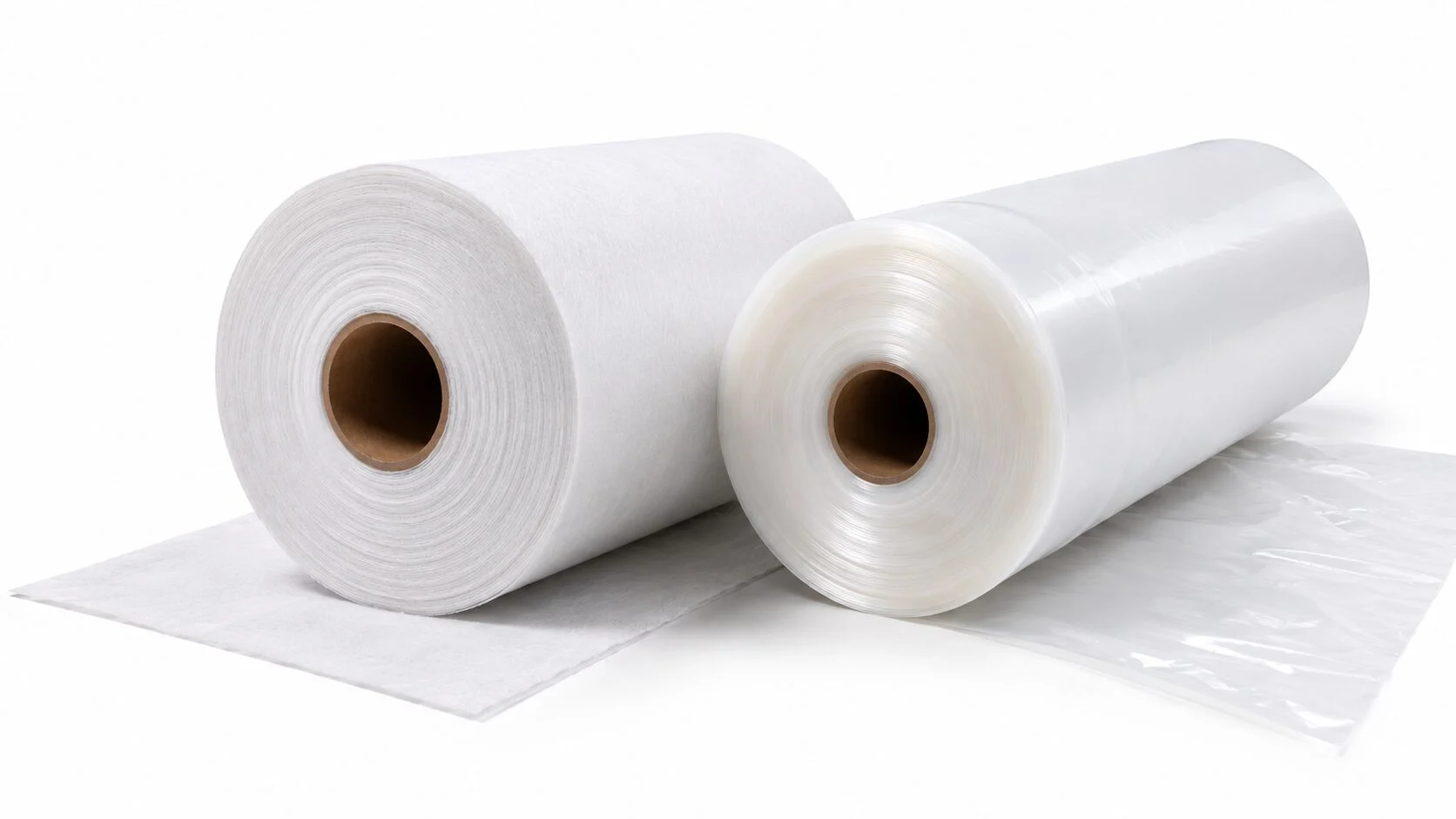
Non Woven Fabric vs Tyvek for Desiccant Packaging — Cost Comparison India
Choosing between non woven fabric vs Tyvek for desiccant packaging comes down to three trade-offs: cost, availability, and tensile strength. PP/Bico spunbond is significantly cheaper, domestically available in India with lower MOQs, and heat-sealable on bar, ultrasonic, or impulse machines. Tyvek (DuPont HDPE flash-spun) delivers higher tear resistance and peak MVTR — but at a premium import cost.
Tyvek vs Non Woven — What’s the Difference?
Tyvek is a flash-spun HDPE sheet made by DuPont — fibers bonded by heat and pressure without binders, producing a dense web with high tear resistance. It is imported into India. PP/Bico spunbond non woven fabric is manufactured from polypropylene or bicomponent (PP/PE) fibers thermally bonded into rolls, produced domestically at facilities including Favourite Fab’s Agra factory. The Bico construction (PP core, PE sheath) enables reliable heat sealing at lower temperatures than pure PP.
Both are porous wrappers for silica gel, molecular sieve, and clay desiccant sachets. Structurally: Tyvek is denser and stronger per gram; spunbond NWF is more flexible, compatible with more sealing methods, and available at competitive wholesale pricing from domestic supply.
Head-to-Head Comparison
Eight properties that matter for desiccant bag specification and procurement.
| Property | PP/Bico Spunbond NWF | Tyvek (HDPE Flash-Spun) |
|---|---|---|
| MVTR (g/m²/24h) | 800–2,000 | 1,200–2,500 |
| Tensile MD (N/5cm) | 20–35 | 50–80 |
| Heat seal temperature | 130–160°C (bar / ultrasonic) | 135–165°C |
| Sealing method | Bar seal, ultrasonic, impulse | Bar seal only (most machines) |
| Cost/kg (India) | Lower — competitive wholesale, domestic supply | Significantly higher — import-dependent |
| India availability | Direct factory supply, Agra | Import-dependent, longer lead time |
| MOQ | 500 kg | Typically 1,000+ kg (imported) |
| Food / pharma grade | Available | Available |
Heat Sealable Paper vs Non Woven for Silica Gel
Some converters use heat sealable paper — a kraft or glassine base coated with PE or EVA — as a lower-cost desiccant substrate. Its two main limitations: paper is moisture-sensitive (the base sheet softens or tears at perforations under humid storage), and the sealing coat reduces MVTR, slowing the desiccant’s moisture uptake rate. Non woven fabric has no cellulose content, so it maintains dimensional stability across a wide humidity range.
Spunbond NWF is inherently porous — MVTR tunable by GSM, fiber denier, and calender pressure without compromising seal bond strength. For pharmaceutical, electronics, or food-contact sachets, non woven fabric is the more reliable substrate.
When Tyvek Is Still Preferred
Tyvek’s genuinely superior properties apply in three specific scenarios: heavy-fill sachets (>50g) where its high tensile MD (50–80 N/5cm) reduces tear-on-handling risk; applications requiring MVTR above 1,800 g/m²/24h; and legacy pharma specifications that name Tyvek by brand and where reformulation approval is not yet complete. For sachets under 30g fill weight, Bico spunbond NWF at 70–90 gsm provides functional equivalence on MVTR and sufficient tensile strength.
- Tensile strength: Tyvek 50–80 N/5cm vs NWF 20–35 N/5cm — gap matters above 50g fill weight
- Peak MVTR: Tyvek ceiling (2,500 g/m²/24h) exceeds NWF — relevant for very fast-acting desiccant lines
- Brand-name specs: Some pharma customers specify Tyvek by name; substitution requires formal change control
When Non Woven Is the Better Choice
For most desiccant bag converters in India, PP/Bico spunbond NWF is the more practical choice on supply-chain and cost grounds.
- Cost: Domestic production eliminates import duty, freight, and currency-risk premiums. The per-kg differential versus Tyvek is operationally significant at volume.
- Lead time: Factory-direct from Agra, 500 kg MOQ, 7–14 working days from order confirmation — versus import-dependent Tyvek timelines.
- Machine compatibility: Bico spunbond seals on bar seal, impulse seal, and ultrasonic machines. Tyvek is limited to bar seal on most installed Indian converting lines.
- Specification flexibility: GSM, width, and finish customised per order. Tyvek is available in fixed commercial grades only.
- Regulatory compliance: Food-grade and pharma-grade NWF with full documentation (TDS, COA, MOQ confirmation) available.
Why Source Non Woven From Favourite Fab
Favourite Fab is a direct manufacturer — PP and PP/PE Bico spunbond produced in-house at Agra, dispatched factory-direct to desiccant converters and packaging manufacturers in India and for export. No trader markup, no intermediary.
- GSM range: 20–120 gsm in desiccant-grade constructions
- Width: custom slit widths from 10 cm to 320 cm
- Finish: natural (white), calendered, or treated surface
- Certifications: ISO 9001; food-grade and pharma-grade documentation (COA, TDS, country of origin) available; export supply to Southeast Asia, Middle East, Europe
How to Order
Send your specs — GSM, width, quantity, sealing method, regulatory requirements — to our sales team. We respond with a material recommendation, TDS, and quotation within one business day.
Request a Sample or Quotation
Share your spec sheet and we will match the right grade for your desiccant converting line.
Frequently Asked Questions
Is non woven fabric as breathable as Tyvek for silica gel sachets?
PP/Bico spunbond NWF achieves 800–2,000 g/m²/24h MVTR, overlapping the lower range of Tyvek (1,200–2,500 g/m²/24h). For electronics, shipping desiccants, and general storage sachets, spunbond NWF at 50–80 gsm provides sufficient vapour transmission. Applications requiring MVTR above 1,800 g/m²/24h may still favour Tyvek.
Can PP spunbond replace Tyvek on existing bar-seal machines?
Yes. PP/Bico spunbond NWF seals on standard bar-seal machines at 130–160°C — within the operating range of most installed desiccant lines. No machine modification is required. Bico (PP/PE) grades seal at the lower end of this range, reducing cycle time. Share your machine’s platen temperature and dwell time for a grade recommendation.
What is the cost difference between Tyvek and non woven for desiccant bags?
Tyvek is imported, carrying ocean freight, import duty, and currency-risk costs that make its India landed cost substantially higher than domestic PP spunbond NWF. The exact differential depends on volume and Tyvek grade. Contact our sales team for a comparative quotation against your current Tyvek spend.
Is non woven fabric food-safe for silica gel packaging?
Yes. Food-grade PP spunbond NWF from Favourite Fab uses virgin polymer with no restricted dyes or binders. Full documentation — COA and TDS confirming polymer grade and restricted-substance absence — supplied with each order. Pharma-grade documentation available on request.
What GSM non woven is equivalent to standard Tyvek 1073B for desiccant use?
Tyvek 1073B is 75.8 gsm flash-spun HDPE. Direct GSM comparison is not reliable — flash-spun HDPE is denser and stronger per gram than spunbond PP. The functional equivalent for desiccant sachets (balancing MVTR, seal integrity, and handling strength) is typically 70–90 gsm PP/Bico spunbond NWF, adequate for sachets up to ~30g fill weight. Provide your fill weight, sachet dimensions, and sealing method for an exact grade recommendation.
Related Resources
Full range: desiccant nonwoven fabric manufacturer India. Related: heat sealable nonwoven fabric and Tyvek alternative HDPE spunbond.

Gaurav Garg
I'm Gaurav Garg, CEO of Favourite Fab, a company on a mission to revolutionize the nonwoven industry with sustainable practices. We work hand-in-hand with manufacturers and suppliers who share our commitment to eco-friendly production. With a deep interest in textile innovation, I'm passionate about educating consumers about sustainable material options and their potential to transform the nonwoven landscape.


