

Nonwoven Fabric for Filtration Industry HEPA HVAC Media India
Nonwoven fabric for filtration industry HEPA HVAC media India is a specialised raw material category where fibre selection, bonding method, and electrostatic treatment determine filter efficiency. Favourite Fab supplies spunbond, meltblown, and spunlace nonwoven fabrics to filter media manufacturers, HVAC equipment producers, and air purification companies across India and global markets. We are an upstream raw material supplier — not a filter assembler.
What Is Filtration Nonwoven Fabric
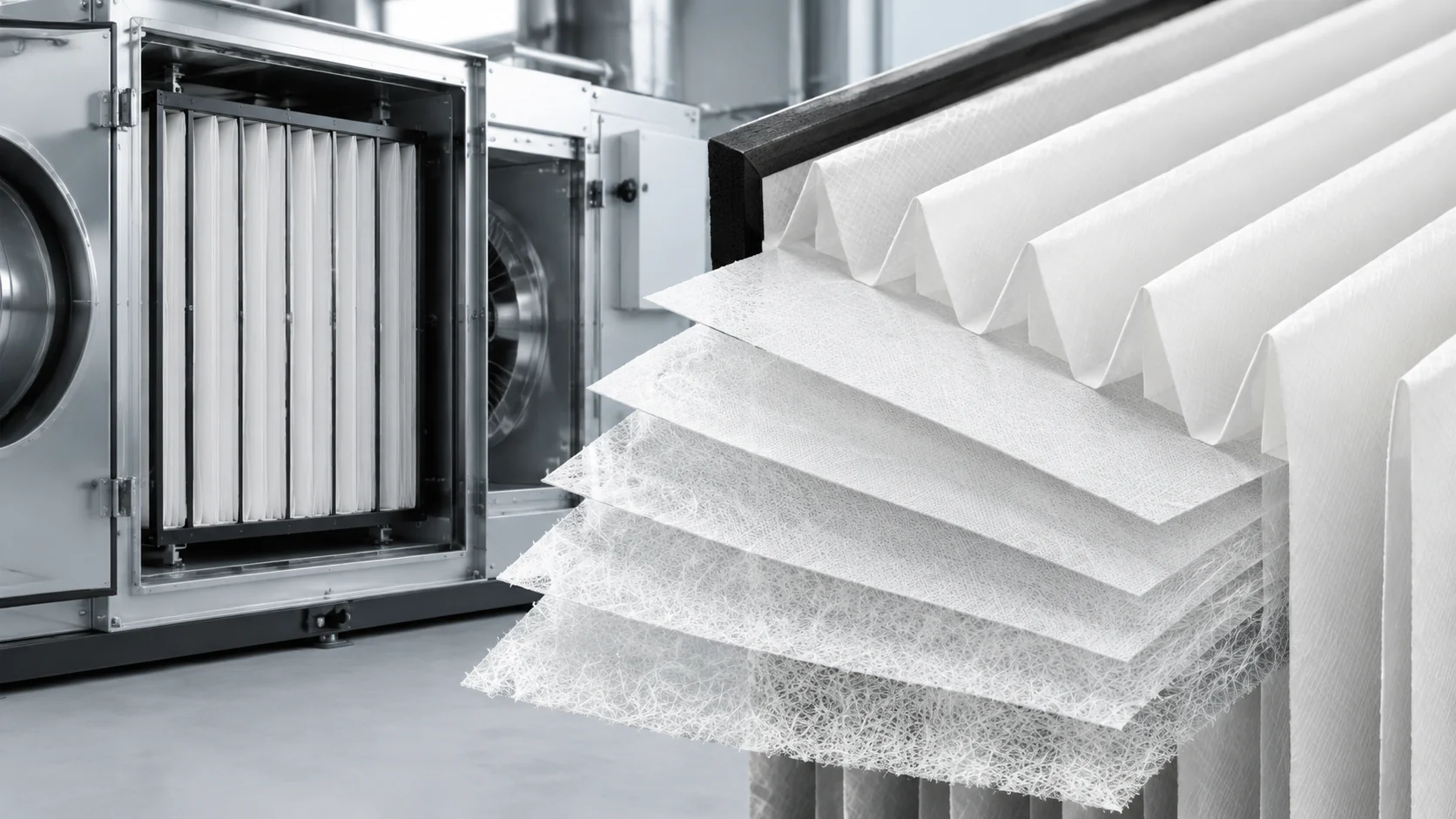
Filtration nonwoven fabric is engineered to capture particles from air or liquid streams at defined efficiency levels. It ranges from coarse pre-filter media (G1–G4) to fine HEPA-grade meltblown layers (H13–H14). Each layer in a filter stack performs a distinct function based on its fibre diameter, porosity, and surface treatment.
Spunbond PP forms the structural pre-filter and backing layer. Meltblown PP delivers sub-micron particle capture, including bacteria and fine particulate matter (PM2.5). Electrostatic treatment on meltblown raises initial efficiency without increasing pressure drop — critical for HVAC energy performance.
Liquid filter media require wet-laid or spunlace nonwoven with controlled pore structure. These are used in water treatment, oil filtration, pharmaceutical processing, and industrial coolant systems.
Specifications and Grade Options
| Parameter | Specification | Detail |
|---|---|---|
| Fabric Type | Spunbond, Meltblown, Spunlace | Meltblown for HEPA; spunbond for pre-filter/backing |
| GSM Range | 15–200 gsm | 15–30 gsm meltblown for HEPA; 50–150 gsm spunbond pre-filter |
| Fibre Diameter | 0.5–5 µm (meltblown); 10–25 µm (spunbond) | Finer fibre = higher efficiency, higher pressure drop |
| Filter Efficiency | G2–H14 (EN 779 / EN 1822) | Electrostatic meltblown reaches H13 ≥99.95% at 0.3 µm |
| Width | 1.6 m, 2.4 m | Slit rolls available for pleating lines |
| Surface Treatment | Electrostatic, Hydrophilic, Plain | Electrostatic enhances capture without increasing resistance |
| Certifications | ISO 9001, CE available | COA and test reports supplied with each batch |
Why Nonwoven Fabric Is Used in the Filtration Industry
Nonwoven filtration media delivers the combination of fine pore structure and high throughput that woven fabrics cannot match at comparable cost. Meltblown PP achieves fibre diameters below 1 micron — essential for PM2.5 and bacterial filtration in HEPA applications.
HVAC systems use nonwoven pre-filters to extend the life of fine HEPA stages. A properly selected G3 spunbond pre-filter captures coarse dust and extends the HEPA element replacement interval by 3–5x. This reduces operating costs across large commercial HVAC installations.
Industrial liquid filtration uses needlepunch and wet-laid nonwoven for oil, coolant, and wastewater applications. These media withstand aggressive chemicals and elevated temperatures. Favourite Fab’s meltblown nonwoven fabric range is specifically engineered for sub-micron air filtration. Our fabrics are also used in car cabin air filters. For liquid separation, see our liquid filter media.
Why Source From Favourite Fab
- MOQ-friendly — suitable for small and large manufacturers
- Export-ready — ships raw materials to 50+ countries
- ISO certified manufacturing facility
- 10+ years supplying the hygiene and medical industry
- Custom specifications available on request
- Meltblown electrostatic grades available for HEPA and surgical mask media
Pricing and MOQ
Filtration nonwoven is priced per kg based on fibre type, GSM, and surface treatment. Meltblown grades carry a premium over standard spunbond due to process complexity. MOQ starts at 300 kg for meltblown and 500 kg for spunbond filter grades. Volume contracts with quarterly delivery schedules are available for regular filter manufacturers.
Our spunbond nonwoven for face masks is also widely used as a filter interliner in medical-grade respirators and surgical masks.
How to Order
- Send your material requirements to sale@favouritehub.com
- Receive a quote and sample within 48 hours
- Confirm order and production begins
Frequently Asked Questions
Q: What meltblown grade achieves HEPA H13 efficiency?
A: HEPA H13 requires ≥99.95% efficiency at 0.3 µm MPPS. Electrostatic meltblown PP at 20–30 gsm with fibre diameter below 1 µm achieves this. Favourite Fab supplies electrostatic meltblown with test reports confirming H13 classification per EN 1822.
Q: Can you supply nonwoven media for industrial oil filtration?
A: Yes. Needlepunch polyester and polypropylene nonwoven in 100–500 gsm is available for oil and coolant filtration. These grades withstand temperatures up to 120°C and resist common industrial lubricants. Provide your flow rate and particle retention target for a specific recommendation.
Q: What is the pressure drop of your HEPA meltblown fabric?
A: Pressure drop at 0.05 m/s face velocity is typically 30–80 Pa for our electrostatic meltblown grades depending on GSM. Electrostatic treatment allows high efficiency at lower GSM, which reduces pressure drop compared to non-treated equivalents. Full test data supplied with samples.
Q: Do you offer slit rolls for automated pleating machines?
A: Yes. Filter media rolls are available in custom slit widths from 100 mm to full web width. Specify your pleating line width and core diameter. We supply master rolls or slit rolls based on your production setup.
Q: Is your meltblown media suitable for automotive cabin air filters?
A: Yes. Our meltblown PP is used by cabin filter manufacturers for ISO 15075 / DIN 71460 compliant filters. It captures pollen, fine dust, and PM2.5. Electrostatic grades also adsorb certain odour molecules. Contact us for automotive-specific grade details.
Contact Favourite Fab
Email: sale@favouritehub.com
WhatsApp: +91-8800775462
Send your material specifications today for a same-day quote.

Gaurav Garg
I'm Gaurav Garg, CEO of Favourite Fab, a company on a mission to revolutionize the nonwoven industry with sustainable practices. We work hand-in-hand with manufacturers and suppliers who share our commitment to eco-friendly production. With a deep interest in textile innovation, I'm passionate about educating consumers about sustainable material options and their potential to transform the nonwoven landscape.


