

Nonwoven Fabric for Shoe Components Stiffening Lining India — Favourite Fab
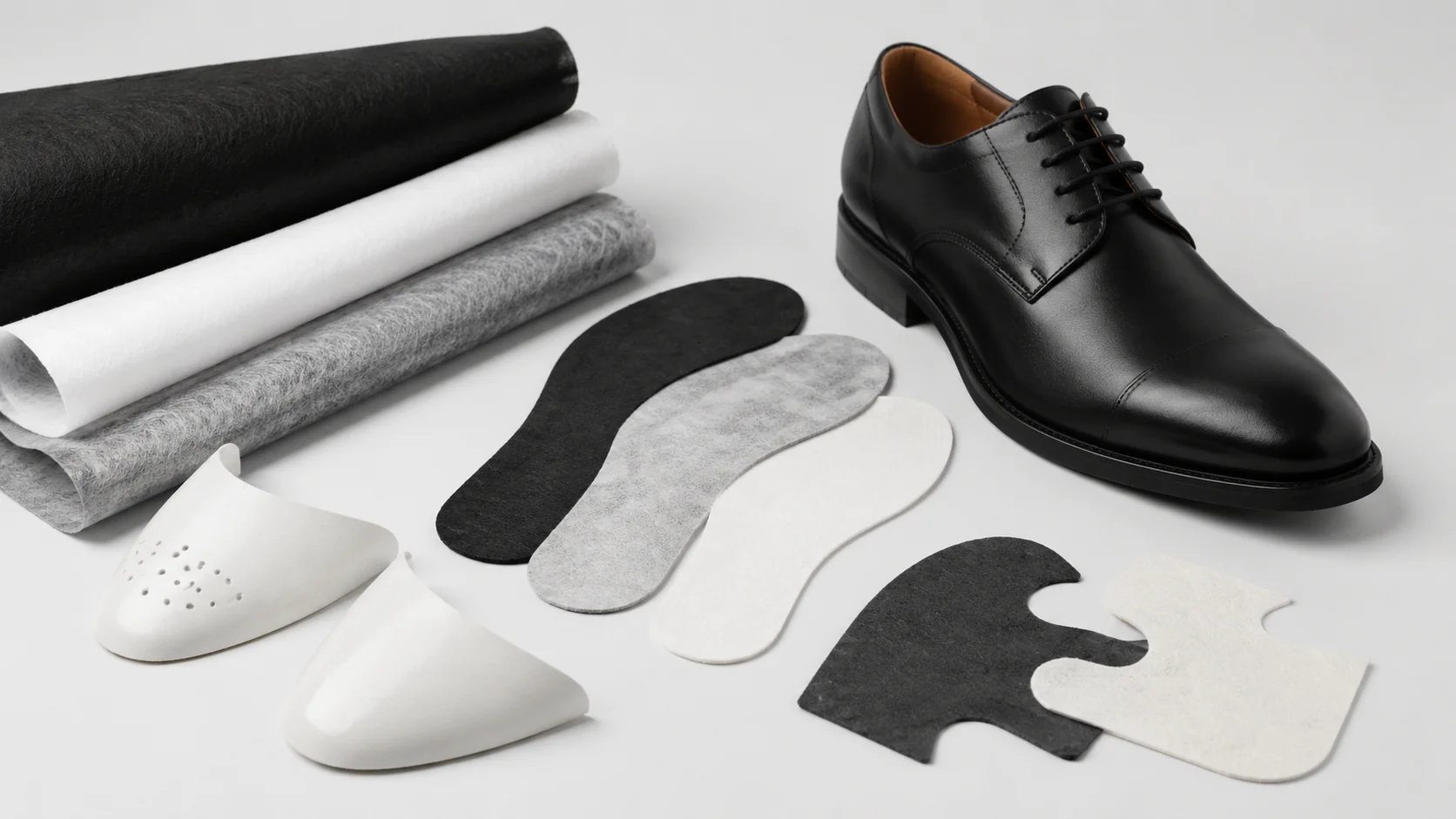
Nonwoven fabric for shoe components is a structural raw material used by footwear manufacturers to produce toe caps, heel counters, insoles, and inner lining layers. Favourite Fab supplies thermally-bonded, needle-punched, and spunbond nonwoven fabrics engineered for footwear production lines across India and international markets. Our materials deliver the stiffness, bonding compatibility, and dimensional stability that shoe component manufacturers require for consistent production output.
What Is Nonwoven Fabric for Shoe Components
Modern footwear construction relies on multiple nonwoven layers to achieve shape, comfort, and durability. Each layer serves a distinct function. The toe cap stiffener holds the front profile of the shoe. The heel counter maintains the rear structure. Inner lining fabrics provide comfort, moisture management, and a smooth surface against the foot or sock.
Thermoplastic nonwoven stiffeners are activated by heat during lasting. When heated above their softening point, the material becomes pliable and conforms to the last shape. On cooling it sets permanently, locking the shoe profile. This thermoplastic behaviour eliminates the need for solvent-based stiffener systems used in older production methods.
Needle-punched nonwoven provides the density and resilience required for insole and midsole applications. The mechanical entanglement of fibres in needle-punching creates a compressed felt-like structure that resists compression over the shoe’s service life. This material is cost-effective and recyclable compared to synthetic foam alternatives.
Specifications and Grade Options
| Parameter | Specification | Detail |
|---|---|---|
| Application | Toe cap, heel counter, insole, lining | Different grades for each application |
| Basis Weight | 80–600 GSM | Low GSM for lining; high GSM for structural components |
| Fibre Type | PP, PET, co-PET (thermoplastic binder) | Co-PET for thermoplastic stiffener grades |
| Stiffener Activation Temp | 90–130°C | Compatible with standard lasting equipment |
| Compression Resistance | ≥85% recovery after 25,000 cycles | Critical for insole longevity |
| Tensile Strength (MD) | ≥200 N/5cm (stiffener grades) | Resists lasting forces during production |
| Moisture Absorption | <0.5% (PP grades) | Prevents delamination in wet conditions |
| Roll Width | 1.0–2.4 m | Custom widths for die-cutting operations |
Why Nonwoven Fabric Is Used in Shoe Components
Thermoplastic nonwoven stiffeners replaced traditional solvent-based cellulosic boards across most modern footwear factories. Thermoplastic nonwoven activates at predictable temperatures, enables precise process control, and produces consistent stiffness without solvent handling. This shift has improved factory safety and reduced waste in lasting operations.
Needle-punched nonwoven insoles offer compression resilience that synthetic foams cannot match across the full service life of a shoe. Foam insoles lose compression set after repeated loading. Needle-punched felt maintains thickness and cushioning over millions of steps, reducing consumer complaints about comfort degradation.
Spunbond nonwoven inner linings are smooth, abrasion-resistant, and compatible with adhesive systems used in shoe assembly. The controlled surface texture prevents sock snag while the nonwoven structure wicks moisture away from the foot. These properties make spunbond the preferred lining material for athletic and occupational footwear.
Footwear manufacturers sourcing interlining for garment divisions can review our nonwoven fabric for garment interlining page. Our full spunbond nonwoven fabric range covers all footwear and apparel applications. For medical-grade nonwoven adjacent to protective footwear covers, see our spunbond nonwoven for surgical gowns. Browse our complete nonwoven fabric portfolio for all grades.
Why Source From Favourite Fab
- MOQ-friendly — suitable for small and large manufacturers
- Export-ready — ships raw materials to 50+ countries
- ISO certified manufacturing facility
- 10+ years supplying the hygiene and medical industry
- Custom specifications available on request
Pricing and MOQ
Favourite Fab supplies shoe component nonwoven at competitive wholesale pricing based on application grade, GSM, and monthly volume. Thermoplastic stiffener grades, needle-punched insole materials, and spunbond linings are all priced separately. Trial roll quantities are available for production testing before bulk commitment. Contact our team for a detailed price schedule.
How to Order
- Send your material requirements to sale@favouritehub.com
- Receive a quote and sample within 48 hours
- Confirm order and production begins
Frequently Asked Questions
Q: What type of nonwoven is used for thermoplastic toe cap stiffeners?
A: Thermoplastic stiffeners use a blend of regular PET fibres with a low-melt co-PET binder fibre. When heated to 90–130°C, the binder softens and the material moulds to the last shape. On cooling it sets rigid. Favourite Fab supplies both the base nonwoven and can guide specification selection for your lasting equipment.
Q: Can Favourite Fab supply nonwoven for sports shoe insoles?
A: Yes. We supply needle-punched nonwoven from 200–500 GSM for insole applications. Sports shoe insoles require high compression recovery. Our needle-punched grades maintain thickness through high-cycle loading. Custom thickness and density combinations are available for sports and occupational footwear requirements.
Q: What nonwoven is recommended for shoe inner lining?
A: Spunbond PP or PET at 30–60 GSM is the standard lining fabric. The smooth surface suits direct contact with the foot or sock. Hydrophilic-finished grades are available for improved moisture management in athletic footwear applications.
Q: Does your shoe component nonwoven pass REACH and OEKO-TEX requirements?
A: Our PP and PET nonwovens are produced from virgin polymer free from restricted substances under REACH. OEKO-TEX Standard 100 certification documentation can be arranged for export markets that require it.
Q: Can rolls be supplied in narrow widths for automated die-cutting lines?
A: Yes. We supply slit rolls from 200 mm to full roll width. Custom widths are available for rotary die-cutting and reciprocating press operations. Consistent edge quality is maintained on all slit rolls.
Q: Do you export shoe component nonwoven fabrics?
A: Yes. We export to footwear manufacturing hubs across Southeast Asia, Bangladesh, Vietnam, and the Middle East. Export orders include material test reports, origin certificates, and MSDS. Lead times and freight options are discussed at order stage.
Contact Favourite Fab
Email: sale@favouritehub.com
WhatsApp: +91-8800775462
Send your material specifications today for a same-day quote.

Gaurav Garg
I'm Gaurav Garg, CEO of Favourite Fab, a company on a mission to revolutionize the nonwoven industry with sustainable practices. We work hand-in-hand with manufacturers and suppliers who share our commitment to eco-friendly production. With a deep interest in textile innovation, I'm passionate about educating consumers about sustainable material options and their potential to transform the nonwoven landscape.


