

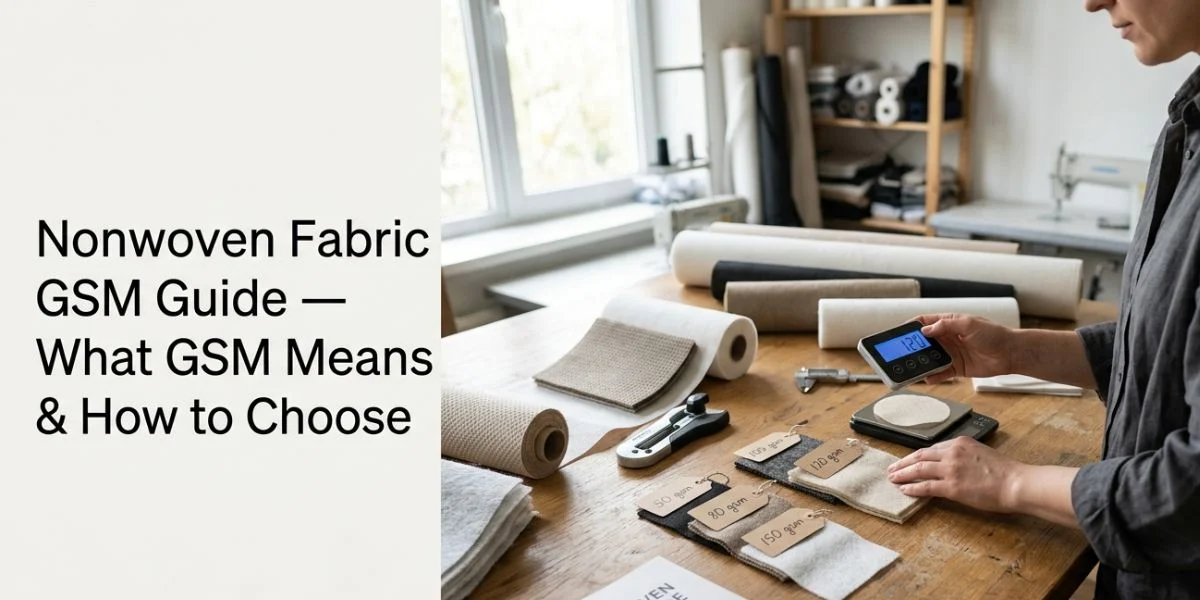
Nonwoven Fabric GSM Guide: What GSM Means & How to Choose the Right Weight
Nonwoven fabric GSM — grams per square metre — is the first number on every specification sheet, purchase order, and COA in this industry. It sets the fabric’s weight, strength, absorbency, and your cost per bag, wipe, or pad. This nonwoven fabric GSM guide covers what GSM means, how it is measured, which GSM band fits which application, and the conversion formulas procurement teams use daily — with the math shown so you can verify every number.
Skip the manual math: our GSM calculator converts GSM ↔ roll weight ↔ length ↔ price per unit in one screen.
What Is GSM in Nonwoven Fabric?
GSM (also written g/m² or grammage) is the mass of one square metre of fabric in grams. A 50 GSM spunbond weighs 50 grams per square metre. Because nonwoven fabric is sold by weight, GSM is simultaneously a performance spec and a cost spec:
- Cost per m² = GSM ÷ 1000 × rate per kg. At the same rate per kg, 60 GSM fabric costs 20% more per square metre than 50 GSM.
- Higher GSM = more fibre per unit area = higher tensile strength, absorbent capacity, and opacity.
- Higher GSM does not mean higher quality — it means more material. The right GSM is the lowest one that passes your performance test.
How GSM Is Measured (ISO 9073-1 / EDANA WSP 130.1)
The standard method is simple enough to run at incoming QC:
- Die-cut 5 circular samples of exactly 100 cm² each from across the roll width.
- Weigh each sample on an analytical balance.
- Mean sample weight in grams × 100 = GSM.
Example: five samples weigh 0.59, 0.61, 0.60, 0.60, 0.60 g → mean 0.60 g → 60 GSM. A GSM cutter and balance cost less than one rejected batch — every converting line running above 500 kg/day should own both.
Nonwoven GSM Range by Application
| GSM range | Application | Typical fabric |
|---|---|---|
| 8–15 GSM | Ultra-light topsheet, tea bags, light covers | PP spunbond |
| 15–25 GSM | Diaper/pad topsheet & coverstock, mask layers | Hydrophilic spunbond, SMS |
| 25–50 GSM | Wet wipes, facial wipes, surgical caps/covers | Spunlace, SMS/SSMMS |
| 40–90 GSM | Carry bags (D-cut, W-cut, box bags), gowns, drapes | PP spunbond, SMS |
| 80–150 GSM | Industrial wipes, reusable cloths, upholstery backing | Spunlace, PET spunbond, needle punch |
| 150–600 GSM | Geotextile, automotive felt, heavy filtration | PET needle punch, high-GSM spunbond |
Favourite Fab supplies all four underlying families: PP Spunbond 8–200 GSM (width 800–3200 mm), SSS/SSMMS 10–60 GSM, Spunlace 30–80 GSM (viscose, viscose/PET, cotton), and PE/PP Laminated for backsheet and barrier applications.
How to Choose the Right GSM — 5-Step Method
Most buyers inherit a GSM number from an old spec sheet and never re-test it. This method replaces habit with measurement:
- Define the job. Load-bearing (bags)? Barrier (drapes, backsheet)? Absorbency (wipes, pads)? Each maps to a different test, not to a GSM.
- Set the pass value. Bags: MD/CD tensile per ISO 9073-3 against your load test. Medical barrier: hydrostatic head (ISO 811) and BFE (ASTM F2101). Wipes: absorbency g/g per EDANA WSP 10.1.
- Sample down, not up. Get cross-GSM samples (e.g. 70, 60, 55, 50 GSM) and run them on your own machine. The lowest GSM that passes is the right GSM.
- Fix tolerance in writing. A “60 GSM” order at ±2 GSM arrives between 58 and 62. At loose tolerance the giveaway math turns against you (next section).
- Verify incoming rolls. Cut-and-weigh per ISO 9073-1 at left edge, centre, and right edge of the roll width — GSM variation across width is where thin bands hide.
Worked example — example scenario, verify against your own line: a W-cut bag converter running 60 GSM tests 55 and 52 GSM samples. The 52 GSM fails the 6 kg load test, 55 GSM passes. Moving 60 → 55 GSM cuts fabric weight — and therefore fabric spend — by 8.3% at identical output. Full cost method: how bag manufacturers cut raw material cost 10–15%.
GSM Tolerance: The Hidden Line Item
Tolerance is the band a supplier commits around nominal GSM. It is a cost control, not a formality:
- At ±2 GSM on a 60 GSM order, worst-case over-delivery is 62 GSM = 3.3% extra weight you pay for.
- At ±5 GSM, worst case is 65 GSM = 8.3% giveaway — or 55 GSM, which may fail your QC and become rejection cost instead.
Favourite Fab supplies at ±2 GSM tolerance, with GSM verified at three positions across roll width per production lot and reported on the COA. Ask any supplier for their tolerance in writing; if it is not on the quotation, assume ±5 or worse.
GSM Conversion Formulas (the ones buyers actually use)
GSM to roll weight (kg)
Roll weight (kg) = GSM × width (m) × length (m) ÷ 1000.
Example: 50 GSM × 1.6 m width × 2000 m length ÷ 1000 = 160 kg per roll. Reverse it to check invoiced weight against delivered length.
GSM to fabric per piece
Fabric weight per piece (g) = piece area (m²) × GSM.
Example: a 40×46 cm double-panel bag with gusset ≈ 0.4 m² → at 60 GSM = 24 g fabric per bag → 10,000 bags/day = 240 kg/day.
GSM to oz/yd² (US/UK specs)
oz/yd² = GSM ÷ 33.906. Reference points: 1.0 oz/yd² = 33.9 GSM · 1.5 = 50.9 GSM · 2.0 = 67.8 GSM · 3.0 = 101.7 GSM. Favourite Fab quotes in GSM and includes the oz/yd² equivalent on the technical data sheet for export buyers.
GSM to thickness (mm) — no universal conversion
GSM is weight; thickness (caliper) depends on bulk density, fibre type, and bonding. Two 60 GSM fabrics can differ 3× in thickness (a dense spunbond vs a lofty needle punch). Thickness is measured directly per ISO 9073-2 under standard pressure — specify it separately if your application needs it; never derive it from GSM.
All four conversions run automatically in the GSM calculator; formula derivations with metric/imperial variants are in our GSM calculation formulas guide.
GSM by Fabric Family — What Favourite Fab Supplies
- PP Spunbond, 8–200 GSM — bags, agriculture covers, mattress and furniture, hygiene topsheet, packaging. 25+ stock colors, hydrophilic or hydrophobic, UV-stabilised on order. See spunbond nonwoven fabric manufacturer.
- SSS / SSMMS, 10–60 GSM — surgical gowns, drapes, masks, PPE. Hydrostatic head 20–60 cmH₂O; BFE up to 99.9% (ASTM F2101).
- Spunlace, 30–80 GSM — wet wipes, cosmetic masks, medical and industrial wipes. 100% viscose to 100% PET blends, absorbency 6–12 g/g. See spunlace nonwoven fabric.
- PE/PP Laminated — diaper backsheet, underpads, drape backing. MVTR 1500–5000 g/m²/24h (ASTM E96) depending on film.
ISO 9001:2015 · OEKO-TEX Standard 100 · REACH · shipping to 30+ countries since 2011.
Frequently Asked Questions
Q: What does GSM mean in nonwoven fabric?
A: GSM is grams per square metre — the weight of 1 m² of fabric. It is the primary specification for nonwoven fabric because the material is priced by weight and its strength and absorbency scale with it.
Q: How do you calculate the GSM of fabric?
A: Die-cut a 100 cm² circular sample, weigh it in grams, multiply by 100. Standard method: ISO 9073-1 / EDANA WSP 130.1 with 5 samples averaged. A sample weighing 0.45 g = 45 GSM.
Q: Which GSM is best for non woven carry bags?
A: 40–90 GSM covers the full bag range: 40–50 GSM for light retail bags, 60–70 GSM for grocery weight, 80–90 GSM for heavy-duty and box bags. Confirm with a load test at the lowest candidate GSM per ISO 9073-3 rather than defaulting to the heavier grade.
Q: How do I convert GSM to kg per roll?
A: Roll weight (kg) = GSM × width (m) × length (m) ÷ 1000. A 50 GSM roll, 1.6 m wide, 2000 m long weighs 160 kg.
Q: Can I convert GSM to thickness in mm?
A: No universal formula exists — thickness depends on bulk density and bonding, not weight alone. Measure caliper separately per ISO 9073-2 and specify both values if your application needs a thickness window.
Q: How do I convert GSM to oz/yd²?
A: Divide GSM by 33.906. Example: 40 GSM ÷ 33.906 = 1.18 oz/yd². Multiply oz/yd² by 33.906 to go back to GSM.
Q: Does higher GSM always mean better quality?
A: No. GSM is a weight spec, not a performance spec. A 15 GSM hydrophilic spunbond is the correct grade for a topsheet; 80 GSM there would be over-specification and pure extra cost. Quality is hitting the specified GSM consistently — that is what tolerance and COA reporting measure.
Test the right GSM on your own machine
Request a cross-GSM sample kit — spunbond 8–200 GSM, spunlace 30–80 GSM, SMS 10–60 GSM — slit to your working width. ±2 GSM tolerance · ISO 9001:2015 · 7-day dispatch ex-Agra.

Gaurav Garg
I'm Gaurav Garg, CEO of Favourite Fab, a company on a mission to revolutionize the nonwoven industry with sustainable practices. We work hand-in-hand with manufacturers and suppliers who share our commitment to eco-friendly production. With a deep interest in textile innovation, I'm passionate about educating consumers about sustainable material options and their potential to transform the nonwoven landscape.


