

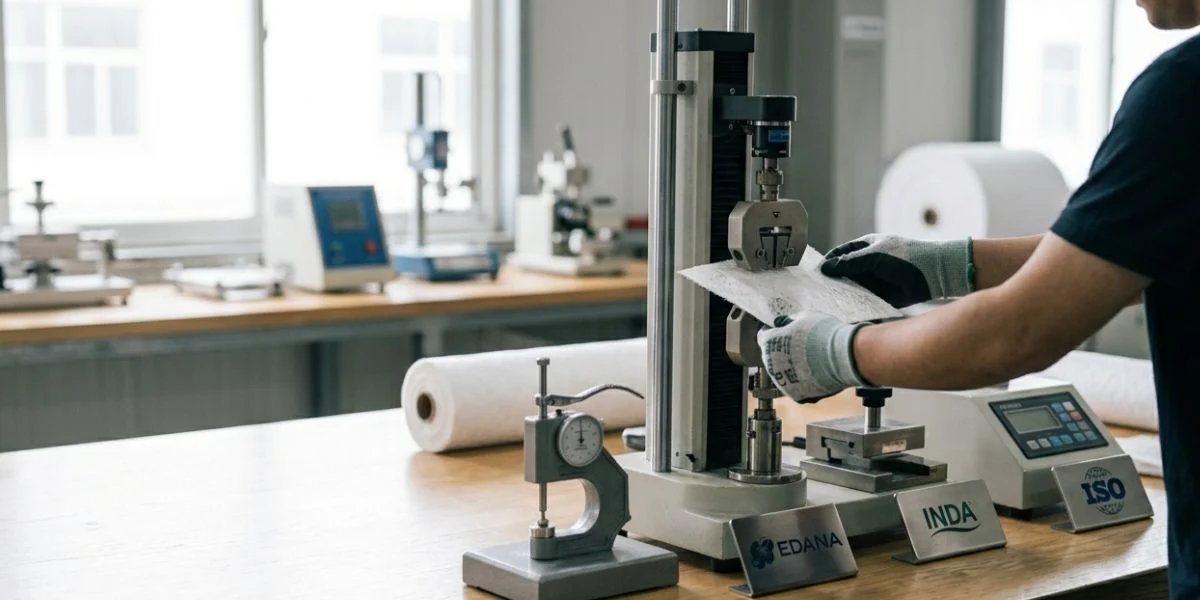
Nonwoven Fabric Testing Standards — EDANA, INDA & ISO Guide
Nonwoven fabric quality is measured against standardised test methods from EDANA (European Disposables and Nonwovens Association), INDA (Association of the Nonwoven Fabrics Industry), and ISO. Understanding these standards helps B2B buyers specify acceptance criteria, interpret COA data, and compare suppliers on a common basis.
Browse our full range: View all nonwoven fabric products — spunlace, spunbond, SMS, bico — with GSM, width and certification options. B2B MOQ from 500 kg.
Key Test Methods
| Property | EDANA Method | INDA Method | ISO/ASTM Equivalent |
|---|---|---|---|
| GSM (basis weight) | EDANA 40.3 | IST 130.1 | ISO 9073-1 |
| Tensile strength | EDANA 20.2 | IST 110.4 | ISO 9073-3 |
| Liquid strike-through | EDANA 150.3 | IST 70.3 | — |
| Rewet | EDANA 151.1 | — | — |
| Absorbency (capacity) | EDANA 10.3 | IST 10.3 | ISO 9073-6 |
| pH | EDANA 70.2 | — | — |
| Lint | — | IST 160.1 | — |
| Air permeability | — | — | ISO 9237 |
| BFE (bacterial filtration) | — | — | ASTM F2101 |
| Hydrostatic head | — | — | AATCC 127 |
What Favourite Fab COA Includes
Every Favourite Fab shipment COA reports: GSM (EDANA 40.3), tensile MD and CD (EDANA 20.2, N/5cm), absorbency (EDANA 10.3, %), and pH (EDANA 70.2). Additional tests (strike-through, BFE, lint) available on request for qualifying grades.
FAQ
What is the difference between EDANA and INDA test methods?
EDANA methods are European standards; INDA methods are North American. They are largely harmonised (joint EDANA/INDA publication on many methods). Both are widely accepted globally. COA values from either method are directly comparable for the same property.
Can Favourite Fab provide third-party test reports?
Yes — third-party testing from NABL-accredited labs in India available on request (turnaround 5–7 days). For export orders requiring accredited lab reports for regulatory submissions, specify at time of order.
Full range: spunlace nonwoven fabric. Related: ISO certified nonwoven fabric manufacturer India.
B2B Applications & End-Uses
Understanding nonwoven fabric testing standards is a prerequisite competency for procurement engineers, quality managers, and product developers who specify nonwoven substrates across hygiene, medical, filtration, geotextile, and industrial applications. The commercial consequence of misunderstanding which test method applies — or accepting a COA that references a superseded or incorrect standard — ranges from failed product qualification audits to regulatory non-compliance in export markets.
This reference resource is intended for the B2B buyer who needs to read, interpret, and specify COA requirements with precision. The four principal standards bodies whose test methods dominate global nonwoven commerce are:
- EDANA (European Disposables and Nonwovens Association): Publishes the ERT (EDANA Recommended Test) series and the NWSP (Nonwovens Standard Procedures) series, developed jointly with INDA. EDANA methods dominate hygiene, medical, and European industrial nonwoven specifications.
- INDA (INDA, Association of the Nonwoven Fabrics Industry, North America): Co-publishes NWSP methods with EDANA. INDA-only methods (IST series) are referenced by some North American buyer specifications, particularly in the wipes and filtration sectors.
- ISO TC 38/SC 23: The International Organization for Standardization technical committee for nonwoven textiles. ISO 9073 series (Parts 1–18) are the primary international standard test methods and are referenced by buyers in markets where EDANA/INDA methods are not the commercial norm, including parts of Asia and the Middle East.
- BIS (Bureau of Indian Standards): IS methods applicable to nonwoven in the Indian domestic market. BIS methods are frequently equivalent to ISO methods but reference IS method numbers in regulatory filings, tender documents, and Bureau of Indian Standards product certification (ISI mark) applications.
Procurement teams at hygiene OEMs, medical device manufacturers, geotextile contractors, and filtration equipment OEMs all require COA documentation aligned with the standards body relevant to their regulatory filing, customer audit, or product specification. Favourite Fab issues COAs with explicit standard test method references for all key parameters, ensuring the COA is directly usable without requiring the buyer to cross-reference method equivalencies.
Certifications & Quality Assurance
The following reference table covers the key nonwoven test parameters, the applicable EDANA/NWSP, ISO, and BIS methods, and the commercial significance of each parameter in buyer COA specifications:
- Basis Weight (GSM): EDANA ERT 40.3 / NWSP 010.1 / ISO 9073-1. Foundational parameter for material specification and price-per-unit-area calculations. CV% (coefficient of variation) should also be requested to assess within-roll uniformity.
- Tensile Strength and Elongation: ISO 9073-3 / NWSP 020.6. MD (machine direction) and CD (cross direction) tensile are both required. CD tensile is often the limiting dimension for converting line web tension management.
- Tear Strength: ISO 9073-4. Relevant for applications involving die-cutting, stitching, or mechanical stress in end-use, including disposable garments and geotextile applications.
- Absorbency: EDANA ERT 10.4 / NWSP 010.4. Total fluid uptake in grams per gram. Standard for hygiene, medical, and wipe applications. Must be read alongside rewet data for absorbent hygiene topsheet specification.
- Strike-Through / Penetration Time: EDANA ERT 150.5 / NWSP 080.10. Critical for hygiene topsheet specification. Measured in seconds under defined synthetic urine volume and flow rate.
- Air Permeability: EDANA ERT 140.1 / NWSP 070.1 / ISO 9237. Critical for filtration, breathable medical textile, and agricultural mulch fabric applications. Reported in mm/s or L/m²/s at defined pressure differential.
- Pilling Resistance: EDANA ERT 50.5. Surface integrity assessment under abrasion. Relevant for skin-contact medical and hygiene applications where fibre shedding affects biocompatibility claims.
- Hydrostatic Head: ISO 811 / EDANA ERT 120.2. Water penetration resistance. Relevant for waterproof medical gowns, protective coveralls, and breathable barrier membranes.
Favourite Fab’s standard COA includes results for all parameters applicable to the material grade and end-use, with test method citation, result value, and customer-agreed specification limit displayed side by side for direct incoming inspection decision-making.
More Questions Answered
Are EDANA ERT methods and NWSP methods interchangeable on a nonwoven COA?
EDANA ERT (EDANA Recommended Test) methods and NWSP (Nonwovens Standard Procedures) methods are closely related because NWSP methods were developed jointly by EDANA and INDA as a harmonised replacement for the separate ERT and INDA IST method series. For most parameters, the NWSP method is technically equivalent to or a direct update of the corresponding ERT method. However, it is important to reference the specific method number your specification requires — some buyer quality agreements specify ERT method numbers because they were written before NWSP superseded them, and while the results are typically equivalent, referencing the correct method number on your COA avoids audit non-conformance flags. Favourite Fab’s COA format references both ERT and NWSP numbers for harmonised parameters and can issue COAs citing whichever method designation your quality agreement requires.
What is the correct ISO method for measuring nonwoven basis weight, and how does it relate to the EDANA method?
ISO 9073-1 is the International Standard test method for determining the mass per unit area (basis weight / GSM) of nonwoven fabrics. EDANA ERT 40.3 and NWSP 010.1 are technically equivalent procedures developed by EDANA and INDA using the same conditioning, sampling, and weighing protocol. The numerical result produced by all three methods for the same sample is functionally identical. For Indian domestic market regulatory filings and BIS product certification applications, the equivalent IS method number should be cited — our quality team can identify the applicable IS method reference for your specific product category. When reviewing a supplier COA for basis weight, verify that the stated GSM value is supported by a method reference; a bare GSM number without method citation is not an auditable data point.

Gaurav Garg
I'm Gaurav Garg, CEO of Favourite Fab, a company on a mission to revolutionize the nonwoven industry with sustainable practices. We work hand-in-hand with manufacturers and suppliers who share our commitment to eco-friendly production. With a deep interest in textile innovation, I'm passionate about educating consumers about sustainable material options and their potential to transform the nonwoven landscape.


