

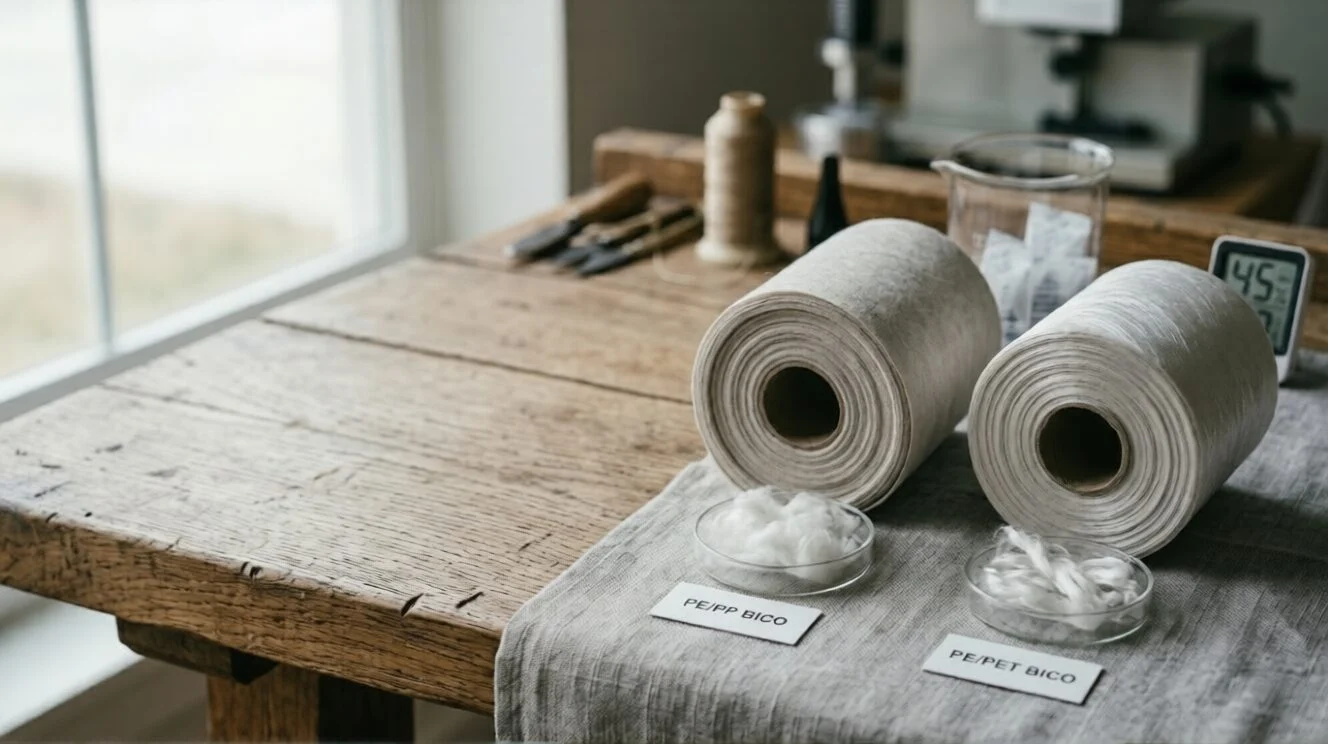
PE/PP vs PE/PET Bico Nonwoven — Which Bicomponent Grade to Choose?
Both PE/PP and PE/PET bicomponent spunbond use a polyethylene sheath for low-temperature bonding and softness — but the core polymer determines strength, temperature resistance, and application fit. This comparison helps hygiene and technical nonwoven buyers choose the right bico grade.
Browse our full range: View all nonwoven fabric products — spunlace, spunbond, SMS, bico — with GSM, width and certification options. B2B MOQ from 500 kg.
Comparison Table
| Property | PE/PP Bico | PE/PET Bico |
|---|---|---|
| Core polymer | Polypropylene | Polyester (PET) |
| Tensile strength | Moderate | High |
| Service temperature | Up to 100°C | Up to 150°C |
| Softness | Very high (PE sheath dominant) | High |
| Cost | Lower | Higher |
| Primary use | Hygiene coverstock, desiccant pouches | Technical filtration, composite layers |
FAQ
Which bico is used for baby diaper coverstock?
PE/PP bico is standard for baby diaper coverstock — PE sheath provides maximum softness at lower cost. PE/PET used only where higher tensile or temperature resistance justifies cost premium.
When is PE/PET bico better than PE/PP?
When the application involves: temperatures above 100°C (automotive, industrial), high mechanical load requiring PET core strength, or 100% polyester composition preference for recyclability/chemical resistance.
Full range: spunbond nonwoven fabric manufacturer India. Related: bicomponent nonwoven fabric manufacturer India.
B2B Applications & End-Uses
Bicomponent (bico) nonwoven fibres are produced with two polymer components — core and sheath — in a single fibre cross-section. The commercial value of bico construction lies in combining the thermal bonding advantage of a low-melt sheath with the structural performance of a higher-melt core. For product developers and procurement engineers, the choice between PE/PP and PE/PET bico determines downstream product performance across softness, strength, dimensional stability, and end-use temperature range.
PE/PP bicomponent nonwoven — polyethylene sheath over polypropylene core — is the dominant construction in hygiene product coverstocks. The PE sheath melts at approximately 130°C, enabling thermal point-bonding without compromising the PP core’s structural integrity. The resulting fabric is exceptionally soft, making it the preferred topsheet material for sanitary pads, baby diapers, and adult incontinence products where skin feel is a primary consumer metric. OEM hygiene product manufacturers specify PE/PP bico topsheet at 15–25 GSM, with hydrophilic finish for rapid liquid strike-through, and supply from India avoids the import lead time and currency exposure associated with European or Chinese sources.
PE/PET bicomponent nonwoven — polyethylene sheath over polyethylene terephthalate core — targets applications where higher mechanical strength, greater dimensional stability under heat, or improved resilience are required. PET’s higher melting point (approximately 260°C) means the core maintains structural integrity well above the PE sheath’s bond temperature. This makes PE/PET bico suitable for industrial filtration media (where the nonwoven must withstand elevated process temperatures), medical nonwovens requiring gamma sterilisation stability, and automotive interior components where dimensional creep under cabin temperature cycling is a failure mode.
Specification comparison for product development decisions:
| Parameter | PE/PP Bico | PE/PET Bico |
|---|---|---|
| Sheath polymer | Polyethylene (PE) | Polyethylene (PE) |
| Core polymer | Polypropylene (PP) — melts ~165°C | Polyethylene terephthalate (PET) — melts ~260°C |
| Bonding temp (sheath) | ~130°C | ~130°C |
| Fabric softness | Very high | Moderate |
| Tensile strength | Moderate | High |
| Dimensional stability (elevated temp) | Moderate | High |
| Primary applications | Hygiene topsheet, baby diapers, sanitary pads | Medical, industrial filtration, automotive |
| Gamma sterilisation stability | Adequate | Superior |
Certifications & Quality Assurance
Both PE/PP and PE/PET bico nonwoven production at Favourite Fab is covered by incoming polymer certification (polymer grade, melt flow index, density) and finished fabric COA per production lot. Key test parameters: basis weight (ISO 9073-1), tensile strength MD/CD (ISO 9073-3), elongation, thermal bond point integrity (visual and tensile), and — for hygiene grades — strike-through time (ISO 9073-8) and rewet (ISO 9073-9).
OEKO-TEX Standard 100 certification is maintained for hygiene-grade PE/PP bico used in skin-contact applications. For medical and industrial PE/PET grades, ISO 10993 biocompatibility data and REACH compliance documentation are available. All export documentation includes polymer composition declaration, country-of-origin certificate, and relevant test reports for customs and regulatory compliance in destination markets.
More Questions Answered
Can PE/PP bico nonwoven be supplied with hydrophilic finish for topsheet applications?
Yes. Hydrophilic finish is applied during production to achieve strike-through times compliant with ISO 9073-8 for hygiene product topsheet specifications. The finish is durable to single-use life under normal use conditions. Customers requiring specific strike-through time targets (e.g., under 3 seconds at defined test conditions) should specify this at the RFQ stage for formulation confirmation.
What GSM range is available for PE/PET bico in industrial filtration applications?
PE/PET bico for filtration and industrial applications is available from approximately 30 GSM to 150 GSM. Higher GSM constructions provide greater mechanical strength and depth filtration capacity. Pore size distribution and air permeability data can be supplied for filter media qualification. Custom constructions outside the standard range are subject to minimum order volume and development lead time.
How does PE/PET bico compare to 100% PET spunbond for automotive interior applications?
PE/PET bico offers the advantage of thermal bondability via the PE sheath at lower process temperatures compared to 100% PET spunbond (which requires higher bonding temperatures or chemical binders). This makes bico more process-friendly for converters using standard thermal calendar equipment. 100% PET spunbond may have marginal strength advantage at equivalent GSM, but PE/PET bico provides a practical balance of convertibility and performance for most automotive trim applications.

Gaurav Garg
I'm Gaurav Garg, CEO of Favourite Fab, a company on a mission to revolutionize the nonwoven industry with sustainable practices. We work hand-in-hand with manufacturers and suppliers who share our commitment to eco-friendly production. With a deep interest in textile innovation, I'm passionate about educating consumers about sustainable material options and their potential to transform the nonwoven landscape.


