

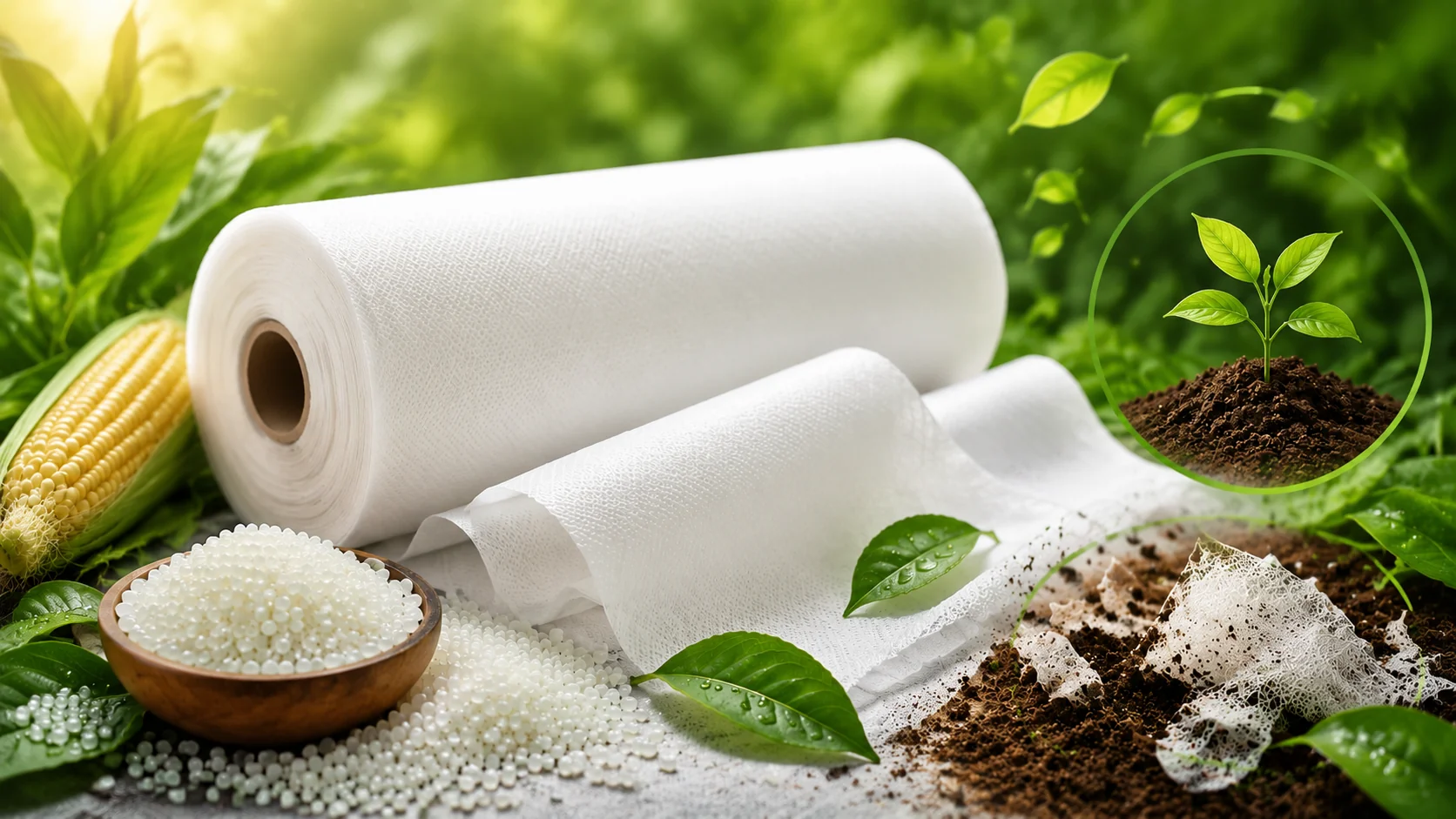
PLA Biodegradable Nonwoven Fabric — Compostable EN13432 India
PLA biodegradable nonwoven fabric offers hygiene and medical manufacturers a certified compostable alternative to conventional polypropylene substrates. Favourite Fab supplies PLA nonwoven as an upstream raw material to sanitary product converters, packaging manufacturers, and sustainable hygiene brands sourcing from India and export markets. This guide covers PLA nonwoven properties, EN13432 certification context, and sourcing specifications.
What Is PLA Biodegradable Nonwoven Fabric
PLA stands for polylactic acid — a thermoplastic polymer derived from renewable plant starch sources such as corn, sugarcane, or cassava. Unlike petroleum-based PP or PE, PLA is bio-based and compostable under controlled industrial conditions.
PLA biodegradable nonwoven is produced on spunbond or spunlace lines using PLA polymer in place of PP or PET. The resulting fabric has comparable softness and processability to conventional nonwoven substrates but degrades to water and carbon dioxide in industrial composting environments that maintain temperatures above 55°C.
EN13432 is the European standard for packaging compostability. It requires greater than 90% biodegradation within 6 months under industrial composting conditions. PLA nonwoven that meets EN13432 allows finished product manufacturers to make verified compostability claims on hygiene and packaging products sold in regulated markets.
PLA vs PP vs PE — Degradation Timeline
PLA Biodegradable Nonwoven — Specifications and Options
Favourite Fab supplies PLA nonwoven in spunbond and spunlace configurations for hygiene, packaging, and agricultural converter applications.
| Parameter | Specification | Detail |
|---|---|---|
| Polymer | Polylactic acid (PLA) | NatureWorks Ingeo or equivalent bio-based PLA |
| Fabric Type | Spunbond / Spunlace | Carded PLA available for airlaid blends |
| Basis Weight | 15–80 gsm | Hygiene topsheet: 15–20 gsm; Packaging: 30–60 gsm |
| Compostability Standard | EN13432 / ASTM D6400 | Certificate available on request for qualifying grades |
| Degradation Temp | ≥55°C (industrial compost) | Not home-compostable at ambient temperatures |
| Tensile Strength (MD) | Comparable to PP at same GSM | Lower elongation at break than PP spunbond |
| Surface Finish | Hydrophilic / Hydrophobic | Bio-based hydrophilic finish available |
| Roll Width | 1,600 mm standard | Slit widths from 200 mm on request |
Applications in Hygiene and Medical Manufacturing
PLA biodegradable nonwoven is increasingly specified by hygiene product brands targeting sustainability certifications and regulated European markets where end-of-life claims must be substantiated.
- Compostable sanitary napkin topsheets: PLA spunbond at 15–18 gsm replaces conventional PP topsheet. Product is marketed as compostable when entire construction meets EN13432. See our spunbond nonwoven for surgical gowns range for related bio-based substrate options.
- Biodegradable baby wipes: PLA spunlace provides a compostable base fabric for water wipes and fragrance-free biodegradable wipe products.
- Eco-friendly packaging nonwoven: PLA spunbond bags and wraps for retail packaging that carry verified compostability certification.
- Agricultural mulch fabrics: PLA nonwoven degrades in field composting applications, eliminating recovery and disposal costs versus conventional PP mulch.
- Compostable hygiene product backsheets: thin PLA film-laminated nonwoven for fully compostable sanitary pad constructions.
- Medical device packaging: PLA-based pouches and wraps for facilities targeting reduced single-use plastic waste in clinical environments.
PLA Nonwoven in the Sustainable Material Landscape
PLA biodegradable nonwoven sits at one end of the sustainable material spectrum. For manufacturers not yet ready to switch to fully bio-based substrates, recycled PET (rPET) spunbond offers a circular economy option using post-consumer bottle flake. For natural fibre alternatives, hemp airlaid nonwoven provides a plant-based substrate with different mechanical properties.
The parent category for all bio-based and sustainable nonwoven substrates is our spunbond nonwoven fabric range, where standard PP, bio-based PLA, and rPET grades are compared side by side.
PLA biodegradable nonwoven requires industrial composting infrastructure to degrade within the EN13432 timeframe. It does not degrade in landfill or ocean environments at meaningful rates. Manufacturers making compostability claims must verify that their entire product construction — including all components — meets EN13432 or equivalent certification requirements.
Why Source From Favourite Fab
- MOQ-friendly — suitable for small and large manufacturers
- Export-ready — ships raw materials to 50+ countries
- ISO certified manufacturing facility
- 10+ years supplying the hygiene and medical industry
- Custom specifications available on request
Pricing and MOQ
PLA biodegradable nonwoven carries a price premium over equivalent PP spunbond due to higher raw material cost and more demanding process control. Pricing varies with PLA polymer grade, basis weight, and certification requirements. Volume commitments reduce per-kilogram cost substantially for regular buyers.
Minimum order quantities start from 500 kg for standard PLA spunbond grades. EN13432-certified grades and custom finishes require confirmation from the sales team before order placement. Contact sale@favouritehub.com with your target GSM, fabric type, monthly volume, and certification requirements for a precise quote.
How to Order
- Send your material requirements to sale@favouritehub.com
- Receive a quote and sample within 48 hours
- Confirm order and production begins
Frequently Asked Questions
What does EN13432 certification mean for PLA biodegradable nonwoven?
EN13432 is the European standard for packaging compostability. It requires that a material biodegrades by more than 90% within 180 days under controlled industrial composting conditions at temperatures above 58°C. PLA nonwoven that meets EN13432 allows product manufacturers to make verified compostability claims on packaging sold in EU markets. Certification applies to the specific formulation tested — not all PLA nonwoven is automatically EN13432 compliant.
Is PLA biodegradable nonwoven suitable for home composting?
No. Standard PLA requires industrial composting conditions — sustained temperatures above 55°C and specific humidity and microbial activity levels — to degrade within the EN13432 timeframe. Home compost heaps typically do not reach or sustain these temperatures. PLA disposed in home compost bins may take several years to show significant degradation. For home-compostable claims, manufacturers must use specific lower-melt-temperature PLA grades or blends tested under home composting protocols.
How does PLA nonwoven compare to PP spunbond in mechanical performance?
PLA spunbond offers tensile strength comparable to PP at equivalent basis weight. The key differences are lower elongation at break, higher stiffness, and lower heat resistance — PLA softens at approximately 55–60°C versus over 120°C for PP. PLA is not suitable for applications involving steam sterilisation or elevated temperature exposure. For ambient-temperature hygiene applications, PLA performs adequately as a topsheet or coverstock substrate.
Can PLA biodegradable nonwoven be used as a baby diaper topsheet?
Yes. PLA spunbond at 15–18 gsm with hydrophilic finish is used as the skin-contact topsheet in compostable baby diaper constructions. The entire diaper construction must also use compostable absorbent core, backsheet, and elastic materials to qualify for compostability certification. Favourite Fab supplies PLA topsheet rolls and can advise on compatible bio-based components for full-construction compostable diaper development.
What is the minimum order quantity for PLA nonwoven from Favourite Fab?
Standard MOQ for PLA spunbond is 500 kg. EN13432-certified grades, custom hydrophilic finishes, and non-standard widths may require 1,000 kg minimum. Sample rolls of 50–100 kg are available for product development and qualification testing. Contact sale@favouritehub.com with your basis weight, width, and certification requirements for a confirmed MOQ and lead time.
Does PLA nonwoven require special handling or storage conditions?
Yes. PLA is more moisture-sensitive than PP and should be stored in sealed moisture-barrier packaging at ambient temperature below 30°C. Prolonged exposure to humidity accelerates hydrolytic degradation and reduces polymer molecular weight before processing. Rolls should be used within 12 months of manufacture date when stored correctly. Favourite Fab packages PLA rolls in sealed polyethylene bags with desiccant for transit and storage protection.
Contact Favourite Fab
Email: sale@favouritehub.com
WhatsApp: +91-8800775462
Send your material specifications today for a same-day quote.

Gaurav Garg
I'm Gaurav Garg, CEO of Favourite Fab, a company on a mission to revolutionize the nonwoven industry with sustainable practices. We work hand-in-hand with manufacturers and suppliers who share our commitment to eco-friendly production. With a deep interest in textile innovation, I'm passionate about educating consumers about sustainable material options and their potential to transform the nonwoven landscape.


