

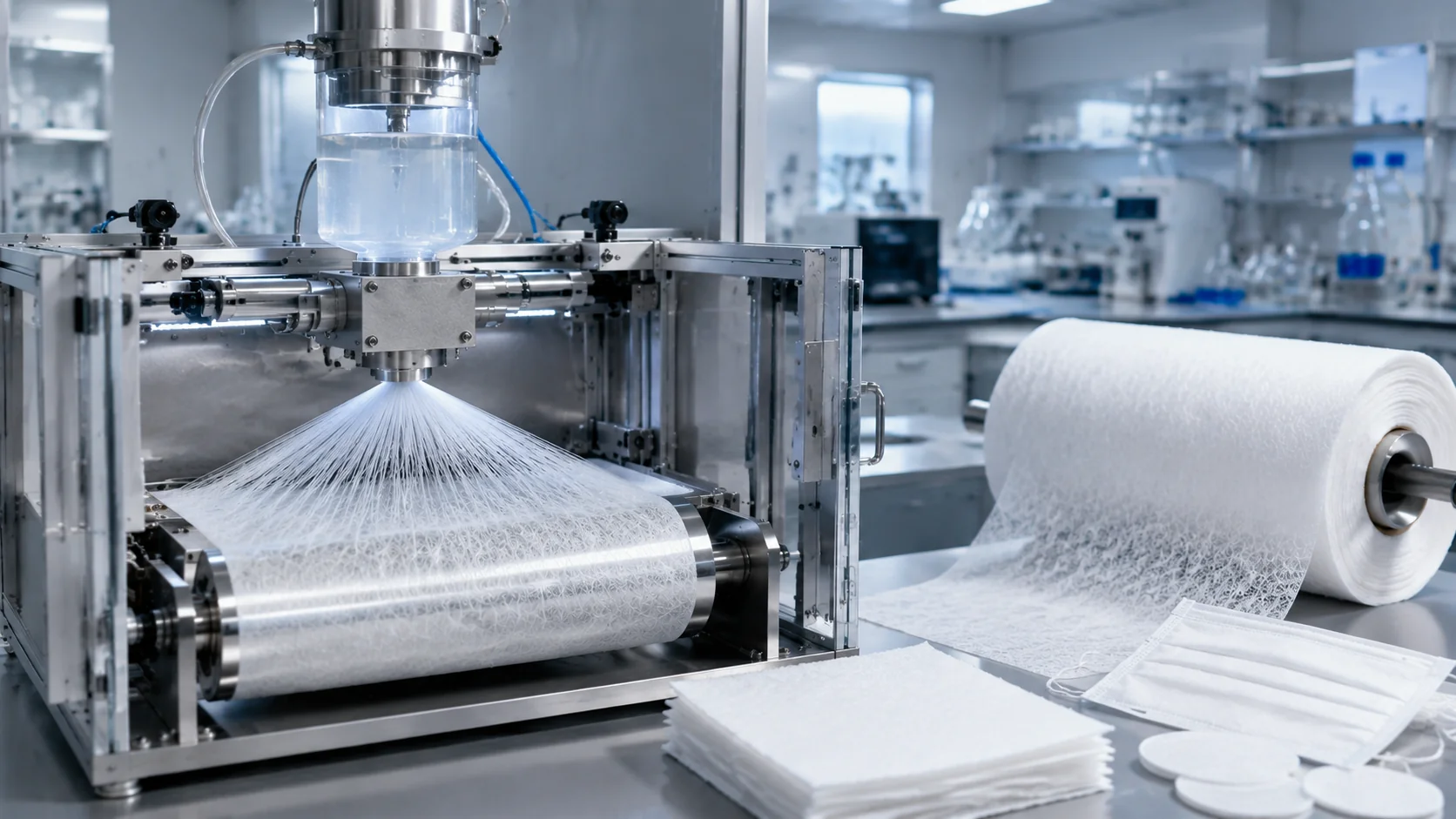
Solution Blow Spinning Nonwoven for Medical and Filtration Applications in India
Solution blow spinning nonwoven medical filtration India raw materials are supplied by Favourite Fab to air filter manufacturers, medical barrier fabric converters, and wound care producers. Solution blow spinning produces microfibre and nanofibre webs using high-speed pressurised air — without the high-voltage electrical field required by electrospinning. B2B manufacturers source solution-blown nonwoven rolls from Favourite Fab for scalable microfibre production at competitive wholesale pricing with India-based supply reliability.
What Is Solution Blow Spinning Nonwoven
Solution blow spinning (SBS) is a fibre-forming process that combines elements of electrospinning and meltblowing. A polymer solution is fed through a concentric die — an inner nozzle surrounded by an outer high-speed air annulus. The pressurised air accelerates and stretches the polymer solution jet into fine fibres. The solvent evaporates during fibre flight, and the dried fibres are deposited on a collector screen to form a nonwoven web.
Unlike electrospinning, SBS requires no high-voltage power supply, making it safer to scale for industrial production. Unlike meltblowing, SBS processes polymers in solution rather than as a melt — enabling use of biopolymers and temperature-sensitive polymers that cannot be melt-processed.
Fibre diameters achievable by SBS range from 200 nm to 5 µm, depending on polymer concentration, air pressure, and nozzle geometry. This places SBS between electrospinning (finer fibres) and meltblowing (coarser fibres) in the fibre diameter spectrum — at a process complexity and cost level accessible for industrial-scale production.
Solution Blow Spinning Nonwoven — Specifications and Options
| Parameter | Specification | Detail |
|---|---|---|
| Fibre Diameter | 200 nm–5 µm | Controlled by polymer concentration and air pressure |
| Basis Weight | 5–80 gsm | Single-layer and multi-layer configurations |
| Polymer Options | PLA, PLGA, PU, PCL, Cellulose acetate | Biopolymers processable without high-temperature melt |
| Substrate Integration | Standalone web or laminated onto spunbond carrier | Carrier improves handleability for converting |
| Filtration Efficiency | 85–98% at 1 µm | Dependent on basis weight and fibre diameter |
| Air Permeability | 5–150 cm³/cm²/s | Adjusted by compaction and basis weight |
| Biodegradable Options | PLA, PLGA grades available | Compostable end-of-life for sustainable applications |
| Roll Width | 100–1,200 mm | Narrower than meltblown; wider than lab electrospinning |
| Roll Length | 200–800 m per roll | Depends on basis weight and substrate |
| Biocompatibility | ISO 10993 tested (medical grade PLA/PLGA) | Wound contact and implant-adjacent grades available |
Applications in Hygiene and Medical Manufacturing
Solution blow spinning nonwoven medical filtration India applications are expanding as manufacturers seek biopolymer-based and scalable microfibre solutions. Air filter producers use SBS microfibre layers as a middle filtration stage in multi-layer HVAC and cabin air filter assemblies. The microfibre layer captures 1–5 µm particles that pass through the upstream coarser pre-filter layer.
Medical mask manufacturers use SBS filter media as the filtration layer in surgical masks and procedure masks. SBS media made from PLA offers a biodegradable alternative to PP meltblown — addressing sustainability requirements in healthcare procurement.
Wound care dressing converters use biocompatible PLA and PLGA SBS webs as the wound-contact layer in advanced dressings. These biopolymer fibres support cell attachment and can be formulated to degrade in contact with wound exudate, reducing dressing change frequency.
Drug delivery researchers and pharmaceutical manufacturers use SBS to incorporate active pharmaceutical ingredients directly into fibre webs for transdermal and wound-applied drug delivery systems.
This product complements our meltblown range. See our meltblown nonwoven fabric range for conventional microfibre filtration. For higher-performance nanofibre applications, see our electrospinning nanofibre nonwoven page. For meltblown process details, see our meltblown process guide. For face mask filter media supply, see our spunbond nonwoven for face masks.
Why Source From Favourite Fab
- MOQ-friendly — suitable for small and large manufacturers
- Export-ready — ships raw materials to 50+ countries
- ISO certified manufacturing facility
- 10+ years supplying the hygiene and medical industry
- Custom specifications available on request
Favourite Fab is an upstream raw material supplier. We supply solution blow spinning nonwoven rolls to filter converters, medical device manufacturers, and dressing producers. Our technical team supports polymer selection, fibre specification, and lamination configuration for your specific application.
Pricing and MOQ
Solution blow spinning nonwoven is available at competitive wholesale pricing. Pricing reflects polymer type, fibre diameter range, basis weight, and order volume. Development sample rolls are available for filtration testing and product qualification.
Contact our sales team with your fibre specification, polymer requirement, roll width, and estimated monthly volume. We issue a detailed quotation within 48 hours.
How to Order
- Send your material requirements to sale@favouritehub.com
- Receive a quote and sample within 48 hours
- Confirm order and production begins
Frequently Asked Questions
What is the difference between solution blow spinning and meltblowing?
Meltblowing processes molten polymer at high temperature, limiting it to thermoplastics like PP and PET. Solution blow spinning dissolves the polymer in solvent before processing, enabling biopolymers like PLA, PLGA, and cellulose acetate — and producing finer fibres at lower processing temperatures. SBS is preferred when polymer thermal stability or biodegradability is required.
Can Favourite Fab supply biodegradable solution blow spinning nonwoven?
Yes. We supply SBS nonwoven made from PLA (polylactic acid) and PLGA. These biopolymer webs are compostable under industrial composting conditions. PLA and PLGA grades are also available in biocompatible versions for medical and wound care applications.
What filtration efficiency does solution blow spinning nonwoven achieve?
SBS microfibre webs achieve 85–98% filtration efficiency at 1 µm depending on fibre diameter and basis weight. For higher efficiency at submicron particle sizes, we recommend combining SBS with our electrospun nanofibre layer. Multi-layer configurations are available.
Is solution blow spinning nonwoven suitable for medical device packaging?
SBS nonwoven can be used as a breathable barrier layer in medical device packaging when made from compatible polymers and tested to ISO 11607. Contact our technical team for packaging-grade material specifications and validation support.
How does solution blow spinning compare to electrospinning?
Electrospinning produces finer fibres (50–500 nm) but requires a high-voltage field and is more challenging to scale industrially. Solution blow spinning produces slightly coarser fibres (200 nm–5 µm) using air pressure only, making it safer and more scalable at lower capital cost. For sub-200 nm applications, electrospinning remains the preferred process.
Does Favourite Fab export solution blow spinning nonwoven?
Yes. We export SBS nonwoven rolls to filter manufacturers, medical device companies, and dressing converters in Southeast Asia, the Middle East, Africa, and Europe. Full export documentation and technical data sheets are provided with each shipment.
Contact Favourite Fab
Email: sale@favouritehub.com
WhatsApp: +91-8800775462
Send your material specifications today for a same-day quote.

Gaurav Garg
I'm Gaurav Garg, CEO of Favourite Fab, a company on a mission to revolutionize the nonwoven industry with sustainable practices. We work hand-in-hand with manufacturers and suppliers who share our commitment to eco-friendly production. With a deep interest in textile innovation, I'm passionate about educating consumers about sustainable material options and their potential to transform the nonwoven landscape.


