

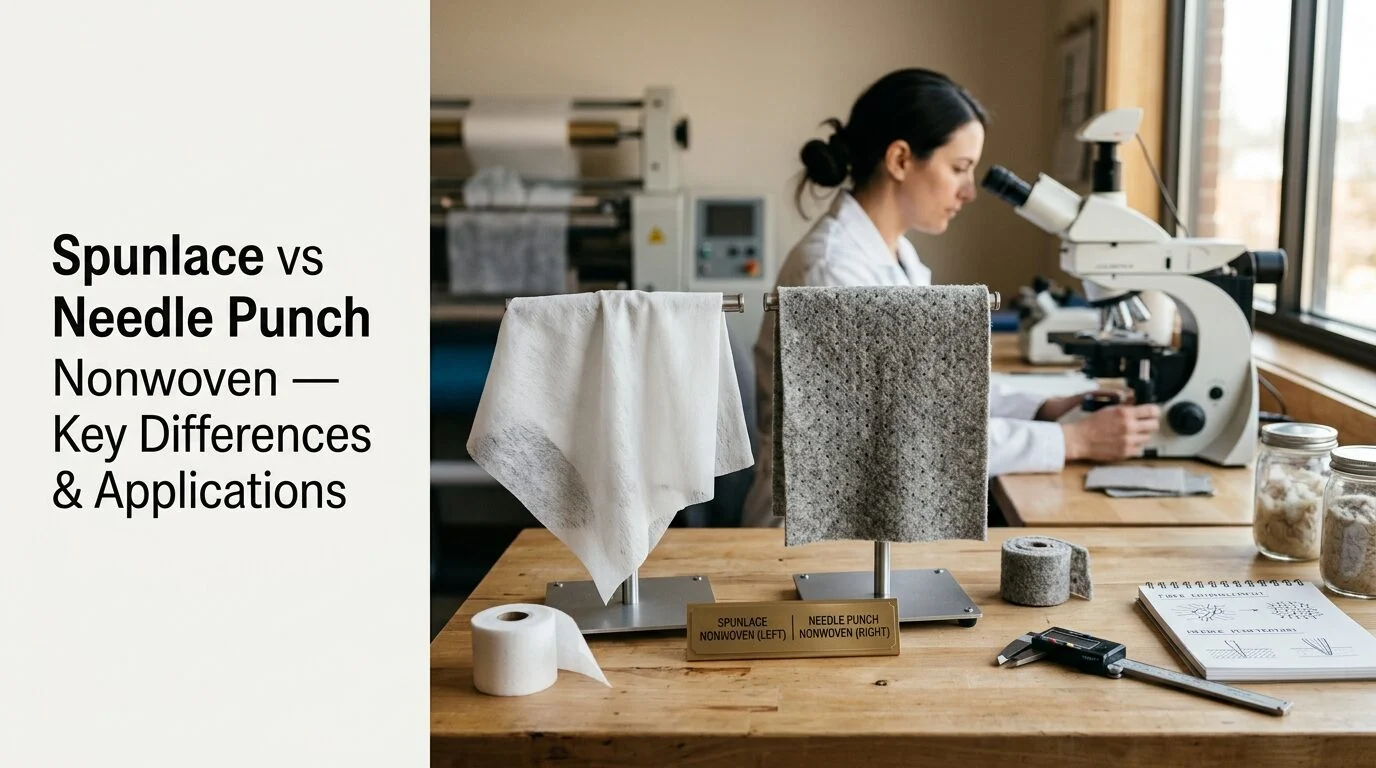
Spunlace vs Needle Punch Nonwoven — Key Differences & Applications
Spunlace and needle punch are both mechanical bonding methods — but they use fundamentally different mechanisms (water jets vs barbed needles) that produce very different fabric characteristics. Understanding these differences is essential for specifying the right fabric for your application.
Browse our full range: View all nonwoven fabric products — spunlace, spunbond, SMS, bico — with GSM, width and certification options. B2B MOQ from 500 kg.
Comparison Table
| Property | Spunlace (Hydroentangled) | Needle Punch |
|---|---|---|
| Bonding method | High-pressure water jets | Barbed needles (mechanical) |
| GSM range | 20–150 GSM | 100–2,000+ GSM |
| Softness | Very high (cloth-like) | Moderate (rougher texture) |
| Absorbency | High | High (bulk dependent) |
| Thickness/bulk | Thin (0.2–2mm) | Thick (2–20mm) |
| Cost | Higher/m² | Lower/m² at high GSM |
| Primary application | Wipes, hygiene, medical | Geotextile, filtration, automotive |
FAQ
When should I choose spunlace over needle punch?
Choose spunlace for skin-contact, hygiene, and medical applications requiring softness and precise GSM control. Choose needle punch for heavy industrial applications (geotextile, automotive liners, thick filtration media) where bulk and abrasion resistance matter more than softness.
Can needle punch achieve the softness of spunlace?
No — needle punching creates visible needle marks and a rougher texture that cannot match hydroentanglement softness. For any application where skin contact softness is a requirement, spunlace is the correct technology.
Full range: spunlace nonwoven fabric. Related: spunlace vs spunbond nonwoven fabric.
B2B Applications & End-Uses
Choosing between spunlace and needlepunch nonwoven is a material specification decision that directly affects converting yield, end-product performance, and regulatory compliance. For procurement managers and R&D engineers sourcing fabric at scale, understanding the process-level differences prevents costly re-specification mid-production.
| Parameter | Spunlace (Hydroentangled) | Needlepunch (Mechanically Bonded) |
|---|---|---|
| Bonding method | High-pressure water jets | Barbed needle penetration |
| Typical GSM range | 20–150 GSM | 100–800 GSM |
| Surface finish | Smooth, low-lint, soft hand | Textured, fibrous, higher bulk |
| Fiber options | Viscose, PET, cotton, lyocell, blends | PP, PET, jute, bicomponent, natural |
| Primary OEM use | Wet wipes, hygiene topsheets, cosmetic pads, wound care | Geotextile, filtration, carpet backing, automotive felt |
| Converting compatibility | High-speed slitting, folding, embossing, lamination | Thermoforming, needling stitch bonding, coating |
Spunlace nonwoven is the preferred substrate for wet wipe converters who require consistent low-lint performance, precise liquid retention, and surface integrity during high-speed folding on Fameccanica or Barry-Wehmiller lines. The hydroentanglement process produces no chemical binders, making it suitable for sensitive skin and OEKO-TEX-certifiable formulations used in baby wipes, feminine hygiene pads, and facial cleansing products.
Needlepunch nonwoven dominates in heavy industrial applications where structural rigidity and high GSM are required. Geotextile manufacturers specify needlepunch PP or PET at 150–500 GSM for erosion control, drainage filtration, and road base separation. Automotive OEMs use needlepunch felt for trunk liners, door panels, and under-hood insulation, where dimensional stability under heat is more critical than surface softness.
The decision framework for procurement teams is straightforward: if the end application involves direct skin or mucous membrane contact, liquid absorption/release, or high-speed converting on hygiene lines — specify spunlace. If the application requires high tensile load, thickness, thermal resistance, or heavy filtration — specify needlepunch. For hybrid applications such as surgical drapes requiring both barrier and soft topsheet layers, laminated composites using both substrates are available on request.
Certifications & Quality Assurance
Favourite Fab operates under ISO 9001:2015 quality management systems covering raw fiber intake, web formation, bonding process parameters, and finished roll inspection. Each production batch is assigned a unique lot number traceable to fiber origin, process date, and line parameters — a requirement for OEM customers who maintain supplier audit trails for regulatory submissions.
Spunlace grades offered for hygiene and medical applications are tested to EDANA standard methods including WSP 10.1 (mass per unit area), WSP 20.2 (tensile strength), WSP 40.3 (absorbency), and WSP 80.3 (lint generation). Needlepunch grades undergo ASTM D3786 (bursting strength) and ASTM D4632 (grab tensile) for geotextile and industrial certifications. Third-party COAs are included with every shipment, and retained samples are held for 12 months for dispute resolution.
OEKO-TEX Standard 100 certification is available for specified spunlace grades used in direct skin-contact applications. Export shipments are supported with a full documentation pack: Certificate of Origin (Form A / preferential COO), Phytosanitary Certificate where required, SGS or Bureau Veritas pre-shipment inspection on request, and MSDS for all fiber types. Customers operating under EU REACH or US FDA 21 CFR skin-contact frameworks can request supporting test data during the sampling stage.
More Questions Answered
Can I get the same GSM in both spunlace and needlepunch for a direct comparison trial?
Yes — Favourite Fab can supply matched GSM samples (for example, 100 GSM in both spunlace and needlepunch) to allow direct side-by-side converting trials. Specify your target GSM, width, and application when submitting your sample request and the technical team will dispatch both grades with COAs for comparison.
Which process produces more dimensional stability during heat lamination?
Needlepunch nonwoven generally exhibits superior dimensional stability at elevated lamination temperatures due to its mechanically entangled fiber matrix. Spunlace can be laminated successfully at lower temperatures with PE or hot-melt adhesives, but requires tighter process controls. The Favourite Fab technical team can advise on lamination window parameters for each specific grade.
Is needlepunch nonwoven compatible with biodegradable fiber specifications?
Yes — Favourite Fab produces needlepunch nonwoven using natural fiber inputs including jute, coir, and lyocell blends for customers requiring compostable or biodegradable end products. These grades are suitable for erosion control mats, biodegradable geotextiles, and eco-packaging applications. Minimum order quantities and lead times for natural fiber needlepunch are available on inquiry.
📋 Related: Spunlace Nonwoven Fabric — Full Range & Specs | All Nonwoven Products from Favourite Fab

Gaurav Garg
I'm Gaurav Garg, CEO of Favourite Fab, a company on a mission to revolutionize the nonwoven industry with sustainable practices. We work hand-in-hand with manufacturers and suppliers who share our commitment to eco-friendly production. With a deep interest in textile innovation, I'm passionate about educating consumers about sustainable material options and their potential to transform the nonwoven landscape.


