

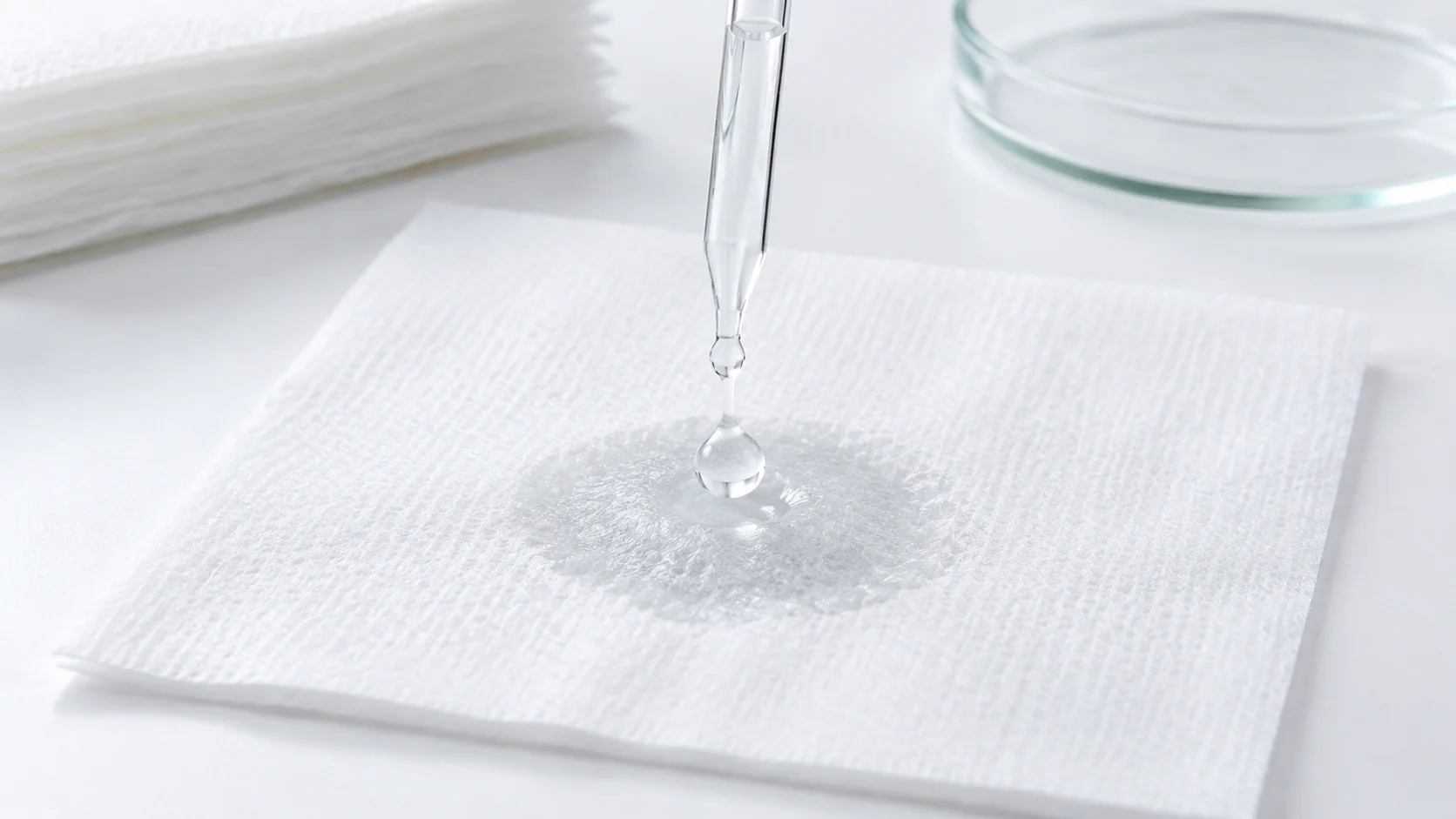
Troubleshooting Poor Absorbency in Wipes Nonwoven: Hydrophilic Failure Root Causes
Poor absorbency in wipes nonwoven is one of the most common and costly quality failures in wet wipes manufacturing. When your wipe does not absorb liquid on contact, it fails the sink-time test and the end user experience. The root cause is almost always in the raw material specification — wrong fibre type, wrong hydrophilic finish, wrong GSM, or wrong processing parameters. Favourite Fab supplies hydrophilic spunlace nonwoven fabric engineered for fast, consistent absorbency in wipes applications. This guide walks you through the root cause tree and specifies the exact material parameters that fix each failure mode.
Favourite Fab is a B2B raw material supplier based in Agra, India. We supply the nonwoven substrate for wet wipes production — not the finished wipes. Our spunlace nonwoven fabric for wet wipes is available in hydrophilic-finished grades tested for sink time and absorbency capacity. See our full spunlace range at spunlace nonwoven fabric.
Understanding the Problem: Why Absorbency Fails in Wipes Nonwoven
Absorbency in nonwoven wipes depends on three mechanisms working together: capillary wetting at the fibre surface, liquid transport through the pore network, and bulk storage capacity in the fabric structure. A failure at any point in this chain results in poor absorbency — slow strike-through, low total uptake, or liquid pooling on the surface instead of being drawn in.
The most common cause is a hydrophilic finish that has degraded, was applied incorrectly, or was specified for the wrong fibre type. Hydrophilic finishes work by lowering surface energy at the fibre-liquid interface. If the finish is absent, insufficient, or incompatible with the fibre chemistry, water beads up on the surface instead of wicking in.
GSM is the second key variable. Too low a GSM means inadequate pore volume for liquid storage. Too high a GSM means excessive tortuous path length — the liquid cannot penetrate to the inner layers before it spreads on the surface. The correct GSM depends on your target absorbency capacity and the wipe format (dry, pre-wetted, or lotion-loaded).
Root Causes and Diagnostic Checklist
- Wrong fibre type: Are you using PP spunbond (inherently hydrophobic) instead of viscose or hydrophilic PET? PP requires a finish to absorb — viscose is naturally hydrophilic.
- Hydrophilic finish absent or degraded: Has your fabric been in storage for more than 6 months? Hydrophilic finishes can volatilise or oxidise over time, especially in hot or humid storage.
- Finish add-on rate too low: Is the finish add-on below 0.3% by weight? At very low rates, fibre coverage is incomplete and absorbency is inconsistent across the roll width.
- Wrong GSM for target absorbency: Are you below 35 GSM for a pre-wetted wipe application? Insufficient pore volume means the wipe cannot retain the liquid load.
- Over-calendered or over-bonded fabric: High thermal bonding density compresses pores and reduces wicking speed. Is your bonding area ratio above 20%?
- Wrong fibre blend ratio: Pure PET spunlace is slower to absorb than a viscose blend. Are you at 70% viscose / 30% PET or better for wipes?
- Lotion or preservative incompatibility: Is the liquid formulation compatible with the finish on the fabric? Some preservatives deactivate hydrophilic finishes on contact.
Material-Side Fixes — Specifications That Resolve the Issue
| Root Cause | Correct Specification | Why It Fixes the Problem |
|---|---|---|
| Inherently hydrophobic fibre (PP) — surface tension too high | Switch to viscose-PET spunlace (70/30) or 100% viscose | Viscose has natural cellulosic hydroxyl groups — absorbs water without any finish required |
| Hydrophilic finish absent or degraded in storage | Specify fresh-stock fabric; request manufacture date on certificate; store below 25°C | Fresh finish maintains complete fibre surface coverage; full wicking restored |
| Finish add-on too low — incomplete fibre coverage | Specify finish add-on 0.5–1.0% by weight on test certificate | Adequate coverage lowers contact angle uniformly; consistent absorbency across roll width |
| GSM too low — insufficient pore volume for liquid storage | 40–55 GSM for standard wet wipes; 55–70 GSM for lotion-heavy wipes | Higher pore volume accommodates full liquid load without saturation at the surface |
| Over-bonded fabric compressing pore network | Spunlace hydroentanglement instead of thermal bonding for wipes | Hydroentanglement bonds fibres without compressing pores — maintains open capillary network |
| Wrong fibre blend — slow strike-through time | 70% viscose / 30% polyester spunlace | Viscose provides fast wicking; PET provides structural integrity and wet tensile strength |
| Liquid formulation incompatible with finish | Request finish compatibility data from supplier; test sample in your liquid formulation before bulk order | Confirmed compatibility prevents finish deactivation in the finished wet wipe product |
How Favourite Fab Supplies the Right Grade
Favourite Fab supplies hydroentangled (spunlace) nonwoven fabric in viscose, PET, and viscose-PET blend constructions. We test absorbency (EDANA WSP 10.1 sink time) and wet tensile on every production batch. Our application engineers have experience with baby wipes, personal care wipes, industrial wipes, and medical wipes formulations. We also supply fabrics for breathable desiccant packaging and other technical nonwoven applications.
- Grade-specific absorbency and sink-time test certificates available on request
- Sample dispatch within 48 hours for trial runs
- Technical support from application engineers with wipes manufacturing experience
- Custom GSM / width / fibre blend to match your wipes machine and liquid formulation
- ISO certified — batch-to-batch consistency guaranteed
Pricing and MOQ
Favourite Fab offers competitive wholesale pricing for hydrophilic spunlace nonwoven fabric. Pricing depends on fibre blend (viscose/PET ratio), GSM, roll width, and order volume. MOQ is typically 500 kg per grade. Contact our sales team with your wipes machine width, target GSM, fibre blend preference, and monthly consumption for a tailored quotation. Actual prices are quoted by our sales engineers — we do not publish fixed price lists.
How to Order
- Send your current fabric spec, sink-time target, liquid formulation type (baby wipes / industrial / medical), and machine width to sale@favouritehub.com
- Receive recommended spunlace grade + absorbency test data + sample within 48 hours
- Run wipes production trial — measure sink time and wet tensile on finished wipe
- Confirm production order with agreed GSM, blend, and finish specification
Frequently Asked Questions
Q: What sink time should I target for baby wipes nonwoven?
A: Baby wipes typically require a sink time of ≤3 seconds (EDANA WSP 10.1). Some premium baby wipe specifications require ≤1.5 seconds. Favourite Fab can supply spunlace grades meeting both standards — specify your sink-time target when requesting a sample.
Q: Does viscose spunlace lose absorbency after repeated use in industrial wipes?
A: Pure viscose does degrade faster under mechanical abrasion than viscose-PET blends. For reusable industrial wipes, a 50% viscose / 50% PET or 30% viscose / 70% PET blend gives better durability while retaining acceptable absorbency. Favourite Fab supplies both standard and heavy-duty blends.
Q: Can the hydrophilic finish on spunlace nonwoven cause skin irritation in baby wipes?
A: Hydrophilic finishes used in baby wipes applications are formulated to meet dermatological safety standards. Favourite Fab can provide finish chemistry data on request so your formulation team can verify compatibility. We supply finish-free viscose grades for sensitive-skin applications where no finish is preferred.
Q: What is the difference between spunlace and SMS nonwoven for wipes absorbency?
A: Spunlace (hydroentangled) nonwoven is significantly more absorbent than SMS for wipes applications. SMS has a meltblown barrier layer that restricts liquid penetration — it is designed for repellency, not absorption. Wipes always use spunlace or carded-bonded constructions, not SMS.
Q: We are experiencing fabric curling during the wipes slitting process — is this related to absorbency?
A: Fabric curling during slitting is a separate issue related to tension control and residual stress in the roll — not directly related to absorbency. See our guide on fixing fabric curling during slitting for that diagnosis. Both issues can occur simultaneously if you have a problematic roll, but they have different root causes.
Q: Does Favourite Fab supply nonwoven for both wet wipes and dry wipes?
A: Yes. For dry wipes, we supply lower-GSM spunlace (25–35 GSM) in hydrophilic or hydrophobic grades depending on the dry wipe application (dusting, polishing, or dry personal care). For wet wipes, 40–70 GSM hydrophilic grades are standard. Specify your application and we will recommend the correct construction.
Contact Favourite Fab
Favourite Fab — B2B spunlace nonwoven fabric supplier for wipes manufacturers, Agra, India.
Email: sale@favouritehub.com
WhatsApp: +91-8800775462
Describe your absorbency problem and current fabric specification today — our team responds within 4 hours and dispatches samples within 48 hours.
Also see: absorbency testing nonwoven fabric — sink time methods.
Related Hydrophilic Cluster Resources
- Master Pillar: Hydrophilic Non Woven Fabric Manufacturer India — production, grades (SS / SSS / SMS / HATB / spunlace), GSM matrix, B2B ordering.
- Application Pillar: Hydrophilic Top Sheet for Diapers and Hygiene Products — topsheet selection logic for baby diaper, sanitary napkin, adult incontinence, underpad.
- Process Pillar: Hydrophilic Hot Air Through Nonwoven Fabric — HATB / TAB lofty topsheet + ADL grades, bicomponent fibers, premium hygiene applications.

Gaurav Garg
I'm Gaurav Garg, CEO of Favourite Fab, a company on a mission to revolutionize the nonwoven industry with sustainable practices. We work hand-in-hand with manufacturers and suppliers who share our commitment to eco-friendly production. With a deep interest in textile innovation, I'm passionate about educating consumers about sustainable material options and their potential to transform the nonwoven landscape.


