

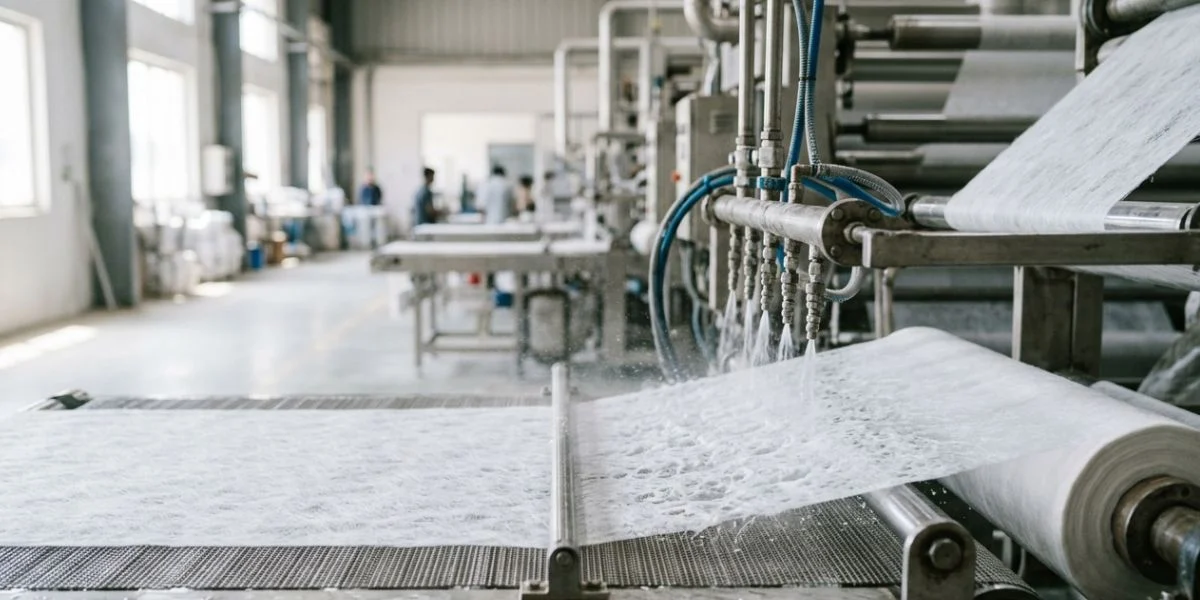
Wetlace Nonwoven Fabric — Wetlaid Spunlace Composite Manufacturer India
Wetlace nonwoven fabric is produced by wetlaid web formation followed by hydroentanglement (spunlace) bonding. In the wetlaid process, fibres are dispersed in water and deposited onto a forming wire — similar to papermaking. This creates an exceptionally uniform, fine-fibre web that hydroentanglement bonds into a strong, smooth fabric. Wetlace is the technology of choice for flushable wipes (EDANA/INDA flushability guidelines) and ultra-fine filter media where fibre uniformity is critical.
Technical Specifications
| Parameter | Specification |
|---|---|
| GSM | 30–100 GSM |
| Fibre | Cellulose (flushable grade), viscose, lyocell |
| Uniformity | Exceptional (wetlaid formation) |
| Flushability | EDANA/INDA guidelines compliant grades |
| Tensile MD | 60–250 N/5cm |
| MOQ | 1,000 kg |
Applications
Flushable wet wipes, ultra-fine filtration media, premium facial wipes, specialty medical nonwovens.
Source from Favourite Fab
Direct manufacturer Agra, India. Custom GSM/width. COA per batch. Sample 3–5 days. See: spunlace nonwoven fabric. Related: airlace nonwoven fabric.
Frequently Asked Questions
What makes wetlace suitable for flushable wipes?
Wetlace uses cellulose fibres (wood pulp/lyocell) that hydroentanglement bonds without synthetic binders. In water, the hydroentangled bond disperses — allowing the wipe to break apart when flushed. No synthetic fibres means no microplastic concern. Complies with EDANA/INDA flushability code of practice.
How is wetlace different from standard spunlace?
Standard spunlace: staple fibres carded into web, then hydroentangled. Wetlace: fibres dispersed in water slurry, deposited by wetlaid forming. Wetlaid web is more uniform and allows use of very short fibres (wood pulp) impossible in carding. Result: smoother surface, finer pore structure, flushable capability.
Is flushable wetlace available from Favourite Fab?
Yes. Cellulose-based wetlace compliant with EDANA Code of Practice for Flushable Products available in 40–80 GSM. Full flushability test report per batch. Used by flushable wipe brands requiring compliant substrate.
B2B Applications & End-Uses
Wetlace nonwoven fabric — the composite produced by bonding a wetlaid cellulosic web with a spunlace facing — was developed specifically to meet the dispersibility requirements of the global flushable wipe market. Standard spunlace, even in pure viscose grades, does not disaggregate in wastewater systems at a rate or mechanism consistent with EDANA GD4 or INDA/EDANA flushability guidelines. Wetlaid/spunlace composites solve this problem by incorporating a wetlaid cellulosic core whose fibre-to-fibre bonding mechanism — hydrogen bonding rather than mechanical entanglement — allows the web to disaggregate when agitated in water without the synthetic entanglement structure that makes conventional spunlace resistant to dispersal.
Flushable personal care wipe converters represent the primary buyer segment for wetlace composites. This includes OEM manufacturers producing flushable toilet wipes, feminine hygiene wipes, and adult care wipes for markets where flushability claims are subject to regulatory or retailer compliance requirements. The INDA/EDANA guidance document (GD4 or its regional equivalent) defines a suite of seven tests that a wipe substrate and finished product must pass before a flushability claim can be made — including household pump passage, slosh box dispersibility, and marine/aerobic/anaerobic disintegration. Favourite Fab’s wetlace composites are developed with GD4 compliance as a design criterion, and buyers can request test data supporting GD4 performance at the qualification stage.
Biodegradable wipe converters producing products for the European and UK markets are a growing buyer segment. UK WRAP and the EU’s Single-Use Plastics Directive create regulatory pressure on wipe OEMs and retailers to eliminate or disclose synthetic fibre content in wet wipes. Wetlace composites with viscose/cotton spunlace facings and cellulosic wetlaid cores contain no synthetic polymer fibres, making them fully eligible for biodegradability claims in composting (EN 13432) and marine environments (OECD 306). Converters developing next-generation sustainable wipe SKUs for retail supply chains with explicit plastic-free or biodegradable SKU targets should engage Favourite Fab’s technical team at the early concept stage to align substrate composition and test protocol with their sustainability claim framework.
OEM contract manufacturers producing private-label hygiene programmes for major EU, UK, and US retailers have driven demand for wetlace substrates as retailers increasingly require plastic-free or flushable wipe options across their own-brand ranges. At 40–80 GSM, wetlace composites are compatible with standard horizontal flow-wrap and vertical form-fill-seal packaging formats used across the wet wipe industry without requiring converting line modification. The spunlace facing provides the surface texture and tactile uniformity that retailer brand buyers expect from premium wipe substrates, while the wetlaid core delivers the dispersibility that makes the flushability claim defensible under third-party audit.
Certifications & Quality Assurance
Wetlace composite manufacturing at Favourite Fab requires a dual-process quality management approach covering both the wetlaid web formation stage and the spunlace bonding stage. Both processes are governed under the ISO 9001:2015 certified quality management system, with process parameters documented separately for each stage and monitored via in-process controls. The wetlaid web formation process requires precise control of fibre slurry concentration, web formation uniformity, and drying conditions — parameters that determine the dispersibility characteristics of the finished composite. Deviations in wetlaid web formation are more directly consequential for dispersibility performance than for mechanical performance, making this the most critical in-process control point for flushable wipe grades.
Dispersibility performance of wetlace composites is validated per the INDA/EDANA GD4 test suite at the time of product qualification. Specific tests relevant to OEM buyer compliance include the slosh box test (GD4 Test 1), which evaluates fabric disaggregation rate under mechanical agitation, and the household pump passage test (GD4 Test 3), which confirms that dispersed fragments will pass through standard domestic sewer infrastructure. Test reports from accredited third-party laboratories are available for wetlace grades that have been validated through the GD4 test programme. OEM buyers making flushability claims in regulated markets (EU, UK, Australia) are advised to review their specific regulatory and retailer compliance requirements against the GD4 test data to confirm the claim basis is defensible.
For biodegradability claims, Favourite Fab can provide test data or support buyer-commissioned testing for wetlace composites under EN 13432 (industrial composting), ISO 14851/14852 (aerobic aquatic biodegradation), and OECD 306 (marine biodegradation). The cellulosic composition of the wetlaid core and viscose/cotton spunlace facing is inherently advantageous for biodegradability testing relative to synthetic-fibre composites, but buyers should confirm that their specific product formulation — including any coating, print, or lotion — does not compromise the composite’s biodegradability performance before making a certified claim. Batch COAs for wetlace grades include basis weight, tensile, absorbency, and — for flushable grades — dispersibility metrics as standard.
More Questions Answered
What is the difference between EDANA GD4 and the INDA/EDANA international guidelines for flushability compliance?
EDANA GD4 is the European flushability guidance document produced by the European Disposables and Nonwovens Association. The INDA/EDANA International Flushability Guidelines represent the jointly published version of this guidance, aligned between INDA (the North American nonwoven industry association) and EDANA to create a harmonised international standard. Both documents define the same core test battery of seven tests covering dispersibility, household pump passage, slosh box performance, and environmental disintegration, but the joint INDA/EDANA version is referenced in more regulatory frameworks and retailer compliance schemes internationally. For OEM buyers selling flushable wipe products across multiple markets simultaneously, using the INDA/EDANA joint guidelines as the compliance reference provides the broadest market coverage. Favourite Fab’s wetlace composites are developed against the INDA/EDANA joint guidelines, and the technical team can advise on which specific test reports are required for the buyer’s target market regulatory environment.
Can wetlace composites be supplied with a printed or embossed surface finish for brand differentiation?
Surface embossing of wetlace composites is feasible within defined process limits. The wetlaid core’s hydrogen-bond structure makes the composite more sensitive to calender pressure than equivalent-weight spunlace, and embossing patterns must be designed to avoid localised compression that would reduce dispersibility performance by increasing fibre-to-fibre bond density in the embossed zones. Favourite Fab’s converting team can advise on emboss pattern geometries and calender pressure ranges that achieve visible surface texture differentiation without compromising GD4 slosh box dispersibility. Water-based flexographic printing on the spunlace facing surface is also available for wetlace composites where retail pack differentiation requires a printed product — ink selection must be confirmed for dispersibility compatibility and compliance with the relevant food safety or skin-contact chemical standards for the target market.

Gaurav Garg
I'm Gaurav Garg, CEO of Favourite Fab, a company on a mission to revolutionize the nonwoven industry with sustainable practices. We work hand-in-hand with manufacturers and suppliers who share our commitment to eco-friendly production. With a deep interest in textile innovation, I'm passionate about educating consumers about sustainable material options and their potential to transform the nonwoven landscape.


