

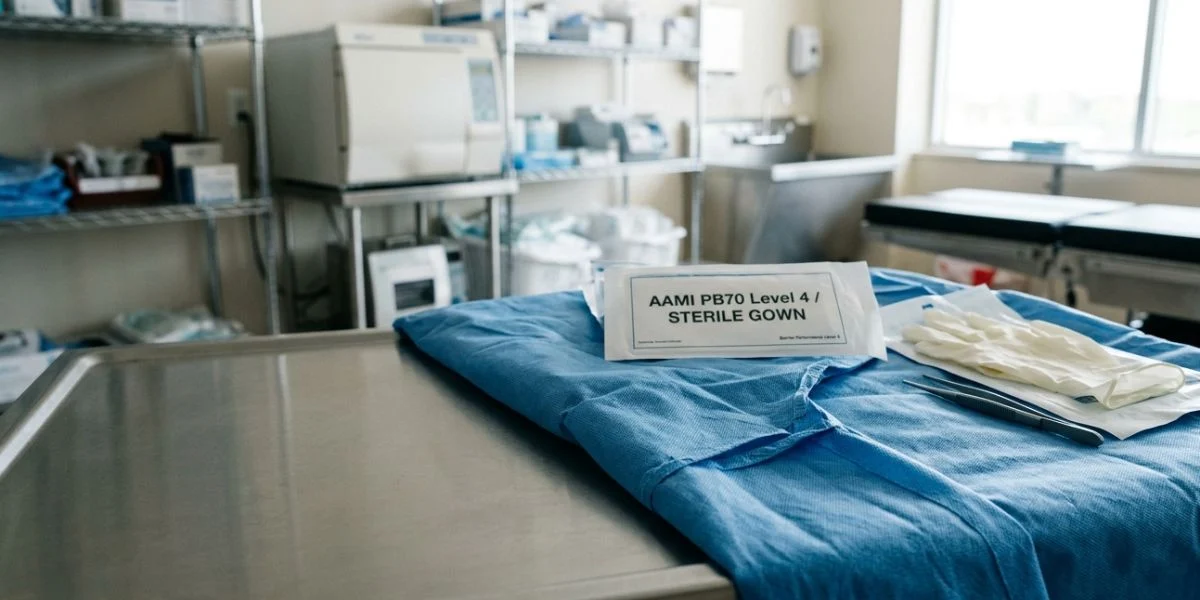
AAMI PB70 Level 4 Nonwoven Surgical Gown Fabric
Hospital procurement teams and PPE manufacturers sourcing AAMI PB70 Level 4 nonwoven surgical gown fabric require the highest liquid barrier performance classification available under the Association for the Advancement of Medical Instrumentation’s barrier standard. AAMI PB70 Level 4 represents the most demanding fluid resistance requirement for surgical and isolation gowns, required for procedures involving high exposure risk to blood, body fluids, and viral penetration. Favourite Fab manufactures SMS and SMMS nonwoven fabrics meeting the barrier requirements for AAMI PB70 Level 4 surgical gown production, supplied wholesale to PPE OEMs, gown manufacturers, and hospital supply chain distributors.
AAMI PB70 Barrier Level Classification — Overview
AAMI PB70 (formerly ANSI/AAMI PB70) defines four levels of liquid barrier performance for protective apparel used in healthcare settings. Each level is defined by specific test methods and pass criteria:
| Level | Critical Zone Barrier Test | Test Method | Pass Criteria | Typical Application |
|---|---|---|---|---|
| Level 1 | Spray Impact | AATCC 42 | Water penetration ≤4.5 g | Minimal fluid exposure procedures |
| Level 2 | Spray Impact + Hydrostatic Pressure | AATCC 42 + AATCC 127 | ≤1.0 g spray; ≥20 cm H₂O hydrostatic | Low to moderate fluid exposure |
| Level 3 | Spray Impact + Hydrostatic Pressure | AATCC 42 + AATCC 127 | ≤1.0 g spray; ≥50 cm H₂O hydrostatic | Moderate to high fluid exposure |
| Level 4 | Viral Penetration (Simulated Blood) | ASTM F1671 or ASTM F1670 | No penetration — complete barrier | High viral/pathogen exposure, surgical gowns |
SMS and SMMS Nonwoven for Level 4 Surgical Gowns
Achieving AAMI PB70 Level 4 requires nonwoven fabric that provides a complete barrier to viral particle penetration under pressurized liquid challenge. Favourite Fab’s SMS and SMMS constructions for surgical gown applications are engineered to meet this requirement:
SMS (Spunbond-Meltblown-Spunbond)
- GSM range: 35–70 gsm for gown critical zone fabric
- Meltblown core provides the primary barrier against viral penetration
- Hydrostatic head: typically ≥100 cm H₂O for Level 4 grades
- Breathability maintained through controlled porosity balance
- Available with anti-static and soft-finish treatments
SMMS (Spunbond-Meltblown-Meltblown-Spunbond)
- GSM range: 45–90 gsm
- Dual meltblown layer provides superior barrier uniformity and redundancy
- Higher hydrostatic head values — preferred for critical zone panels in Level 4 gowns
- Consistent barrier performance across roll width and length
- Used by leading surgical gown OEMs for the sleeve and front critical zones
Critical Zone vs. Non-Critical Zone Material Selection
AAMI PB70 distinguishes between critical zones (areas of the gown most likely to contact fluid) and non-critical zones. This distinction allows gown manufacturers to optimize material selection and cost:
- Critical zones (front panel, sleeves): SMMS or high-GSM SMS rated to Level 4
- Non-critical zones (back panel, collar): Lower barrier SMS or spunbond, typically Level 1 or Level 2 rated
- Favourite Fab supplies both zone specifications, enabling gown manufacturers to source a complete material package from one supplier
Wholesale Supply Program for PPE OEMs
Favourite Fab’s wholesale supply program for surgical gown fabric is designed to support the production planning cycles of PPE OEMs and hospital supply chain procurement:
- Minimum order from 500 kg per grade
- Custom roll width from 1.0m to 3.2m
- Lot test reports — hydrostatic head, tensile, GSM, and ASTM F1671 test data from accredited labs
- Consistent production quality for regulated medical device supply chains
- Competitive wholesale pricing — request quote for your volume
Frequently Asked Questions
What is the difference between ASTM F1671 and ASTM F1670 for Level 4 testing?
ASTM F1671 tests resistance to penetration of blood-borne pathogens using Phi-X174 bacteriophage as a surrogate for bloodborne pathogens such as hepatitis B and HIV. ASTM F1670 tests resistance to penetration of synthetic blood. ASTM F1671 is the more stringent standard and is typically required for AAMI PB70 Level 4 surgical gown certification. Both tests must show zero penetration for the fabric to qualify for Level 4 use.
Can your SMMS fabric be used for both reusable and single-use surgical gown production?
Favourite Fab’s SMS and SMMS fabrics are designed primarily for single-use surgical gown production, which represents the majority of global surgical gown manufacturing. For reusable gown applications requiring laundering durability, fabric specifications and finishing treatments differ — contact our technical sales team to discuss reusable gown substrate requirements.
What GSM do you recommend for the critical zone of a Level 4 surgical gown?
For AAMI PB70 Level 4 critical zone panels, we typically recommend 45–60 gsm SMMS or 50–70 gsm SMS. The optimum GSM depends on your gown design, assembly method, and additional treatments applied during gown manufacturing. Our technical team can advise based on your product design and performance targets.
Do you supply fabric pre-cut or only in rolls?
We supply fabric in roll form for converter and gown manufacturer operations. Roll widths are customized to your cutting plan specifications. Pre-cut fabric panels can be discussed for specific requirements — contact our sales team for evaluation of your cutting plan and volume requirements.
Source Level 4 Surgical Gown Fabric from Favourite Fab
For hospital procurement systems, PPE OEMs, and surgical gown manufacturers requiring AAMI PB70 Level 4 nonwoven surgical gown fabric, Favourite Fab offers direct manufacturer access to SMS and SMMS nonwovens engineered for the highest barrier performance classification. Request material specifications, available test data, and wholesale pricing from our B2B sales team today.
Related B2B Resources

Gaurav Garg
I'm Gaurav Garg, CEO of Favourite Fab, a company on a mission to revolutionize the nonwoven industry with sustainable practices. We work hand-in-hand with manufacturers and suppliers who share our commitment to eco-friendly production. With a deep interest in textile innovation, I'm passionate about educating consumers about sustainable material options and their potential to transform the nonwoven landscape.


