

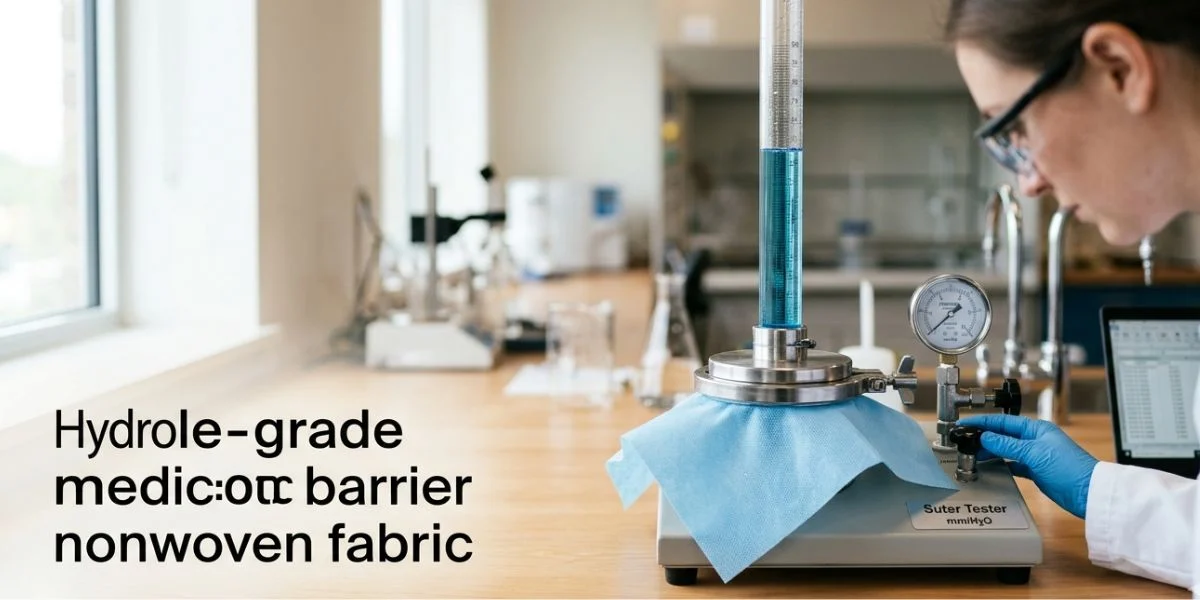
Hydrostatic Head Test Medical Barrier Nonwoven Fabric
The hydrostatic head test is the primary method for measuring liquid barrier performance in medical barrier nonwoven fabrics. For PPE manufacturers, surgical gown OEMs, and hospital supply chain QA teams, understanding hydrostatic head values is essential to selecting the correct nonwoven substrate for barrier-critical medical applications. Favourite Fab manufactures SMS and SMMS barrier nonwoven fabrics with measured and documented hydrostatic head performance, supplying medical textile manufacturers and PPE OEMs worldwide.
What Is the Hydrostatic Head Test?
The hydrostatic head test measures a fabric’s resistance to water penetration under sustained pressure. The test exposes one face of the fabric to a continuously increasing column of water until the first three points of penetration through the fabric are observed. The result — expressed in centimeters of water (cm H₂O) or millimeters of mercury (mmHg) — defines the fabric’s liquid barrier performance.
The two primary standards used in medical textile applications are:
- AATCC 127 (Water Resistance: Hydrostatic Pressure Test): Widely used for medical and industrial barrier fabric testing in North American and international markets. Results reported in cm H₂O or mmHg.
- ISO 811 (Textiles — Determination of resistance to water penetration — Hydrostatic pressure test): The ISO equivalent, used internationally and referenced in European medical standards. Results in cm H₂O.
- EN 20811: European standard equivalent to ISO 811, referenced in surgical textile and PPE standards.
Hydrostatic Head Values for Medical Nonwoven Applications
The required hydrostatic head value varies significantly between medical applications and AAMI PB70 barrier levels:
| Application | Standard | Minimum Hydrostatic Head | Test Method |
|---|---|---|---|
| Surgical gown — AAMI Level 2 (non-critical zone) | AAMI PB70 | ≥20 cm H₂O | AATCC 127 |
| Surgical gown — AAMI Level 3 (critical zone) | AAMI PB70 | ≥50 cm H₂O | AATCC 127 |
| Surgical gown — AAMI Level 4 (critical zone) | AAMI PB70 | Viral penetration test (ASTM F1671) required | AATCC 127 + ASTM F1671 |
| Surgical drape | ISO 22610 / EN 13795 | ≥10 cm H₂O (standard); ≥30 cm H₂O (high performance) | ISO 811 / EN 20811 |
| Sterile barrier packaging | ISO 11607 | Defined by packaging system — typically ≥20 cm H₂O | ISO 811 |
| Isolation gown | AAMI PB70 Level 1 | No hydrostatic test required — spray impact only | AATCC 42 |
Favourite Fab SMS Barrier Nonwoven — Hydrostatic Head Specifications
Favourite Fab manufactures SMS (spunbond-meltblown-spunbond) and SMMS (spunbond-meltblown-meltblown-spunbond) nonwoven fabrics with the following hydrostatic head performance ranges:
SMS Barrier Nonwoven
- GSM range: 20–70 gsm
- Hydrostatic head: 20–80 cm H₂O depending on GSM and meltblown weight
- Standard medical grades: 35 gsm SMS at ≥30 cm H₂O, 50 gsm SMS at ≥50 cm H₂O
- Applications: surgical drapes, Level 2/Level 3 gown non-critical zones, sterile packaging
SMMS Barrier Nonwoven
- GSM range: 40–90 gsm
- Hydrostatic head: 60–150+ cm H₂O depending on GSM and dual meltblown configuration
- Standard medical grades: 50 gsm SMMS at ≥80 cm H₂O, 60 gsm SMMS at ≥100 cm H₂O
- Applications: Level 3/Level 4 gown critical zones, high barrier surgical drapes, sterile device packaging
Factors Affecting Hydrostatic Head in SMS Nonwoven
Understanding what determines hydrostatic head performance helps buyers specify and evaluate barrier nonwoven fabrics more accurately:
- Meltblown layer weight: Higher meltblown GSM within the SMS structure increases hydrostatic head — the meltblown layer is the primary barrier element
- Fiber diameter: Finer meltblown fibers create smaller pores, increasing hydrostatic head for a given GSM
- Processing consistency: Uniform fiber distribution across roll width is critical — pinhole defects in the meltblown layer cause hydrostatic failures
- Water repellent treatment: Hydrocarbon or silicone-based repellency treatments increase effective hydrostatic head values
- Total GSM and construction: SMMS (dual meltblown) achieves higher hydrostatic head than SMS at equivalent total GSM
Frequently Asked Questions
How is hydrostatic head different from water column resistance?
They are essentially the same property measured in the same units. “Water column resistance” describes the height of a water column the fabric can resist before penetration. “Hydrostatic head” is the AATCC 127 / ISO 811 test result expressed as the height of water column (cm H₂O) or pressure (mmHg) at first penetration. The terms are often used interchangeably in medical textile procurement.
What hydrostatic head is required for EN 13795 surgical gowns?
EN 13795 (the European standard for surgical gowns) uses a different test method (ISO 22610 for wet bacterial penetration) rather than purely hydrostatic head. However, hydrostatic head (ISO 811) is commonly used as a quality control parameter alongside EN 13795 testing. Standard performance surgical gowns typically require ≥10 cm H₂O in non-critical zones; high performance gowns require ≥30 cm H₂O in critical zones.
Can you supply SMS nonwoven with hydrostatic head test certificates?
Yes. We provide hydrostatic head test reports per production lot from in-house testing and, on request, from accredited third-party testing laboratories. Lot test reports are available as standard documentation for medical supply chain buyers. Specify your required test standard (AATCC 127, ISO 811, or EN 20811) when placing your order.
What is the relationship between hydrostatic head and AAMI PB70 level?
AAMI PB70 Level 2 and Level 3 directly specify minimum hydrostatic head values (20 cm H₂O and 50 cm H₂O respectively, tested to AATCC 127). Level 4 replaces the hydrostatic test with a viral penetration test (ASTM F1671), which is more demanding. High hydrostatic head values (>100 cm H₂O) in SMMS fabrics are associated with Level 4 capable materials, but viral penetration testing of the finished product is required for Level 4 certification.
Source Documented Medical Barrier Nonwoven from Favourite Fab
For PPE manufacturers and surgical textile OEMs who need verified hydrostatic head test medical barrier nonwoven fabric, Favourite Fab provides SMS and SMMS substrates with documented barrier performance, lot traceability, and the technical support to match your gown design to the correct fabric specification. Contact our B2B sales team for specification sheets, test data, and wholesale pricing.
Related B2B Resources

Gaurav Garg
I'm Gaurav Garg, CEO of Favourite Fab, a company on a mission to revolutionize the nonwoven industry with sustainable practices. We work hand-in-hand with manufacturers and suppliers who share our commitment to eco-friendly production. With a deep interest in textile innovation, I'm passionate about educating consumers about sustainable material options and their potential to transform the nonwoven landscape.


