

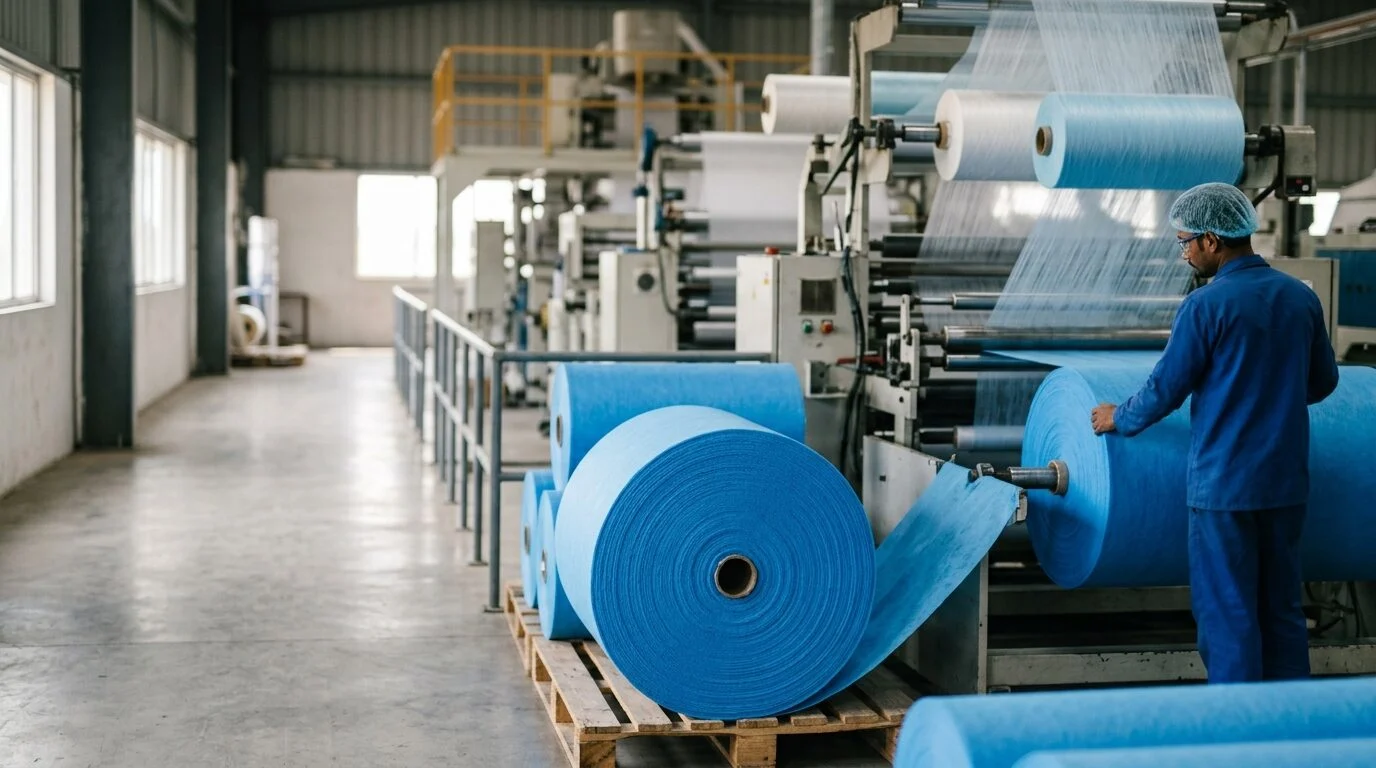
Battery Separator Nonwoven Fabric for EV Energy Storage — Manufacturer India
Battery Separator Nonwoven Fabric For Ev Energy Storage is a critical B2B raw material supplied by Favourite Fab — a manufacturer-direct nonwoven fabric source serving industrial OEMs, hygiene converters, and export buyers across 50+ countries from Agra, India.
What Is Battery Separator Nonwoven Fabric For Ev Energy Storage
Battery separator nonwoven fabric is a microporous wetlaid or meltblown sheet positioned between electrodes in lithium-ion, lead-acid, and supercapacitor cells. It prevents short circuits while allowing ionic conductivity. Demand has surged with India’s EV manufacturing push and energy-storage system roll-outs.
Battery Separator Nonwoven Fabric For Ev Energy Storage — Specifications and Options
| Material / Property | Specification | Detail |
|---|---|---|
| Polymer | PP / PET / PE | Electrolyte compatible |
| GSM | 18–40 g/m² | Cell-design dependent |
| Thickness | 16–40 μm | Tight tolerance ±2 μm |
| Porosity | 40–60% | Uniform pore distribution |
| Tensile strength MD | ≥120 N/15mm | Winding-stress tolerant |
| Shutdown temperature | 130–140°C (PP) | Safety cut-off |
| Width range | 300–1,200 mm | Slit to cell spec |
Why Source From Favourite Fab
- MOQ-friendly — suitable for small and large OEM manufacturers
- Export-ready — ships raw materials to 50+ countries from Agra, India
- ISO 9001 certified manufacturing facility
- 10+ years supplying nonwoven raw materials to industrial and hygiene OEMs
- Custom GSM, width, and treatment available on request
Pricing and MOQ
Favourite Fab offers competitive wholesale pricing structured for B2B procurement. Minimum order quantity is 500 kg per specification, with sample rolls of 10–20 kg available for machine trials. Volume pricing available for orders above 5,000 kg per month — send your specifications for a same-day FOB quote.
How to Order
- Send material specifications to sale@favouritehub.com — fabric type, GSM, width, monthly volume, treatments required
- Receive FOB or CIF quote and dispatched sample within 48 hours
- Confirm order — production starts and dispatch within 21–30 days
Frequently Asked Questions
Q: Which cell chemistries does the separator support?
A: Our nonwoven separator suits lithium-ion (LFP, NMC, NCA), valve-regulated lead-acid (VRLA), and supercapacitor cells. Electrolyte wetting validated for LiPF6 in EC/DMC carbonates.
Q: Is the separator EV-grade?
A: Yes. Wetlaid PET grades supplied to Indian EV cell manufacturers and energy-storage system integrators since 2024. Test certificates issued per IEC 62133 and GB/T 31485.
Q: Can you supply ceramic-coated separators?
A: We supply the base nonwoven substrate. Ceramic alumina/boehmite coating handled by partner converters in India. Coating-ready substrate with surface energy ≥40 mN/m is our standard.
Q: What are typical thickness tolerances?
A: Standard thickness tolerance is ±2 μm across roll width and length. For precision cell-stacking applications, ±1 μm tolerance available on request.
Q: Minimum order quantity?
A: MOQ is 500 kg per grade. Sample rolls of 5–10 kg available for cell-trial and electrolyte-wetting tests.
Q: Do you provide thermal shrinkage data?
A: Yes. Thermal shrinkage <5% at 150°C / 1 hour per IEC 61010 method. Full TDS with shutdown curve and meltdown temperature on request.
Contact Favourite Fab
Email: sale@favouritehub.com
WhatsApp: +91-8800775462
Send your nonwoven fabric specifications today — fabric type, GSM, width, treatments, monthly volume. Receive a same-day quote and 10–20 kg sample dispatch within 48 hours for machine trials.
Technical Specifications
| Parameter | Value |
|---|---|
| GSM Range | 30–200 GSM |
| Base Fiber | PP / PET nonwoven |
| Chemical Resistance | Electrolyte-resistant (H₂SO₄, KOH, LiPF₆) |
| Standard | IEC 60086 battery component grade |
| Application Grade | EV / energy-storage grade |
| Thickness | 0.15–1.2 mm (varies by GSM) |
| Width Options | 1.6 m – 3.2 m |
| Porosity | Controlled open-cell structure for ion transport |
B2B Applications & OEM Use-Cases
- EV Battery Pack Assemblers: Manufacturers of lithium-ion battery packs for two-wheelers, three-wheelers, and commercial EVs use our PP/PET nonwoven separators as thermal runaway barriers and electrode insulation layers between cells.
- Lead-Acid Battery OEMs: Industrial and automotive lead-acid battery manufacturers integrate our electrolyte-resistant nonwoven fabric as AGM (absorbent glass mat) carrier substrates and plate-wrapping media, improving cycle life and acid retention.
- Energy Storage System (ESS) Integrators: Grid-scale and commercial ESS integrators source our IEC 60086-compliant separator fabric for battery module assembly, requiring consistent porosity and dimensional stability across large-format cells.
Sourcing from Favourite Fab — MOQ, Lead Time & Customisation
- MOQ: 500 kg per specification
- Lead Time: 7–14 days domestic India / 21–30 days export
- Custom Options: GSM (30–200), width 1.6 m–3.2 m, PP or PET base, porosity tuning, thickness control
- Certification: ISO 9001 certified manufacturing facility, Agra, India
- Pricing: Competitive wholesale pricing — contact our B2B sales team for volume quotations
Frequently Asked Questions
Why is nonwoven fabric used as a battery separator instead of microporous film?
Nonwoven separators offer superior electrolyte retention, thermal stability, and puncture resistance compared to standard microporous films. In lead-acid AGM batteries, nonwoven fabric absorbs and retains the electrolyte within the mat. In high-power applications, nonwoven layers act as thermal and mechanical buffers. Favourite Fab’s electrolyte-resistant PP/PET nonwovens are specifically engineered for battery-grade consistency.
Is your battery separator nonwoven compatible with lithium-ion chemistries?
Our PP/PET nonwoven separator fabric is chemically stable against common lithium-ion electrolytes including LiPF₆-based solutions. It is used as a secondary insulation and wicking layer rather than a primary microporous separator in Li-ion cells. For AGM and NiMH battery construction, it serves as the primary separator. Please share your cell chemistry and application details for a tailored recommendation.
What GSM is recommended for EV battery pack insulation layers?
For inter-cell thermal management and vibration damping in EV battery packs, we typically recommend 80–120 GSM PP or PET nonwoven. For electrode-wrapping in AGM configurations, 30–60 GSM fine-fibre grades are preferred. Custom GSM within the 30–200 GSM range is available to match your stack thickness and compression targets.
Related B2B Resources

Gaurav Garg
I'm Gaurav Garg, CEO of Favourite Fab, a company on a mission to revolutionize the nonwoven industry with sustainable practices. We work hand-in-hand with manufacturers and suppliers who share our commitment to eco-friendly production. With a deep interest in textile innovation, I'm passionate about educating consumers about sustainable material options and their potential to transform the nonwoven landscape.


