

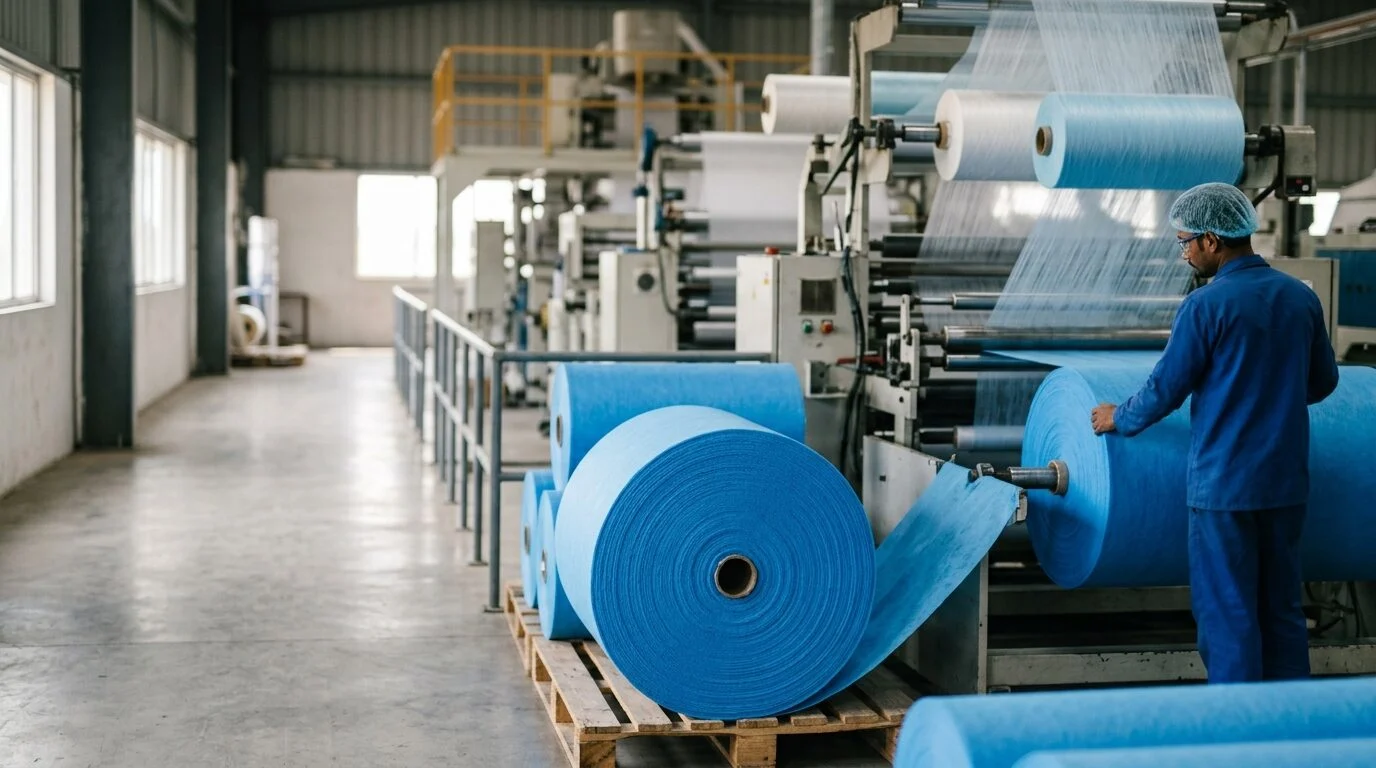
PP Spunbond Nonwoven Fabric — Polypropylene Manufacturer India
PP (polypropylene) spunbond nonwoven fabric is the most widely manufactured nonwoven globally — produced from continuous PP filaments thermally bonded into a uniform web. Lightweight (10–80 GSM), cost-effective, chemically resistant, and customisable with hydrophilic or hydrophobic surface treatment, PP spunbond serves nonwoven bags, hygiene products, agricultural covers, medical packaging, and filtration. Favourite Fab manufactures PP spunbond in Agra, India — supplying B2B buyers across India and 30+ export countries.
Technical Specifications
| Parameter | Specification |
|---|---|
| GSM | 10–80 GSM |
| Fibre | 100% polypropylene |
| Finish | Natural hydrophobic / hydrophilic treated |
| Tensile MD | 30–350 N/5cm |
| Width | 160–320 cm |
| Colour | White, black, custom masterbatch |
| MOQ | 500 kg |
Applications
Nonwoven shopping bags, crop covers, surgical gown outer layer, hygiene outer cover, filter support, furniture backing.
Source from Favourite Fab
Direct manufacturer Agra, India. Custom GSM/width. COA per batch. Sample 3–5 days. See: spunbond nonwoven fabric manufacturer India. Related: nonwoven fabric for hygiene products.
Frequently Asked Questions
What is PP spunbond nonwoven used for?
PP spunbond covers the widest application range of any nonwoven: bags (80 GSM), crop covers (17–50 GSM UV-stabilised), hygiene outer covers (18–22 GSM), medical gown layers (30–60 GSM SMS), filtration support (30–50 GSM), and furniture backing (80–120 GSM).
What is the difference between PP spunbond and SMS?
PP spunbond is a single spunbond layer — no barrier. SMS adds a meltblown middle layer between two spunbond layers, creating a fluid barrier. PP spunbond for bags and covers; SMS for medical gowns and masks.
Can PP spunbond be made hydrophilic?
Yes. PP is naturally hydrophobic. Hydrophilic finish (permanent or durable) applied during production. Hydrophilic PP spunbond achieves liquid strike-through <3 sec (EDANA 150.3) — used as hygiene topsheet.
B2B Applications & End-Uses
PP spunbond nonwoven fabric is the highest-volume nonwoven substrate in global commerce, and Favourite Fab’s position as a direct manufacturer in Agra — with widths from 1.6 m to 3.2 m and GSM coverage from 10 to 150 — places us at the centre of India’s nonwoven supply chain across eight distinct market verticals. The material’s natural hydrophobic character (contact angle 110°+), combined with its excellent strength-to-weight ratio, UV stabilisation capability, and cost efficiency versus woven textiles, makes PP spunbond the preferred substrate across a wide range of converting applications.
Each application sector has distinct specification requirements that drive material selection within the PP spunbond range:
- Reusable shopping bags and tote bag manufacturers — 60–80 GSM PP spunbond is the dominant substrate for non-woven carry bags in India’s post-plastic-ban market. Laminated and non-laminated grades differ in printability and moisture resistance. High MD tensile (EDANA ERT 20.2: ≥25 N/5cm at 40 GSM) is essential for handle-stitch integrity under load.
- Hygiene backsheet and leg cuff manufacturers — 15–25 GSM PP spunbond bonded with breathable PE film forms the standard backsheet construction in sanitary pads, baby diapers, and adult incontinence products. Natural hydrophobicity is a functional requirement for backsheet applications, where fluid barrier performance is critical.
- Medical outer gown and drape manufacturers — 30–60 GSM PP spunbond forms the outer layer of disposable surgical gowns and patient drapes, where bacterial barrier, breathability, and softness are balanced against single-use cost economics.
- Agricultural crop cover OEMs — UV-stabilised PP spunbond at 17–30 GSM is used as row cover and crop protection fabric in horticulture, providing frost protection, light diffusion, and pest exclusion while maintaining air and water permeability. UV stabiliser loading is tailored to the intended seasonal exposure duration (1-season vs 3-season grade).
- Geotextile and civil engineering product manufacturers — 80–150 GSM PP spunbond serves as separation geotextile in road sub-base construction, drainage filter media in retaining wall systems, and erosion control fabric on slopes and embankments.
- Furniture and mattress manufacturers — 40–80 GSM PP spunbond is used as dust cover backing on sofas, chairs, and mattress bases, providing a clean appearance and preventing dust accumulation within the furniture frame.
Certifications & Quality Assurance
As a direct PP spunbond manufacturer — not a distributor or trader — Favourite Fab controls the full quality chain from polymer extrusion through bonding, slitting, and dispatch. Our quality assurance system for PP spunbond covers:
- ISO 9001:2015 Certification: Our quality management system is third-party certified, providing documented process control, calibrated measurement, and corrective action infrastructure for all production and customer-facing processes.
- GSM Uniformity (EDANA ERT 40.3 / ISO 9073-1): Basis weight is verified at defined intervals across roll width. Within-roll CV% and lot-to-lot consistency data are available on request. Standard tolerance ±5% of nominal, with tighter tolerances achievable for qualified high-volume accounts.
- Tensile Strength (EDANA ERT 20.2): MD and CD tensile documented per production lot. Reference benchmarks: 40 GSM standard grade MD ≥25 N/5cm; 80 GSM geotextile grade MD ≥55 N/5cm. Application-specific tensile guarantees are written into supply agreements on request.
- UV Stabilisation Verification: Agricultural grade PP spunbond undergoes accelerated UV exposure testing (Xenon arc weatherometer, per ISO 4892-2) with tensile retention measured after defined exposure hours. Results confirm the grade’s rated outdoor service life.
- Width and Slit Tolerance: Master roll width is produced at ±3 mm. Slit rolls are controlled to ±2 mm. Roll end splices are marked for identification and removal before converting line feeding.
- COA with Shipment: Every shipment is accompanied by a Certificate of Analysis citing test method, result, specification limit, and lot traceability information. COA format is adaptable to customer-specific incoming inspection requirements.
More Questions Answered
What is the functional difference between PP spunbond and PP meltblown nonwoven for filtration applications?
PP spunbond and PP meltblown are both thermally bonded polypropylene nonwovens produced by continuous extrusion, but the fibre formation process differs fundamentally. Spunbond uses mechanically attenuated filaments (15–35 micron diameter) to produce a strong, dimensionally stable fabric optimised for structural applications — bags, medical outer layers, geotextile, hygiene backsheet. Meltblown uses high-velocity hot air to attenuate the extruded polymer into ultra-fine fibres (1–5 micron diameter), producing a fabric with much finer pore structure suited to filtration applications. For filtration media, meltblown provides the particle capture efficiency; for filter element structural integrity, spunbond is laminated to either face of the meltblown to create an SMS (spunbond-meltblown-spunbond) composite. Favourite Fab produces PP spunbond for the structural layers of SMS filter laminates. Contact our technical team with your SMS construction specification for a targeted substrate recommendation.
Can Favourite Fab supply PP spunbond in widths exceeding 2.4 metres for industrial geotextile applications?
Yes. Our production capability extends to 3.2 m width PP spunbond, covering the standard geotextile installation widths used in Indian road construction and drainage engineering projects. Wider rolls reduce field seam frequency in geotextile installation, which lowers the risk of seam failure under differential settlement and reduces installation labour cost. For geotextile applications, we recommend specifying roll width based on your typical installation panel width and slope geometry — our technical team can assist with yield optimisation calculations. Heavy geotextile grades (100–150 GSM) at wide widths are produced on dedicated lines to maintain the tensile and puncture resistance specifications required for civil engineering project compliance documentation. Mass per unit area conformance to BIS standards applicable to geotextile procurement tenders can be certified on COA.
B2B Applications & End-Uses
PP spunbond nonwoven fabric is the highest-volume nonwoven substrate in global commerce, and Favourite Fab’s position as a direct manufacturer in Agra — with widths from 1.6 m to 3.2 m and GSM coverage from 10 to 150 — places us at the centre of India’s nonwoven supply chain across eight distinct market verticals. The material’s natural hydrophobic character (contact angle 110°+), combined with its excellent strength-to-weight ratio, UV stabilisation capability, and cost efficiency versus woven textiles, makes PP spunbond the preferred substrate across a wide range of converting applications.
Each application sector has distinct specification requirements that drive material selection within the PP spunbond range:
- Reusable shopping bags and tote bag manufacturers — 60–80 GSM PP spunbond is the dominant substrate for non-woven carry bags in India’s post-plastic-ban market. Laminated and non-laminated grades differ in printability and moisture resistance. High MD tensile (EDANA ERT 20.2: ≥25 N/5cm at 40 GSM) is essential for handle-stitch integrity under load.
- Hygiene backsheet and leg cuff manufacturers — 15–25 GSM PP spunbond bonded with breathable PE film forms the standard backsheet construction in sanitary pads, baby diapers, and adult incontinence products. Natural hydrophobicity is a functional requirement for backsheet applications, where fluid barrier performance is critical.
- Medical outer gown and drape manufacturers — 30–60 GSM PP spunbond forms the outer layer of disposable surgical gowns and patient drapes, where bacterial barrier, breathability, and softness are balanced against single-use cost economics.
- Agricultural crop cover OEMs — UV-stabilised PP spunbond at 17–30 GSM is used as row cover and crop protection fabric in horticulture, providing frost protection, light diffusion, and pest exclusion while maintaining air and water permeability. UV stabiliser loading is tailored to the intended seasonal exposure duration (1-season vs 3-season grade).
- Geotextile and civil engineering product manufacturers — 80–150 GSM PP spunbond serves as separation geotextile in road sub-base construction, drainage filter media in retaining wall systems, and erosion control fabric on slopes and embankments.
- Furniture and mattress manufacturers — 40–80 GSM PP spunbond is used as dust cover backing on sofas, chairs, and mattress bases, providing a clean appearance and preventing dust accumulation within the furniture frame.
Certifications & Quality Assurance
As a direct PP spunbond manufacturer — not a distributor or trader — Favourite Fab controls the full quality chain from polymer extrusion through bonding, slitting, and dispatch. Our quality assurance system for PP spunbond covers:
- ISO 9001:2015 Certification: Our quality management system is third-party certified, providing documented process control, calibrated measurement, and corrective action infrastructure for all production and customer-facing processes.
- GSM Uniformity (EDANA ERT 40.3 / ISO 9073-1): Basis weight is verified at defined intervals across roll width. Within-roll CV% and lot-to-lot consistency data are available on request. Standard tolerance ±5% of nominal, with tighter tolerances achievable for qualified high-volume accounts.
- Tensile Strength (EDANA ERT 20.2): MD and CD tensile documented per production lot. Reference benchmarks: 40 GSM standard grade MD ≥25 N/5cm; 80 GSM geotextile grade MD ≥55 N/5cm. Application-specific tensile guarantees are written into supply agreements on request.
- UV Stabilisation Verification: Agricultural grade PP spunbond undergoes accelerated UV exposure testing (Xenon arc weatherometer, per ISO 4892-2) with tensile retention measured after defined exposure hours. Results confirm the grade’s rated outdoor service life.
- Width and Slit Tolerance: Master roll width is produced at ±3 mm. Slit rolls are controlled to ±2 mm. Roll end splices are marked for identification and removal before converting line feeding.
- COA with Shipment: Every shipment is accompanied by a Certificate of Analysis citing test method, result, specification limit, and lot traceability information. COA format is adaptable to customer-specific incoming inspection requirements.
More Questions Answered
What is the functional difference between PP spunbond and PP meltblown nonwoven for filtration applications?
PP spunbond and PP meltblown are both thermally bonded polypropylene nonwovens produced by continuous extrusion, but the fibre formation process differs fundamentally. Spunbond uses mechanically attenuated filaments (15–35 micron diameter) to produce a strong, dimensionally stable fabric optimised for structural applications — bags, medical outer layers, geotextile, hygiene backsheet. Meltblown uses high-velocity hot air to attenuate the extruded polymer into ultra-fine fibres (1–5 micron diameter), producing a fabric with much finer pore structure suited to filtration applications. For filtration media, meltblown provides the particle capture efficiency; for filter element structural integrity, spunbond is laminated to either face of the meltblown to create an SMS (spunbond-meltblown-spunbond) composite. Favourite Fab produces PP spunbond for the structural layers of SMS filter laminates. Contact our technical team with your SMS construction specification for a targeted substrate recommendation.
Can Favourite Fab supply PP spunbond in widths exceeding 2.4 metres for industrial geotextile applications?
Yes. Our production capability extends to 3.2 m width PP spunbond, covering the standard geotextile installation widths used in Indian road construction and drainage engineering projects. Wider rolls reduce field seam frequency in geotextile installation, which lowers the risk of seam failure under differential settlement and reduces installation labour cost. For geotextile applications, we recommend specifying roll width based on your typical installation panel width and slope geometry — our technical team can assist with yield optimisation calculations. Heavy geotextile grades (100–150 GSM) at wide widths are produced on dedicated lines to maintain the tensile and puncture resistance specifications required for civil engineering project compliance documentation. Mass per unit area conformance to BIS standards applicable to geotextile procurement tenders can be certified on COA.
Related B2B Resources

Gaurav Garg
I'm Gaurav Garg, CEO of Favourite Fab, a company on a mission to revolutionize the nonwoven industry with sustainable practices. We work hand-in-hand with manufacturers and suppliers who share our commitment to eco-friendly production. With a deep interest in textile innovation, I'm passionate about educating consumers about sustainable material options and their potential to transform the nonwoven landscape.


