

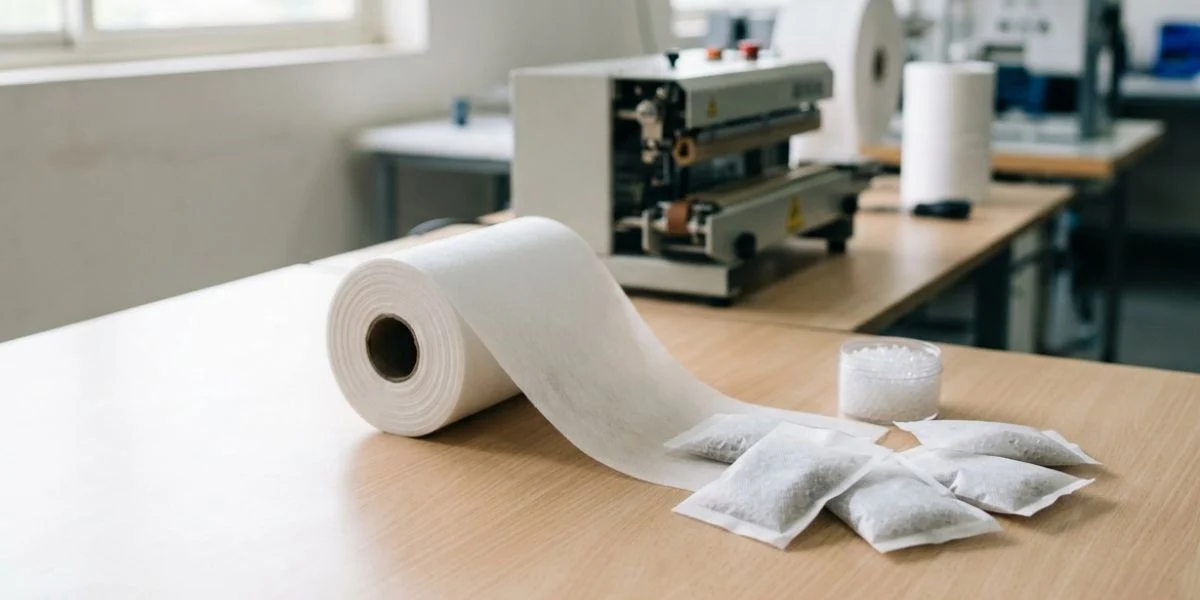
Bico Spunbond Nonwoven for Desiccant Pouches — Soft Seal, Heat-Sealable Grade India
Bicomponent PE/PP spunbond is gaining adoption in desiccant sachet manufacturing as an upgrade to standard PP spunbond. The PE sheath seals at lower temperature (120–135°C vs 150–165°C for PP), enabling faster sachet sealing line speeds and reduced heat exposure to temperature-sensitive desiccant materials (especially silica gel indicator grades). The softer hand feel also produces premium-appearing sachets for pharmaceutical and consumer packaging.
Browse our full range: View all nonwoven fabric products — spunlace, spunbond, SMS, bico — with GSM, width and certification options. B2B MOQ from 500 kg.
Technical Specifications
| Parameter | Specification |
|---|---|
| GSM | 30–60 GSM |
| Fibre | PE/PP bicomponent sheath-core |
| Heat seal temp | 120–135°C (lower than PP spunbond) |
| MVTR | 500–2,000 g/m²/day |
| Lint | <0.05 mg/cm² |
| Width | 10–260 cm |
| MOQ | 500 kg |
Applications
Silica gel sachets (especially indicating grade), pharmaceutical desiccant canisters, premium consumer product moisture absorbers, molecular sieve pouches.
Source from Favourite Fab
Direct manufacturer Agra, India. Custom GSM and width. COA per batch. Sample 3–5 days. See: desiccant nonwoven fabric. Related: breathable nonwoven fabric for sachets.
Frequently Asked Questions
Why use bico spunbond instead of PP spunbond for desiccant sachets?
Lower sealing temperature (120°C vs 150°C) enables 20–30% faster line speeds on sachet machines. Lower heat also protects indicating silica gel from premature colour change during manufacturing. Softer hand feel creates premium sachet appearance for pharmaceutical and consumer packaging.
Is bico spunbond breathable enough for desiccant performance?
Yes. PE/PP bico at 30–50 GSM achieves MVTR 500–2,000 g/m²/day — equivalent to PP spunbond at the same GSM. Desiccant adsorption rate is not limited by the nonwoven — it is limited by the desiccant material itself.
What is the heat seal strength of bico desiccant pouch nonwoven?
PE/PP bico achieves heat seal strength 12–18 N/25mm at 120–130°C sealing temperature — above the 10 N/25mm minimum for sachet integrity. Seal strength matches or exceeds PP spunbond despite lower sealing temperature.
B2B Applications & End-Uses
Bicomponent (bico) spunbond nonwoven in the PE/PP configuration is the preferred substrate for industrial desiccant sachet and pouch manufacturing due to its combination of controlled moisture vapour transmission rate (MVTR) and reliable heat-seal performance on automated packaging lines. Silica gel sachet producers use bico spunbond in the 40u201360 GSM range as the pouch wall material, relying on its MVTR of over 3,000 g/mu00b2/day (measured per ASTM E96 Method B) to allow rapid moisture migration from the packaged environment into the desiccant core while maintaining physical containment of granules. Activated carbon pouch manufacturers specify bico spunbond for odour-control inserts used in shoe packaging, electronics shipping boxes, and food packaging applications where carbon dust containment is critical. Molecular sieve bag producers in the pharmaceutical and petrochemical desiccation segment use heavier 70u201380 GSM bico grades, requiring higher tensile strength at seal points to withstand automated fill-and-seal line speeds on Bossar, IMA, and Rovema sachet machines.
The heat-seal activation temperature range of 120u2013135u00b0C for PE/PP bico spunbond aligns directly with the jaw temperature settings of standard continuous-motion sachet machines, enabling line speeds of 80u2013120 sachets per minute without film deformation or seal failure. Heat-seal strength consistently exceeding 300 g/25 mm (peel test) ensures the sachet wall integrity is maintained during downstream handling, shipping, and end-use. Standard PP spunbond, by comparison, requires higher sealing temperatures (150u2013165u00b0C) and produces more variable seal strength, making bico the technically superior choice for high-speed desiccant packaging lines.
Certifications & Quality Assurance
Bico spunbond for desiccant pouch applications is tested and certified against the critical parameters that sachet machine OEMs and desiccant blenders specify at the procurement stage. Each production lot is tested for MVTR (ASTM E96), heat-seal strength at 120u00b0C, 127u00b0C, and 135u00b0C (peel test per ASTM F88), GSM uniformity (CV% u22643%), and tensile strength MD/CD. Test reports are issued per lot and available for customer QA review. OEKO-TEX Standard 100 certification covers the fabric for use in food-adjacent packaging applications where incidental food contact is a consideration. For pharmaceutical desiccant pouch applications, FDA 21 CFR compliance documentation is available on request. Internal roll-to-roll GSM uniformity is verified every 200 metres of production using inline GSM measurement to ensure consistent seal performance across the full roll length.
More Questions Answered
What GSM of bico spunbond is recommended for 1g and 2g silica gel sachets?
For 1g silica gel sachets running on standard vertical form-fill-seal sachet machines, 40u201350 GSM PE/PP bico spunbond provides the optimal balance of MVTR, machinability, and seal strength. For 2g sachets u2014 which carry a higher fill weight and are subject to greater mechanical stress during sealing and handling u2014 50u201360 GSM is the recommended range. Heavier GSM reduces MVTR marginally but increases tear resistance at the seal boundary. Favourite Fab can supply sample rolls in 40, 50, and 60 GSM for seal-and-run trials before bulk order placement.
Does bico spunbond generate fibre shed or particle contamination during sachet filling?
PE/PP bico spunbond is a thermally bonded continuous-filament fabric with no free fibres or loose particulate at the surface, making it inherently low-shedding compared to wet-laid nonwovens or needle-punch substrates. Lint and particle shed testing per our internal protocol (adapted from EDANA ERT 50.5) confirms particle counts well within limits acceptable for electronics and pharmaceutical desiccant applications. The bonded filament structure also prevents granule bleed-through from standard silica gel and activated carbon particle sizes used in industrial sachets.
Related: SMS non woven fabric for desiccant bags and non woven rolls for automatic desiccant pouch packing machine.

Gaurav Garg
I'm Gaurav Garg, CEO of Favourite Fab, a company on a mission to revolutionize the nonwoven industry with sustainable practices. We work hand-in-hand with manufacturers and suppliers who share our commitment to eco-friendly production. With a deep interest in textile innovation, I'm passionate about educating consumers about sustainable material options and their potential to transform the nonwoven landscape.


