

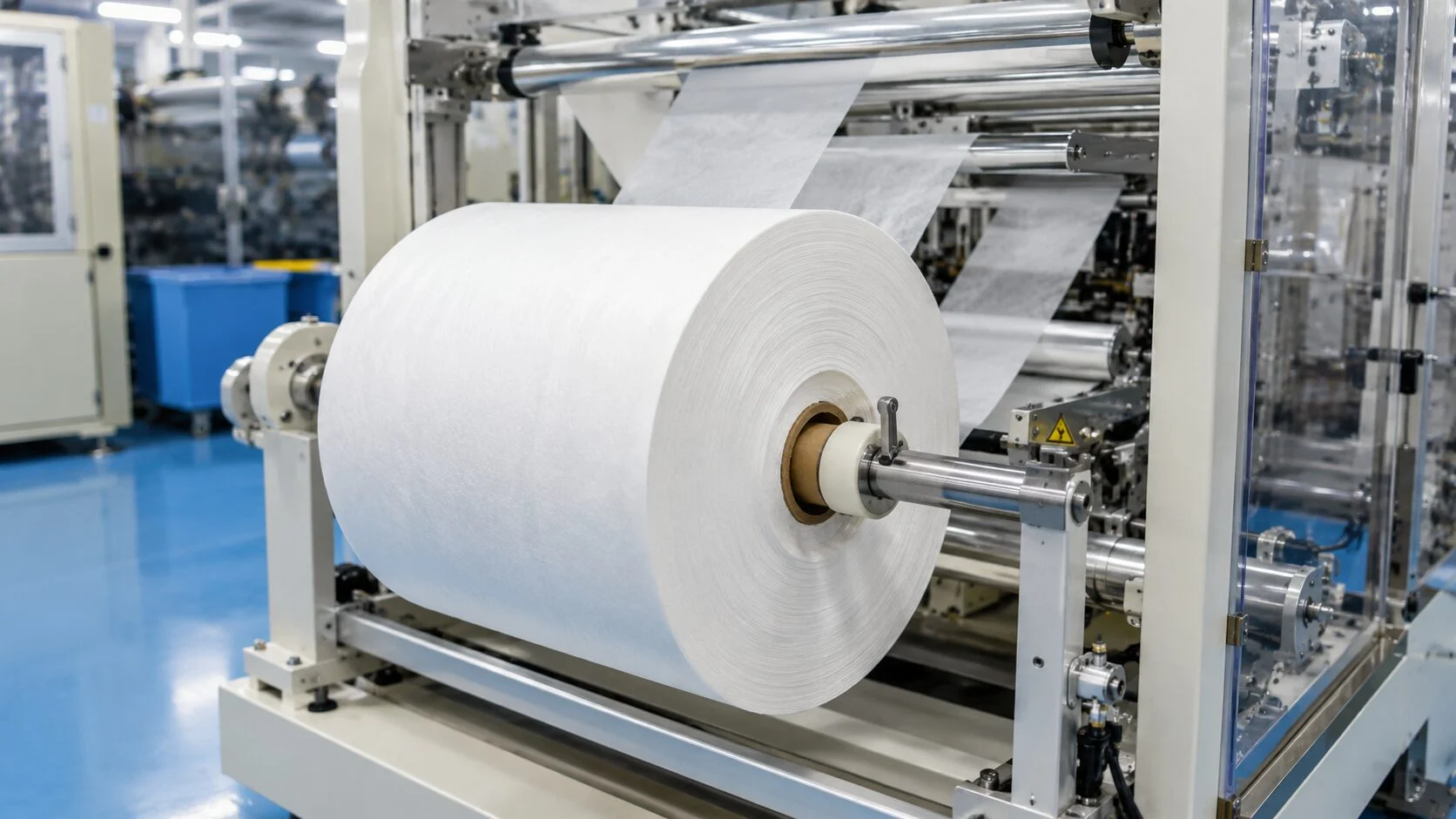
Non Woven Rolls for Automatic Desiccant Pouch Packing Machine — India
Non woven rolls for automatic desiccant pouch packing machine from Favourite Fab: 3-inch (76 mm) core, 25–50 GSM spunbond PP, slit to your exact machine width (100–2,400 mm), bar seal and ultrasonic compatible, running up to 150 m/min without web breaks. B2B supply from Agra, India. Request a trade sample roll.
What Non Woven Rolls Are Used in Automatic Desiccant Pouch Machines?
Automatic desiccant pouch filling and sealing machines — vertical form-fill-seal (VFFS) or horizontal roll-to-roll units — require a fabric that unwinds under tension, forms a sachet, accepts desiccant fill, and seals cleanly at high speed. The correct non woven rolls for automatic pouch packing machine applications are spunbond polypropylene (PP) nonwoven, selected for three reasons:
- Thermal bondability: PP melts cleanly under a bar seal jaw (130–160 °C) and fuses under ultrasonic energy (20–35 kHz), forming a peel-resistant seam without adhesive.
- Controlled MVTR: The microporous structure passes moisture to the desiccant fill while preventing powder bleed — critical for silica gel, activated clay, and molecular sieve sachets.
- Machine-grade tensile strength: Fabric withstands unwind roller pull and forming shoulder load without elongation or breaks, even at 150 m/min.
Reel Specifications for Automatic Machines
Machine compatibility begins with reel geometry. The table below lists standard parameters; custom configurations on request.
| Parameter | Specification | Notes |
|---|---|---|
| Core diameter | 3 inch (76 mm) standard | 6-inch (152 mm) on request |
| Roll OD | Up to 700 mm | Smaller OD for restricted mandrel space |
| Roll weight | 100–300 kg per roll | Heavier rolls reduce splice frequency |
| Available widths | 100 mm – 2,400 mm | Slit-to-order; ±0.5 mm tolerance |
| GSM range | 25, 30, 35, 40, 50 GSM | Custom GSM for large MOQ |
| Running speed | Up to 150 m/min | Validated on VFFS and horizontal machines |
| Bar seal temperature | 130–160 °C | Dwell time 0.3–0.8 s typical |
| Ultrasonic sealing | 20–35 kHz | Compatible with Branson, Herrmann, Rinco heads |
| Impulse sealing | Compatible | Nickel-chrome wire element machines |
| Splicing | Butt splice tape compatible | Flying splice prep available |
| Packaging | PE wrap + wooden pallet | Moisture-protected for sea freight |
| Lead time | 10–18 working days ex-works Agra | FOB/CIF on request |
GSM Selection Guide by Desiccant Type
GSM determines both tensile performance and moisture vapour transmission rate (MVTR). Use the table below to match fabric grade to your desiccant type and fill weight.
| GSM | Best for | Tensile MD (N/5cm) | MVTR (g/m²/24h) |
|---|---|---|---|
| 25 GSM | Silica gel mini sachets, 1–5 g fill | ≥18 | 1,500–2,000 |
| 30 GSM | Standard silica gel sachets, 5–50 g fill | ≥22 | 1,200–1,800 |
| 40 GSM | Activated clay, molecular sieve, 20–100 g fill | ≥28 | 800–1,400 |
| 50 GSM | Container desiccant, heavy fill >100 g | ≥35 | 600–1,000 |
30 GSM non woven fabric for silica gel sachets in the 5–50 g range is our most ordered grade: it runs at 130–145 °C bar-seal temperature and delivers MVTR well above the threshold silica gel needs to remain active. For abrasive fills such as molecular sieve, the 40 GSM breathable non woven for moisture absorber use is the reliable choice — higher tensile strength prevents micro-tears at the forming shoulder.
Sealing Compatibility — Bar Seal vs Ultrasonic
Bar seal (130–160 °C, 0.3–0.8 s dwell): Favourite Fab’s spunbond PP bonds cleanly in this window using virgin-grade PP resin (MFI 20–35 g/10 min). No coatings or laminate layers that could foul the jaw or delaminate at the seal line.
Ultrasonic (20–35 kHz): Frictional heat through the fabric stack — ideal where bar-seal dwell time limits line speed. Qualified on Branson 900 Series and Herrmann VOGA heads at 30–40 GSM. Impulse (nickel-chrome wire) is compatible with all GSM grades; for 25–30 GSM calibrate impulse time to avoid hole formation at the seal.
High Tensile Strength: Why It Matters at Machine Speed
At 80–150 m/min, unwind tension can peak at 15–25 N per 100 mm of width during dancer oscillation. A fabric below the tensile thresholds in the GSM table will elongate at these peaks, causing registration drift, seal misalignment, and web breaks requiring manual re-threading.
Favourite Fab achieves high tensile strength desiccant pouch fabric through controlled fibre draw ratio, calendar bonding pressure (18–22% bond point coverage — maximising strength without reducing MVTR), and a roll winding tension taper that prevents telescoping in transit and ensures even unwind tension on the machine.
Why Source From Favourite Fab
- Desiccant-specialist production: We manufacture for desiccant, hygiene, and technical nonwoven applications — not a commodity converter offering desiccant fabric as a side product.
- Slit-to-order: Any width 100–2,400 mm, ±0.5 mm edge tolerance, carbide-blade slitting. Your machine width, supplied directly.
- Consistent GSM lot-to-lot: ±3% tolerance across rolls in the same order. Your machine dwell-time settings stay stable batch to batch.
- Documentation: TDS, COA, MSDS, and GSM test report (ASTM D3776) with every commercial order. Available in advance for procurement qualification.
How to Order
Share the following with our team to receive a quotation: machine make/model or sealing method, required fabric width in mm, GSM or desiccant type and fill weight, monthly volume in kg, and delivery port or Incoterm preference. Minimum order: 500 kg per width/GSM combination. Sample rolls (1–5 kg) available for qualified B2B buyers with no MOQ.
Request a Sample or Quotation
Our technical team responds within 1 business day.
Frequently Asked Questions
What core diameter should I specify for my desiccant pouch machine?
3-inch (76 mm) ID is the standard for automatic desiccant pouch machines and our default supply. If your mandrel requires 6-inch (152 mm), specify this at order time — we wind on 6-inch cores for large-roll orders (≥200 kg) on request.
Can you slit rolls to custom widths for my machine?
Yes. We slit to any width 100–2,400 mm with ±0.5 mm edge tolerance using carbide blades. Specify your machine web width and we supply slit-to-size rolls — no on-site slitting required.
What is the recommended GSM for 30 g silica gel sachets on an automatic machine?
30 GSM spunbond PP: MD tensile ≥22 N/5 cm, MVTR 1,200–1,800 g/m²/24h. Runs cleanly at 130–145 °C bar-seal temperature at 80–120 m/min. For fill weights above 50 g, use 40 GSM.
Does the fabric cause frequent breaks at high machine speeds?
Not when the correct grade is specified. 30 GSM at ≥22 N/5 cm MD runs to 120 m/min; 40 GSM at ≥28 N/5 cm handles 150 m/min. Roll winding tension taper eliminates telescoping and jerky unwind — a common cause of web breaks. Share your machine speed and current GSM and we will recommend the correct grade.
Can you supply rolls with butt splice marks for continuous run?
Yes. We apply butt splice tape at roll joins and flag each splice with a colour-coded tag so your machine splice detector can trigger an automatic slowdown. Flying splice preparation (pre-taped tail) is available for automatic splicer machines — specify at order time.
Minimum order quantity for machine-ready rolls?
500 kg per width and GSM combination for commercial orders (typically 2–5 rolls). Sample rolls of 1–5 kg available at no MOQ for verified B2B buyers — contact us with your company name and machine details.
Related Resources
Full range: desiccant nonwoven fabric manufacturer India. Related: heat sealable nonwoven fabric and ultrasonic sealing nonwoven bags raw material.

Gaurav Garg
I'm Gaurav Garg, CEO of Favourite Fab, a company on a mission to revolutionize the nonwoven industry with sustainable practices. We work hand-in-hand with manufacturers and suppliers who share our commitment to eco-friendly production. With a deep interest in textile innovation, I'm passionate about educating consumers about sustainable material options and their potential to transform the nonwoven landscape.


