

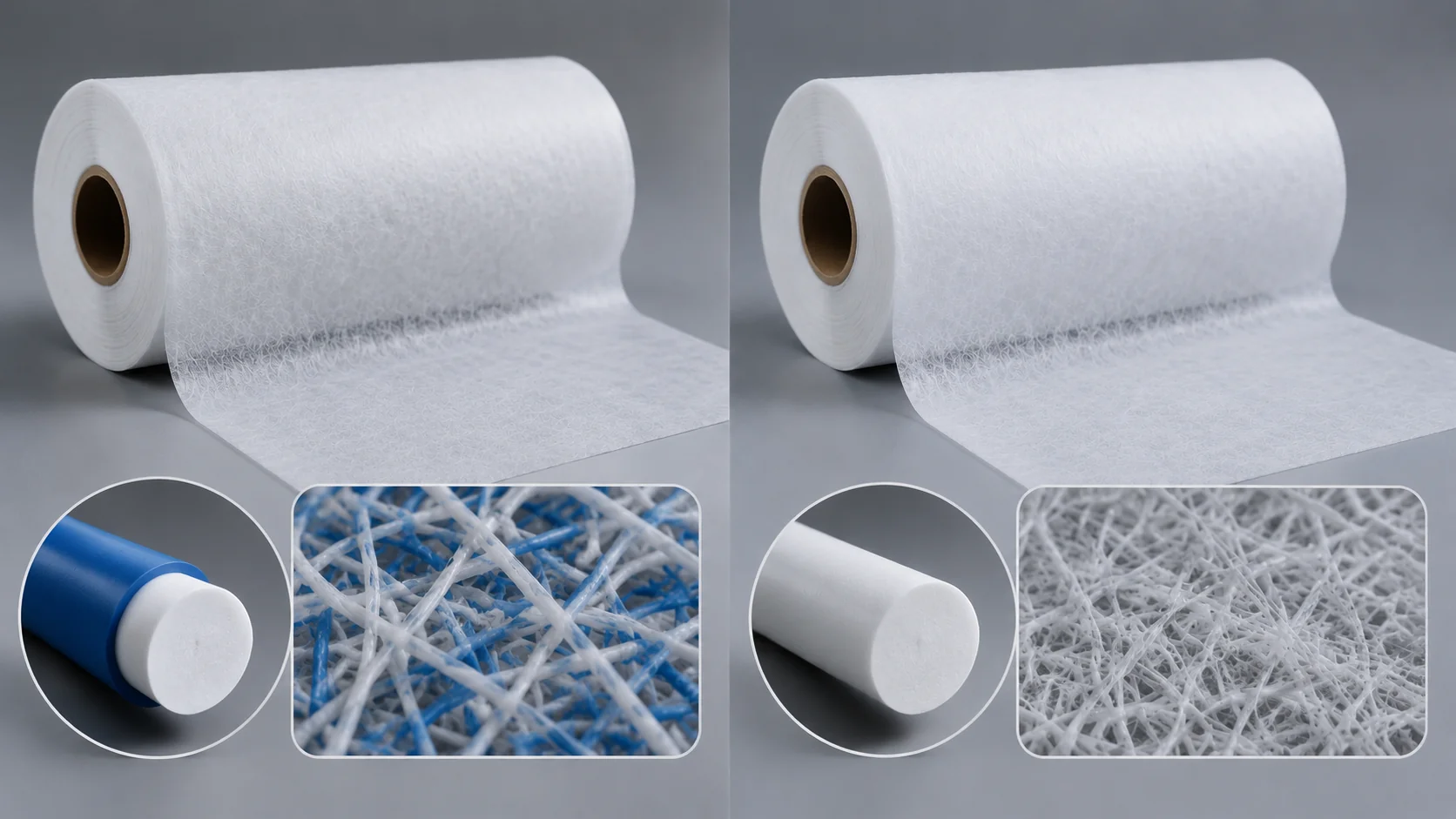
Bicomponent vs Monocomponent Nonwoven Fabric: Performance, Cost and Selection Guide
Manufacturers choosing between bicomponent vs monocomponent nonwoven fabric performance cost must weigh softness, bond strength, thermal range and total raw material cost. Favourite Fab supplies both grades from its ISO-certified facility in Agra, India — giving hygiene, medical and industrial OEMs a single trusted source for both technologies.
This guide breaks down every key difference so procurement teams, R&D engineers and product managers can make the right selection for their application. Whether you manufacture sanitary pads, diapers, surgical gowns or industrial filters, the correct fibre structure determines product performance and cost-per-unit.
Understanding the Difference: Bicomponent vs Monocomponent Nonwoven Fabric
A monocomponent fibre is extruded from a single polymer — typically polypropylene (PP) or polyester (PET). The entire filament has identical chemistry and melting behaviour throughout.
A bicomponent fibre contains two distinct polymers arranged in a defined cross-sectional geometry — sheath/core, side-by-side or islands-in-the-sea. The outer sheath melts at a lower temperature than the inner core, creating a thermal bond while preserving fibre structural integrity. Common combinations are PE/PP and PE/PET.
This structural difference drives measurable differences in every downstream performance parameter.
Detailed Specification Comparison
| Parameter | Bicomponent (PE/PP or PE/PET) | Monocomponent (PP or PET) |
|---|---|---|
| Fibre Structure | Two-polymer sheath/core or side-by-side | Single polymer throughout |
| Bonding Mechanism | Thermal — sheath melts, core preserves strength | Thermal or chemical bonding throughout |
| Surface Softness (Handle) | Very soft — PE sheath gives silky surface | Moderate — PP feel varies by draw ratio |
| Tensile Strength (MD) | Moderate — 18–28 N/5cm typical | High — 25–40 N/5cm typical |
| Bulk / Loft | High — bicomponent creates 3D crimp structure | Low to moderate — flatter web structure |
| Thermal Bonding Window | Wide — sheath melts 10–30°C below core | Narrow — single melt point requires precise control |
| Typical GSM Range | 10–80 GSM (hygiene, medical, filtration) | 10–150 GSM (wider range) |
| Raw Material Cost Index | Higher — two polymers, complex extrusion | Lower — single resin, simpler process |
| Typical End Uses | Topsheet, acquisition layer, surgical drape | Coverstock, geotextile, filter media, bags |
Which Grade to Choose and When
Choose bicomponent nonwoven fabric when your product requires:
- Direct skin contact — topsheets, baby wipe substrates, surgical drapes
- High loft and 3D structure — absorbent core acquisition layers
- Gentle thermal bonding where process temperature control is limited
- Premium product differentiation where softness is a selling point
Choose monocomponent nonwoven fabric when your product requires:
- Higher tensile strength at lower cost — industrial filtration, geotextiles
- Wider GSM range without premium fibre cost
- Applications where softness is not a primary requirement — bags, wrapping
- Cost-sensitive high-volume production runs
Many hygiene manufacturers use both: monocomponent for structural backsheet layers and bicomponent for the skin-facing topsheet. Favourite Fab can supply both grades with matched GSM and consistent lot-to-lot quality.
For detailed guidance on bicomponent fibre grades, see our bicomponent nonwoven fabric manufacturer India product page. You can also compare material options in our guide on rPET vs virgin PET nonwoven fabric. For technology background, visit our bicomponent fibre technology overview.
Spunbond applications benefit from reviewing our full PE/PP bicomponent spunbond nonwoven fabric range.
Why Source From Favourite Fab
- MOQ-friendly — suitable for small and large manufacturers across both bicomponent and monocomponent grades
- Export-ready — ships to 50+ countries with commercial invoice and COA documentation
- ISO certified manufacturing facility in Agra, India
- 10+ years supplying hygiene and medical industry OEMs
- Custom specifications available on request — GSM, width, roll length, fibre denier
- Both bicomponent and monocomponent stocked for fast delivery
Pricing and MOQ
Favourite Fab offers competitive wholesale pricing on bicomponent and monocomponent nonwoven fabric. Pricing varies by GSM, width, fibre type (PE/PP vs PE/PET), and order volume. We do not publish list prices — all quotes are based on your exact specification.
Minimum order quantities are flexible. Small-batch sampling is available for R&D and product development. Contact our team for volume pricing on regular production orders.
How to Order
- Send your material requirements to sale@favouritehub.com — include GSM, width, fibre type and intended end use
- Receive a quote and sample within 48 hours
- Confirm order and production begins — typical lead time 7–14 days ex-factory
Frequently Asked Questions
Q: What is the main advantage of bicomponent nonwoven over monocomponent?
A: Bicomponent nonwoven offers superior softness due to the low-melting PE sheath, higher loft, and a wider thermal bonding window. These properties make it the preferred choice for skin-contact applications such as sanitary pad topsheets, diaper coverstock and surgical drapes.
Q: Is bicomponent nonwoven more expensive than monocomponent?
A: Yes, bicomponent fabric carries a cost premium because it requires two distinct polymer resins and more complex extrusion equipment. However, the performance benefits in hygiene applications typically justify the cost difference versus a failed product or customer complaint.
Q: Can monocomponent PP nonwoven replace bicomponent in a topsheet?
A: In most cases, no. Monocomponent PP lacks the soft PE surface that bicomponent provides. For non-skin-contact applications like outer covers or industrial liners, monocomponent is a cost-effective alternative. Favourite Fab can send comparison samples so your QC team can validate before switching.
Q: What GSM range does Favourite Fab supply for bicomponent nonwoven?
A: We supply bicomponent spunbond nonwoven from 10 GSM to 80 GSM. Custom GSM within this range is available on request with a minimum run quantity. Contact sale@favouritehub.com with your target specification.
Q: Does Favourite Fab supply both PE/PP and PE/PET bicomponent grades?
A: Yes. We supply both PE/PP (softer, lower cost) and PE/PET (higher strength, better dimensional stability) bicomponent grades. The right choice depends on your bonding line temperature and end-use performance requirements. Our technical team can help select the correct grade for your process.
Q: What certifications does Favourite Fab hold for nonwoven fabric?
A: Our manufacturing facility holds ISO certification and we supply COA documentation with every shipment. We can provide test reports for GSM, tensile strength, elongation, and surface resistance on request.
Contact Favourite Fab
Email: sale@favouritehub.com
WhatsApp: +91-8800775462
Send your material specifications today for a same-day quote on bicomponent or monocomponent nonwoven fabric.

Gaurav Garg
I'm Gaurav Garg, CEO of Favourite Fab, a company on a mission to revolutionize the nonwoven industry with sustainable practices. We work hand-in-hand with manufacturers and suppliers who share our commitment to eco-friendly production. With a deep interest in textile innovation, I'm passionate about educating consumers about sustainable material options and their potential to transform the nonwoven landscape.


