

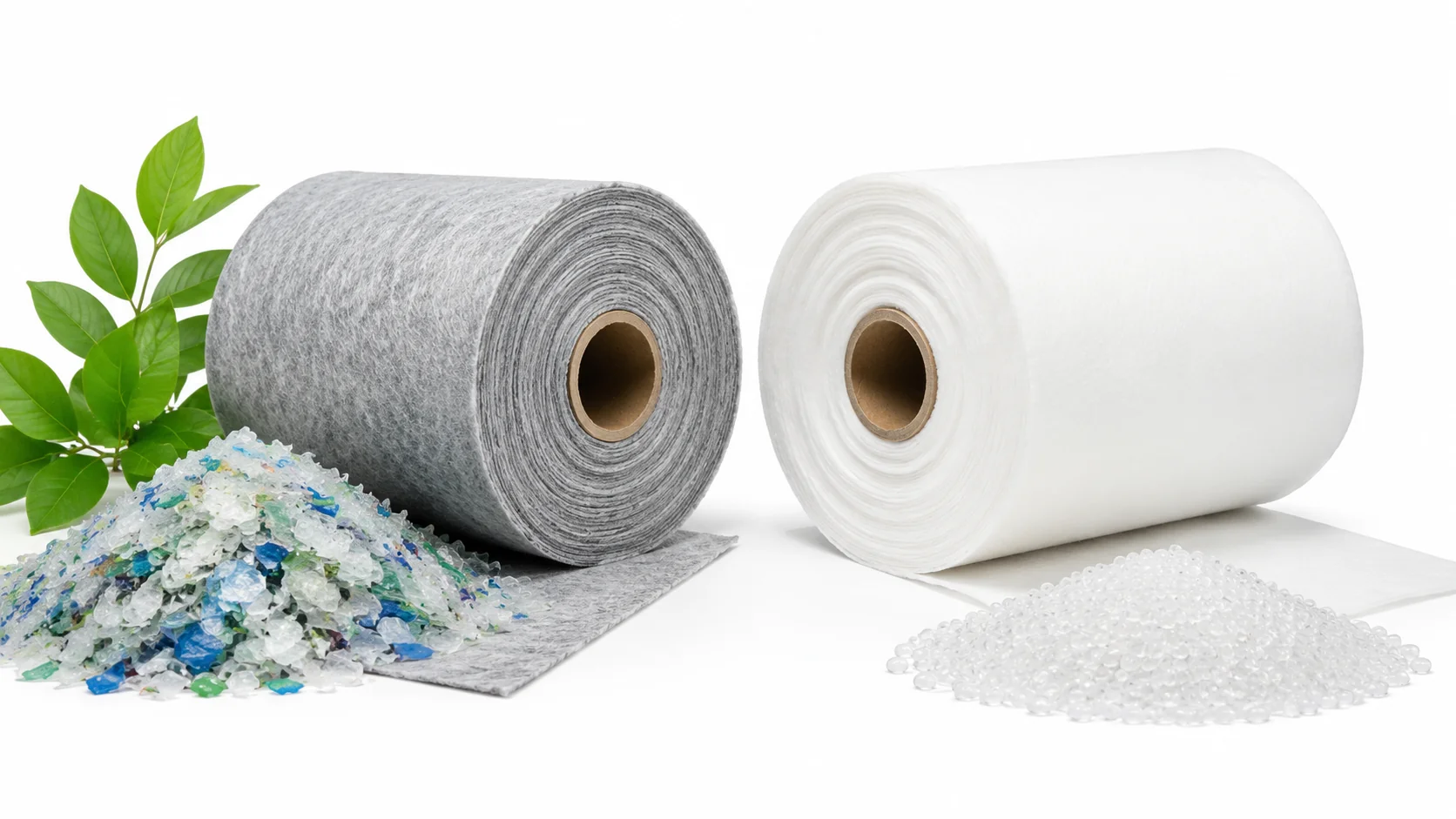
rPET vs Virgin PET Nonwoven Fabric: Sustainability, Cost and Performance Compared
Choosing between rPET vs virgin PET nonwoven fabric sustainability cost performance is a critical procurement decision for manufacturers facing ESG pressure, cost targets and quality standards simultaneously. Favourite Fab supplies both recycled PET and virgin PET spunbond nonwoven from its ISO-certified facility in Agra, India — giving you a single auditable source for either grade.
This guide covers CO2 footprint, tensile properties, whiteness, certification requirements and cost structures so your team can make a data-driven material selection. Whether you manufacture hygiene products, medical textiles, geotextiles or packaging, the rPET vs virgin PET decision affects your product’s sustainability credentials and total cost of ownership.
Understanding the Difference: rPET vs Virgin PET Nonwoven Fabric
Virgin PET nonwoven is produced from freshly polymerised polyethylene terephthalate resin. Every polymer chain is new, resulting in consistent molecular weight distribution, high whiteness and predictable processing behaviour.
Recycled PET (rPET) nonwoven is produced from post-consumer PET — primarily recycled plastic bottles — that has been cleaned, melted, re-extruded and converted into fibre or filament. The raw material cost is lower and the carbon footprint is significantly reduced, but the processing requires careful quality control to maintain consistent fibre properties.
Detailed Specification Comparison
| Parameter | rPET Nonwoven (Recycled) | Virgin PET Nonwoven |
|---|---|---|
| Raw Material Source | Post-consumer recycled PET bottles | Freshly polymerised PET resin |
| CO2 Footprint Reduction | ~50–65% lower than virgin PET | Baseline — no recycled content benefit |
| Tensile Strength (MD, 20 GSM) | 15–22 N/5cm | 20–30 N/5cm |
| Whiteness / Brightness | Slightly off-white — optical brighteners may be added | Bright white — high CIE whiteness index |
| Fibre Consistency | Good — improves with quality input feedstock | Excellent — controlled monomer source |
| Certification Options | GRS (Global Recycled Standard), OEKO-TEX | OEKO-TEX, ISO, REACH compliance |
| ESG / Sustainability Reporting | Supports Scope 3 reduction claims | No recycled content benefit |
| Raw Material Cost | Lower — bottle-grade PET feedstock | Higher — virgin resin market pricing |
| Typical End Uses | Eco hygiene, sustainable packaging, geotextile, filtration | Medical, food-contact, high-purity industrial |
Which Grade to Choose and When
Choose rPET nonwoven when:
- Your brand or retailer requires recycled content percentage in materials
- You are reporting Scope 3 emissions and need documented CO2 reduction
- Your application is non-food-contact and whiteness is not critical — geotextile, eco packaging, outer wraps
- Price reduction is a priority and slight tensile variation is acceptable
- You need GRS or similar recycled content certification for product labelling
Choose virgin PET nonwoven when:
- Your application requires maximum whiteness — medical textiles, visible hygiene components
- Regulatory requirements demand virgin-only materials — food contact, certain medical device classifications
- Your quality system requires the tightest fibre consistency specification
- You are producing for markets with strict chemical compliance requirements
See our full spunbond range at spunbond non woven fabric. For comparison with bicomponent grades, read our bicomponent vs monocomponent nonwoven guide. For more detail on our recycled PET range, visit recycled PET rPET spunbond nonwoven.
Surgical gown manufacturers can review our spunbond nonwoven for surgical gowns product page for application-specific grades.
Why Source From Favourite Fab
- MOQ-friendly — suitable for small and large manufacturers across both rPET and virgin PET grades
- Export-ready — ships to 50+ countries with full documentation including GRS chain-of-custody where required
- ISO certified manufacturing facility in Agra, India
- 10+ years supplying hygiene and medical industry OEMs
- Custom specifications available on request — GSM, width, recycled content percentage
Pricing and MOQ
Favourite Fab offers competitive wholesale pricing on both rPET and virgin PET nonwoven fabric. rPET grades typically carry a lower raw material cost, though specific pricing depends on GSM, width, recycled content percentage and order volume.
We offer sample rolls for qualification testing before production commitment. Contact our team for a volume pricing schedule aligned to your forecast.
How to Order
- Send your material requirements to sale@favouritehub.com — specify rPET or virgin PET, GSM, width and end use
- Receive a quote and sample within 48 hours
- Confirm order and production begins — standard lead time 7–14 days ex-factory
Frequently Asked Questions
Q: Is rPET nonwoven suitable for hygiene product manufacturing?
A: Yes, rPET nonwoven is suitable for many hygiene applications including outer wraps, secondary layers and eco-positioned product lines. For skin-contact layers in baby diapers or sanitary pads, we recommend confirming against your regulatory framework and skin safety requirements before substituting virgin PET.
Q: Does Favourite Fab supply GRS-certified rPET nonwoven?
A: We supply rPET nonwoven and can provide documentation supporting recycled content claims. Contact sale@favouritehub.com to discuss certification requirements for your specific order and market destination.
Q: How much CO2 saving does rPET nonwoven provide vs virgin PET?
A: Life cycle assessments typically show rPET nonwoven fabric carrying a 50–65% lower carbon footprint per kilogram compared to virgin PET, depending on the collection and recycling infrastructure used for feedstock. We can provide feedstock origin documentation on request.
Q: Is the tensile strength of rPET nonwoven sufficient for industrial applications?
A: For most industrial applications — geotextile, filtration, packaging — rPET nonwoven provides adequate tensile strength. The typical range of 15–22 N/5cm at 20 GSM covers most use cases. For high-stress applications, we recommend testing with virgin PET as a baseline comparison.
Q: Can I blend rPET and virgin PET in my product to achieve a cost and sustainability balance?
A: Many manufacturers use different layers with different materials — rPET for structural or outer layers and virgin PET for skin-contact or high-specification layers. Favourite Fab can supply both grades so you can optimise cost and sustainability targets by layer. Contact us for a joint supply quote.
Contact Favourite Fab
Email: sale@favouritehub.com
WhatsApp: +91-8800775462
Send your material specifications today for a same-day quote on rPET or virgin PET nonwoven fabric.

Gaurav Garg
I'm Gaurav Garg, CEO of Favourite Fab, a company on a mission to revolutionize the nonwoven industry with sustainable practices. We work hand-in-hand with manufacturers and suppliers who share our commitment to eco-friendly production. With a deep interest in textile innovation, I'm passionate about educating consumers about sustainable material options and their potential to transform the nonwoven landscape.


