

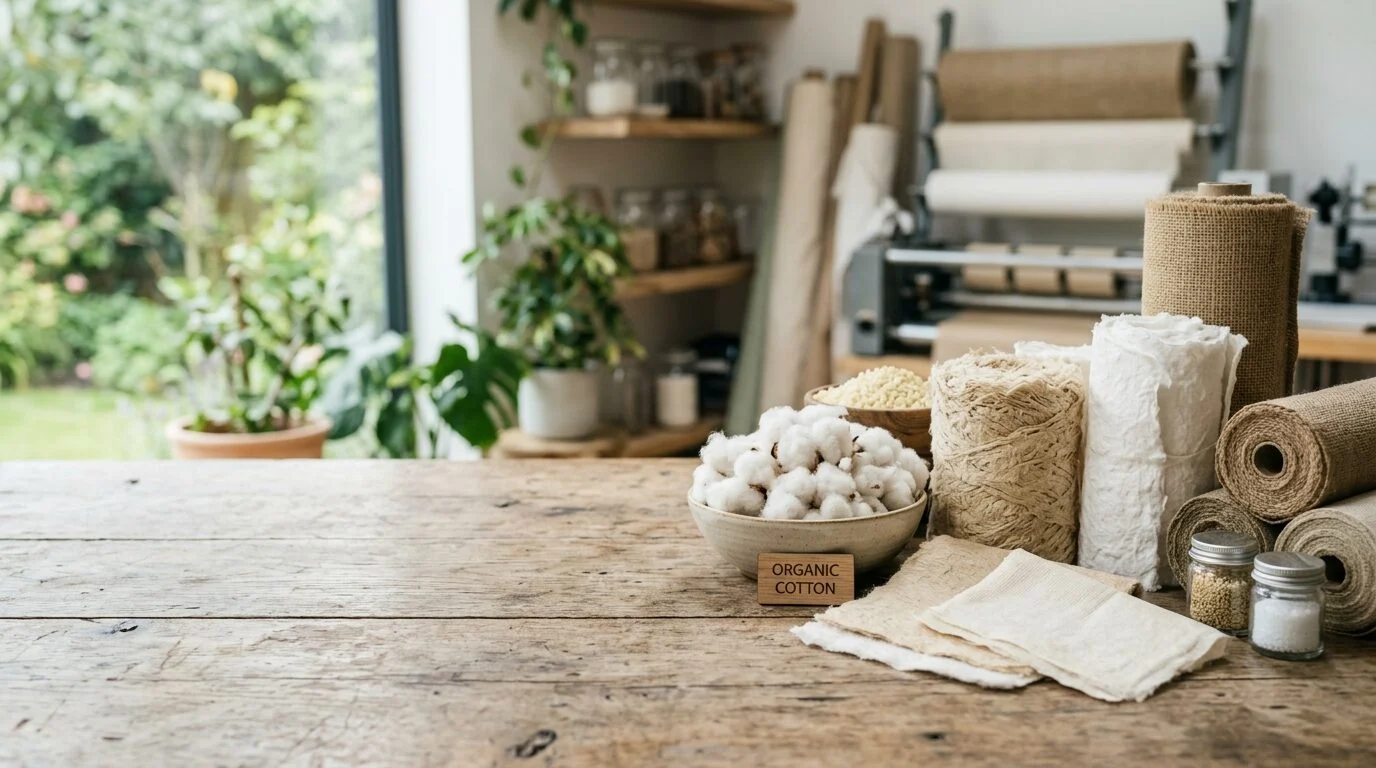
Biodegradable Sanitary Pad Raw Materials — Manufacturer Guide 2026
Biodegradable sanitary pads are the fastest-growing segment in the Indian feminine hygiene market. Eco-conscious consumers, government plastic restrictions, and the “clean label” movement are all pushing manufacturers to reformulate. The challenge: every layer of a conventional pad — topsheet, absorbent core, backsheet — uses petroleum-based plastic. Replacing each layer with a genuinely compostable alternative requires careful raw material selection, testing, and certification.
This guide covers what makes a sanitary pad truly biodegradable, the raw materials available for each layer, certification routes, and supply options from Favourite Fab — supplier of conventional and eco-grade pad raw materials in India.
What Makes a Pad “Biodegradable”?
The term is loosely used. Three definitions matter:
- Biodegradable: Breaks down via biological action (bacteria, fungi). No timeframe specified — could take years.
- Compostable: Breaks down within 90–180 days under industrial composting (EN 13432, ASTM D6400 standards).
- Home compostable: Breaks down within 12 months under home composting conditions (lower temperature, less microbial activity).
For commercial “biodegradable pad” claims in India, the practical bar is industrial compostable — certifiable under EN 13432 or BIS IS 17088.
Conventional vs Biodegradable Pad — Material Comparison
| Layer | Conventional Pad | Biodegradable Pad |
|---|---|---|
| Topsheet | Hydrophilic PP spunbond | Corn PLA spunbond, bamboo viscose, organic cotton |
| ADL | PET/PE bicomponent through-air bonded | PLA bicomponent, viscose airlaid |
| Absorbent core | Wood pulp + SAP (sodium polyacrylate) | Wood pulp + bio-SAP (corn starch based) OR pulp-only thick core |
| Backsheet | PE film | PLA film, PHA film, or starch-based bioplastic film |
| Adhesive | Synthetic hot melt | Plant-based hot melt |
| Wrapper | BOPP film | Compostable cellulose film or paper |
Layer-by-Layer Raw Material Guide
1. Topsheet — Skin Contact Layer
Three biodegradable options:
- Corn PLA spunbond: 14–20 GSM, hydrophilic treated. Strike-through <3 sec. Industrial compostable. Cost ₹220–290/kg.
- Bamboo viscose spunlace: 25–35 GSM. Naturally soft, breathable. Home compostable. Cost ₹180–240/kg.
- Organic cotton spunlace: 25–40 GSM. GOTS-certifiable. Premium price ₹260–420/kg.
Bamboo viscose is the most commonly chosen topsheet for premium biodegradable pads in India — it balances cost, performance, and consumer-friendly story (“bamboo” markets well).
2. ADL — Acquisition & Distribution Layer
The ADL is technically the hardest layer to make compostable. Conventional ADL uses bi-component PE/PET through-air bonded fibre — non-biodegradable. Alternatives:
- PLA bi-component nonwoven (PLA core / PLA sheath) — fully compostable, available 25–40 GSM
- Viscose airlaid — natural cellulose, performs well in low-volume pads
- Skip ADL — many bio pads omit ADL, accepting slightly higher rewet for full compostability
3. Absorbent Core
Conventional cores use 50% fluff pulp + 50% SAP. Sodium polyacrylate (SAP) is petroleum-derived and not biodegradable. Three approaches:
- Bio-SAP (corn starch based): Newer technology, absorbs 25–35 g/g (vs 50+ for synthetic SAP). Expensive: ₹450–650/kg
- Pulp-only thick core: No SAP. Uses 30–50 g of compressed wood pulp. Pad is thicker but fully compostable
- Hybrid (low-SAP): 30% bio-SAP + 70% pulp — partial compostability claim
Pulp-only is the practical choice for most India-market biodegradable pads. Slightly thicker pad in exchange for clean compostability story. Source pulp from conventional pad pulp suppliers — most softwood kraft pulp is naturally biodegradable.
4. Backsheet — Leak Barrier
The backsheet is the second hardest layer. It must be liquid-impermeable but compostable:
- PLA film: 25–35 micron. Fully compostable industrial. Some loss of MVTR vs PE. Cost ₹320–420/kg
- PHA (polyhydroxyalkanoate) film: Marine-degradable. Premium. ₹500+/kg
- Starch-based bioplastic film: Lower cost. Variable barrier performance. Best for light/regular pads
- Compostable PE blend: 30% bio-PE + additives — partial compostability, lower cost
5. Adhesives
Plant-based hot melt adhesives are required throughout — for core construction, wing positioning, and release liner attachment. Most conventional hot melt suppliers now offer bio-based variants (palm derivative or rosin based) at 15–25% cost premium.
6. Wrapper
Replace BOPP wrapper with compostable cellulose film (PLA-coated paper) or bagasse-based packaging. Adds ₹0.30–0.80 per pad.
Certification Routes
| Certification | Standard | Cost Range | Validity |
|---|---|---|---|
| EN 13432 (EU compostable) | European | ₹4–6 lakh | 3–5 years |
| ASTM D6400 (US compostable) | American | ₹3–5 lakh | 5 years |
| BIS IS 17088 (India compostable) | Indian standard | ₹1.5–3 lakh | 2–3 years |
| OK Compost (TÜV Austria) | Industrial & Home | ₹5–8 lakh | 3 years |
| GOTS | Organic textile | ₹2–4 lakh | 1 year |
For Indian market sales, BIS IS 17088 is the most recognised. For exports, EN 13432 or ASTM D6400 carry more weight.
Cost Impact — Bio Pad vs Conventional Pad
| Cost Component | Conventional Pad | Biodegradable Pad | Premium |
|---|---|---|---|
| Topsheet | ₹0.20 | ₹0.45 | +125% |
| ADL | ₹0.15 | ₹0.20–0.30 | +50–100% |
| Core (pulp + SAP) | ₹1.40 | ₹1.80–2.20 | +30–60% |
| Backsheet | ₹0.35 | ₹0.95 | +170% |
| Adhesive + wrapper | ₹0.25 | ₹0.45 | +80% |
| Total raw material/pad | ₹2.35 | ₹3.85–4.55 | +65–95% |
End consumer price: conventional pad ₹6–8/pad vs biodegradable pad ₹10–18/pad in retail. Margin opportunity is real — but only if certification and consumer trust are built properly.
Market Opportunity in India
- Indian feminine hygiene market: ₹6,500+ crore (2026)
- Biodegradable segment: ~3% today, projected 12–15% by 2030
- Key buyer drivers: school programs, urban premium retail, D2C subscriptions, government tenders
- Plastic Waste Management Rules amendments are pushing FMCG players toward partial-bio formulations
Favourite Fab Eco-Grade Raw Material Range
- Bamboo viscose spunlace: 25–35 GSM, OEKO-TEX certified, MOQ 1,000 kg
- Organic cotton spunlace: 30–40 GSM, GOTS available, MOQ 1,000 kg
- Wood pulp: Compressed roll form, sourced from FSC-certified mills
- PLA film: 25–35 micron, available on indent (45-day lead time)
Detailed pad raw material guide: What raw materials are used in sanitary pads | Sanitary napkin raw materials list
Frequently Asked Questions
Are biodegradable sanitary pads as effective as conventional pads?
For light to regular flow, yes. For heavy flow / overnight, conventional pads with synthetic SAP currently outperform pulp-only bio cores. Bio-SAP technology is closing the gap but still costs significantly more. Most Indian biodegradable pad brands position regular and light variants first.
How long does a biodegradable pad take to decompose?
An industrial-compostable pad (EN 13432 certified) breaks down in 90–180 days under industrial composting. In landfill or home composting, it can take 1–5 years. A conventional pad takes 500–800 years.
Can I label my pad “biodegradable” without certification?
Not safely. India’s Consumer Protection Act and Plastic Waste Management Rules treat unverified eco claims as misleading marketing. BIS IS 17088 certification is the cleanest route. Without certification, use neutral language like “eco-friendly raw materials” rather than “100% biodegradable”.
Is bamboo really better than cotton for biodegradable pads?
Bamboo viscose is regenerated cellulose — chemically processed but from a renewable, fast-growing plant. Cotton is natural but water-intensive to grow. From a raw material perspective, both are biodegradable; bamboo costs less. Most certified biodegradable brands use bamboo for the topsheet.
What’s the lowest viable cost for a biodegradable pad?
Using bamboo topsheet, pulp-only core, and PLA backsheet — total raw material cost is ₹3.85–4.55 per pad (regular size). With converting cost and margin, retail price floor is ~₹9–10 per pad. Any cheaper than this typically means partial-bio (PE backsheet still in place).
Where can I source PLA film in India?
PLA film is mostly imported (China, US, Thailand). Favourite Fab can source on indent for orders ≥500 kg, lead time 45 days. Local Indian manufacturers are emerging but supply is currently limited and inconsistent.
Do biodegradable pads need different machinery?
Mostly no. Existing pad lines run bio raw materials with minor adjustments — slower line speed (PLA film is more heat sensitive than PE) and adhesive temperature recalibration for plant-based hot melts. Pad and diaper line setup guide covers full machinery considerations.
Get Bio Raw Material Samples
Test bamboo viscose, organic cotton, and PLA film samples on your existing line before committing to certification. Favourite Fab provides 5–10 metre sample rolls for free on serious enquiries.
- 📞 +91 88007 75462 / +91 88007 75462
- ✉️ sale@favouritehub.com
- 🌐 Send specification sheet

Gaurav Garg
I'm Gaurav Garg, CEO of Favourite Fab, a company on a mission to revolutionize the nonwoven industry with sustainable practices. We work hand-in-hand with manufacturers and suppliers who share our commitment to eco-friendly production. With a deep interest in textile innovation, I'm passionate about educating consumers about sustainable material options and their potential to transform the nonwoven landscape.


