

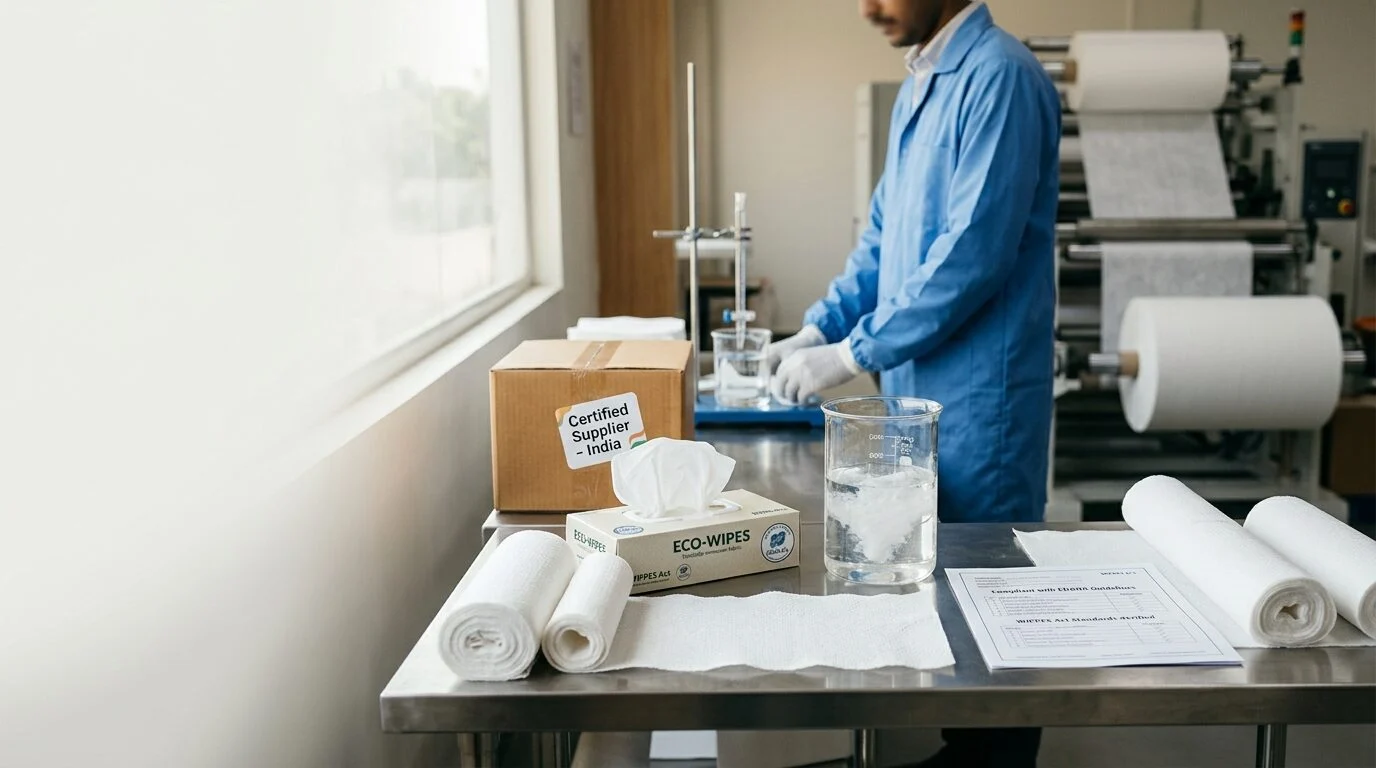
Flushable Nonwoven Fabric — WIPPES Act & EDANA Compliant Supplier India
The US WIPPES Act (Wastewater Infrastructure Pollution Prevention and Environmental Safety Act) and EDANA’s Code of Practice for Flushable Products require wet wipes claiming flushability to pass independent third-party flushability tests — disintegrating within 30 minutes in wastewater conditions without clogging pipes or pumps. Only cellulose-based nonwoven fabrics (no synthetic fibres) can achieve true flushability. Favourite Fab supplies WIPPES-Act-compliant cellulose wetlace nonwoven for US and EU flushable wipe brands requiring compliant raw materials.
Browse our full range: View all nonwoven fabric products — spunlace, spunbond, SMS, bico — with GSM, width and certification options. B2B MOQ from 500 kg.
Flushability Test Requirements
| Test | Standard | Pass Criterion |
|---|---|---|
| Disintegration | INDA/EDANA FG1 | >95% pass 12.5mm screen within 30 min |
| Settling | INDA/EDANA FG2 | No significant floatation |
| Household drain clearance | INDA/EDANA FG3 | Pass 100+ flush cycles without clogging |
| Slosh box | INDA/EDANA FG4 | Fibre breakdown under agitation |
| Pump test | INDA/EDANA FG5 | No pump damage or clogging |
FAQ
What nonwoven fabric passes WIPPES Act flushability tests?
Only 100% cellulose-based nonwovens (wood pulp, lyocell, viscose) with hydroentanglement bonding (no synthetic binder) pass all WIPPES/EDANA flushability criteria. Synthetic fibres (polyester, PP) do not disintegrate in water and fail FG1. Our cellulose wetlace nonwoven passes all 5 INDA/EDANA criteria with test reports per batch.
Can Favourite Fab provide WIPPES Act compliance documentation?
Yes. We provide: flushability test reports (FG1–FG5 per INDA/EDANA protocols), material composition declaration (100% cellulose, zero synthetic), and supply chain traceability. Sufficient for US brand compliance documentation under WIPPES Act Section 4 labelling requirements.
Full range: spunlace nonwoven fabric. Related: wetlace nonwoven fabric.
B2B Applications & End-Uses
Flushable nonwoven fabric sits at the convergence of regulatory compliance, environmental liability management, and market access strategy for wet wipes converters targeting EU and North American retail and professional markets. The WIPPES Act (Wastewater Infrastructure Protection and Pollution Elimination from Sewers Act), enacted in the United States in 2023, establishes federal labelling requirements and flushability standards for consumer wipes — ending the era of discretionary “flushable” claims and creating a legal obligation for wet wipes manufacturers to demonstrate GD4 (INDA/EDANA joint guidance document, 4th edition) compliance before making flushability claims on packaging.
For nonwoven fabric buyers — the wet wipes converters, private label wipes manufacturers, and branded wipes OEMs who constitute Favourite Fab’s customer base in this segment — the WIPPES Act and EDANA GD4 create a sourcing imperative: the substrate nonwoven must itself be capable of passing the GD4 test battery, and the supplier must be able to provide the material characterisation data to support the converter’s own product compliance documentation.
B2B application sectors with active demand for flushable nonwoven substrate:
- Consumer flushable wet wipes converters — Moist toilet tissue, flushable personal hygiene wipes, and flushable baby wipes targeting EU and US retail chains. Retailers in both markets are tightening private label supplier requirements following municipal wastewater authority pressure on wet wipes-related blockage costs.
- Professional hygiene product OEMs — Healthcare facility flushable wipes for patient hygiene, wound cleaning, and surface disinfection where flushing disposal is standard protocol in bedside and ward environments. NHS and US hospital procurement standards increasingly require GD4 documentation from product suppliers.
- Feminine hygiene wipes exporters — Intimate hygiene wipes with flushable claims targeting EU premium market segments. EU retail listing requirements for flushable claims are aligned with EDANA GD4 criteria.
- Travel and hospitality wipes brands — Single-use flushable wipes for airline, hotel, and hospitality sector use where waste management infrastructure may not accommodate a separate wipes disposal stream.
- Industrial maintenance wipes — A niche but growing application for dispersible substrate in environments where drain disposal is operationally convenient and flushing volume is sufficient to achieve GD4-compliant disintegration.
Favourite Fab’s flushable nonwoven substrates — viscose/cotton blends, lyocell-based grades, and natural fibre dispersible constructions at 40–70 GSM — are formulated to achieve >95% dispersion in the GD4 24-hour macerator test while maintaining sufficient wet tensile strength for the converting and dispensing process requirements.
Certifications & Quality Assurance
Flushable nonwoven substrate compliance requires a structured test protocol aligned with GD4 and the specific requirements of the WIPPES Act regulatory framework:
- INDA/EDANA GD4 Slosh Box Test: Simulates wastewater turbulence. Substrate samples are placed in a sealed box with water and agitated for a defined cycle duration. Pass criteria require evidence of fibre separation and disintegration initiation. Results documented with photographic evidence and fibre count metrics.
- GD4 Macerator Test — Dispersibility >95%: The primary quantitative flushability metric. Substrate is processed through a defined macerator at standardised flow conditions; residual material retained on a defined screen mesh after 24 hours must be <5% of initial mass. Favourite Fab’s flushable grades are qualified to this threshold prior to commercial supply.
- GD4 Settling Column Test: Assesses whether dispersed fibre fragments settle or remain suspended in a static water column, relevant to wastewater treatment plant processing efficiency.
- Biodegradability / No Microplastic Shedding: Viscose, cotton, and lyocell fibres used in flushable nonwoven are inherently biodegradable and do not generate synthetic microplastic particles. Material composition declarations confirming absence of PE, PP, PET, and other synthetic fibre content are issued with shipments for use in buyers’ own biodegradability marketing claims and EU Single-Use Plastics Directive compliance documentation.
- Wet Tensile Retention: Converting process integrity requires that the flushable substrate maintains sufficient wet tensile strength to run on high-speed wipes saturation and folding lines without tearing. Wet tensile per ISO 9073-3 (conditioned with defined saturation) is documented alongside dry tensile for each flushable grade.
- GSM and Width Uniformity: Basis weight per ISO 9073-1 and width tolerance per slit specification are verified per lot. Consistency is critical for consistent saturation weight and dispensing resistance in the finished wipe.
- ISO 9001:2015 QMS: Lot traceability and documented corrective action protocols support both internal quality management and external customer audit requirements.
More Questions Answered
What fibre blend is recommended for flushable wipes nonwoven to balance dispersibility with converting line runnability?
The optimal fibre blend for flushable wipes nonwoven depends on the specific converting process, the saturation formulation chemistry, and the target GD4 test performance margin required. Viscose (regenerated cellulose) is the most widely used base fibre for flushable nonwoven because of its inherent dispersibility in water, biodegradability, and availability at commercially viable cost. Pure viscose substrates disperse readily but may require careful management of wet tensile on high-speed converting lines running water-based or alcohol-based saturation. Lyocell (TENCEL) fibre provides superior wet strength retention relative to viscose, improving converting runnability, but at a higher fibre cost. Cotton-viscose blends (typically 30% cotton / 70% viscose or 50/50) are used where skin softness and natural fibre marketing positioning are priorities alongside flushability. Favourite Fab can supply trial material across multiple blend compositions for your converting line evaluation — contact our technical team with your saturation weight, line speed, and target GD4 performance margin for a tailored blend recommendation.
How does the WIPPES Act affect import requirements for flushable wipes sold in the United States?
The WIPPES Act establishes that any wipe product labelled “flushable” in US commerce must meet performance standards set by an accredited third-party testing organisation. As of the Act’s implementation, INDA GD4 test compliance is the recognised performance framework. For importers and converters supplying the US market, this means that the finished wipes product must have GD4 test documentation — and the nonwoven substrate is a foundational element of that documentation package, since substrate dispersibility is the primary determinant of finished product flushability. Nonwoven substrate suppliers who can provide GD4-relevant material characterisation data (macerator test results, slosh box results, fibre composition declaration) reduce the converter’s burden in assembling the product compliance package. Favourite Fab provides this documentation set as standard with flushable-grade nonwoven shipments. Buyers should note that GD4 testing of the finished wipe product — including the saturation formula — is separately required and is the converter’s responsibility.

Gaurav Garg
I'm Gaurav Garg, CEO of Favourite Fab, a company on a mission to revolutionize the nonwoven industry with sustainable practices. We work hand-in-hand with manufacturers and suppliers who share our commitment to eco-friendly production. With a deep interest in textile innovation, I'm passionate about educating consumers about sustainable material options and their potential to transform the nonwoven landscape.


