

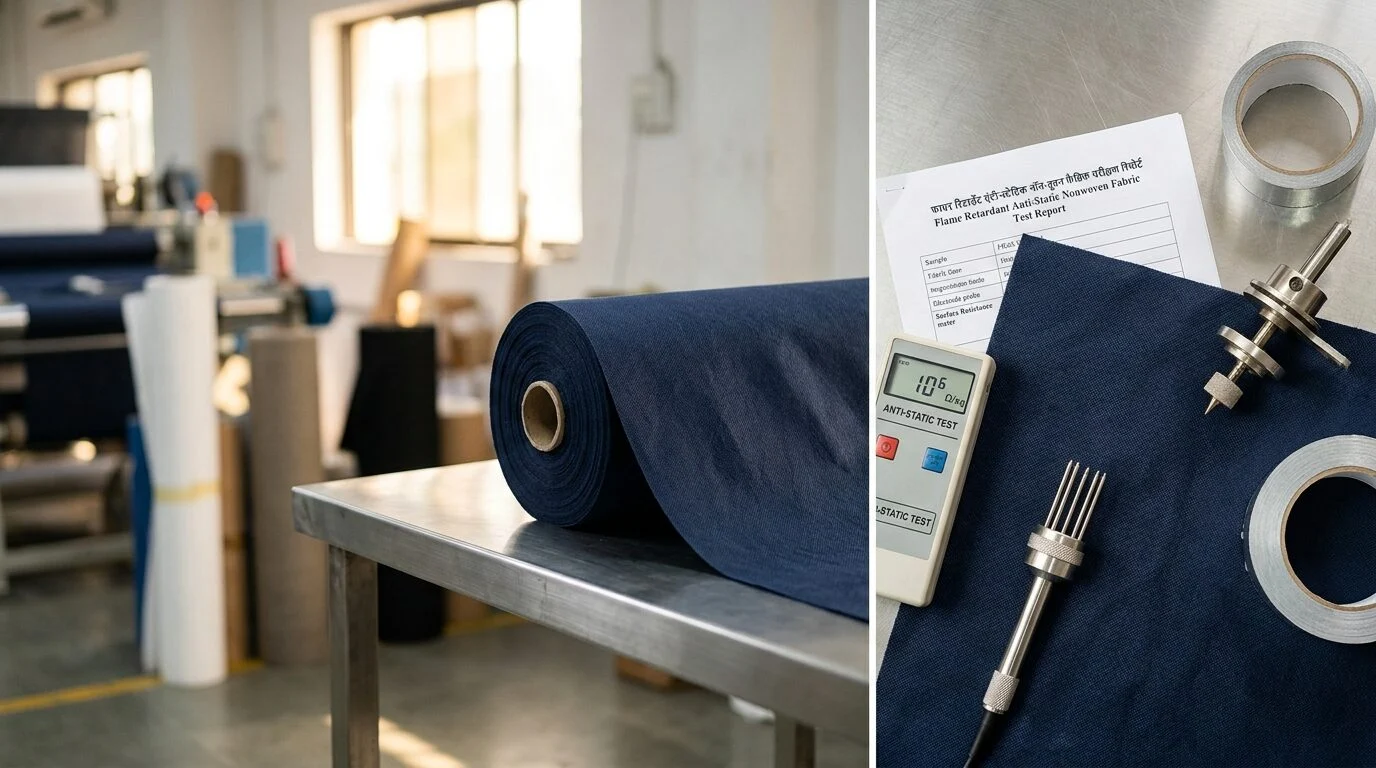
Flame Retardant Anti-Static Nonwoven Fabric — Industrial PPE Grade India
Flame retardant (FR) anti-static nonwoven fabric combines two critical safety properties for hazardous industrial environments: flame resistance (prevents ignition and flame spread) and electrostatic discharge control (prevents spark-triggered explosion). Used in disposable protective coveralls for oil & gas, petrochemical, chemical processing, and explosives manufacturing where both fire and electrostatic ignition risks are present. Favourite Fab supplies SMS and spunbond nonwoven with dual FR + anti-static treatment meeting EN 1149 (anti-static) and ISO 11612 (flame protection) standards.
Browse our full range: View all nonwoven fabric products — spunlace, spunbond, SMS, bico — with GSM, width and certification options. B2B MOQ from 500 kg.
Specifications
| Property | Specification |
|---|---|
| GSM | 40–80 GSM |
| Base fabric | PP SMS or spunbond |
| Flame retardancy | ISO 11612 A1+B1 minimum |
| Anti-static | EN 1149-3: <50V charge decay |
| Surface resistivity | <10⁹ Ω (EN 1149-1) |
| Width | 160–260 cm |
| MOQ | 500 kg |
FAQ
What standards apply to FR anti-static nonwoven for oil & gas PPE?
EN 13034 (liquid chemical protection), EN 1149 (anti-static), ISO 11612 (heat and flame) for typical oil & gas coverall requirements. ATEX zone classification determines which combination of standards applies. Our FR anti-static SMS meets the most common oil & gas PPE specifications.
Is the FR treatment permanent or does it wash off?
FR treatment durability depends on application method. Our inherent FR (built into fibre during extrusion) is permanent — not affected by use or limited handling. Applied FR finishes may reduce with repeated cleaning. For disposable PPE coveralls (single-use), FR durability is not a concern.
Full range: medical nonwoven fabric. Related: anti-static spunlace nonwoven fabric.
B2B Applications & End-Uses
Flame retardant and antistatic nonwoven fabrics occupy a critical position in industrial safety where two distinct hazards — ignition risk and electrostatic discharge — must be addressed simultaneously in a single substrate. Standalone FR or standalone antistatic treatments each address one hazard vector; combined FR + antistatic grades are engineered for environments where both risks are present concurrently, such as ATEX-classified zones, semiconductor fabrication facilities, and hydrocarbon processing areas.
The technical requirement is precise. FR performance to EN 13501-1 Class B limits the contribution of the material to fire spread. Antistatic compliance to EN 1149-5 (surface resistivity <10⁹ Ω) prevents electrostatic charge accumulation that could create an ignition source in the presence of flammable vapours or explosive dust. In ATEX Zone 1 and Zone 2 environments, both properties must be demonstrably present and independently verified — not claimed on the basis of a single combined test.
B2B sectors with active demand for FR + antistatic nonwoven from Favourite Fab:
- Industrial PPE coverall manufacturers — Disposable coveralls for oil refinery, petrochemical plant, and gas terminal workers. EN 13034 (liquid splash) combined with FR and antistatic properties covers the dominant PPE specification in this sector.
- Cleanroom wipe converters — Semiconductor and electronics manufacturing cleanrooms require wipes that do not generate or retain electrostatic charge (which damages components) and do not pose ignition risk in solvent-use areas.
- Oil and gas sector disposable garment OEMs — Offshore platform and onshore terminal operators specifying single-use FR + antistatic garments for contract maintenance workforces require documented compliance with both EN 1149-5 and IS 11871 (Bureau of Indian Standards flame retardancy).
- Automotive paint shop PPE suppliers — Spray booth environments combine flammable solvent vapours with electrostatic spray gun operation, creating dual-hazard conditions requiring FR + antistatic garment substrates.
- Explosive manufacturing facility PPE — ATEX Zone 0 and Zone 1 environments in pyrotechnics and mining explosive production impose the most stringent combined FR + ESD requirements in the industrial sector.
Certifications & Quality Assurance
FR + antistatic combined performance requires dual-stream testing and documentation. Favourite Fab’s industrial-grade nonwoven fabrics in this category are subject to the following quality framework:
- EN 13501-1 — Fire Classification (Class B): Flame spread, heat release rate, and smoke production are assessed under this European classification standard. Class B materials have limited contribution to fire, meeting the threshold required for industrial PPE in ATEX environments. IS 11871 (BIS equivalent) test documentation is additionally available for India-market compliance.
- EN 1149-5 — Electrostatic Properties: Surface resistivity testing confirms values below 10⁹ Ω per the standard’s requirements. Testing is conducted per roll lot, not on representative samples only, for industrial-grade shipments.
- EN ISO 9073 Series — Physical Properties: Tensile (ISO 9073-3), tear (ISO 9073-4), and basis weight (ISO 9073-1) documentation covers the structural performance parameters relevant to PPE converting operations.
- Wash Durability Testing: For reusable industrial garment applications, FR and antistatic retention after defined wash cycles is verified and documented. Single-use grades are exempted from durability cycling.
- Raw Material Traceability: FR and antistatic additive batch records are maintained with each production lot, enabling root-cause investigation if performance variation occurs. Additive chemistry is disclosed to customers under NDA where required for their own regulatory filings.
- ISO 9001:2015 QMS: All production and inspection processes operate within our certified quality management system, with documented corrective action and customer complaint resolution procedures.
More Questions Answered
What is the difference between inherently FR nonwoven and topically treated FR nonwoven for industrial PPE applications?
Inherently FR nonwoven fabrics use polymer fibres where flame retardancy is a property of the base material itself — modacrylic, aramid, or FR-modified polyester fibres that do not sustain combustion regardless of washing or mechanical abrasion. Topically treated FR nonwoven applies a flame retardant finish to standard fibres (PP or PET), which provides compliant FR performance when tested but may degrade with repeated washing, laundering, or mechanical stress. For single-use industrial disposable garments — the primary application for Favourite Fab’s FR + antistatic grades — topical FR treatment is technically and commercially appropriate, as the garment is not subjected to repeat wash cycles. For reusable FR PPE garments, inherently FR fibre-based substrates are the technically correct specification. Buyers should specify their use-case clearly to ensure the correct grade is selected.
Can FR + antistatic nonwoven be supplied in white and colour variants for OEM garment identification purposes?
Yes. Colour variants — including standard industrial colours such as white, blue, yellow, and orange — are available in our FR + antistatic nonwoven range. Colour is applied using pigment masterbatch during fibre production or via topical dyeing, depending on the base substrate and the specific FR treatment chemistry. It is important to verify that the addition of colour pigment does not adversely affect FR or antistatic performance; our quality assurance process includes colour variant testing to confirm that both EN 13501-1 and EN 1149-5 compliance is maintained in coloured grades. Custom colours for OEM branding purposes can be accommodated for volume orders meeting minimum production run quantities.

Gaurav Garg
I'm Gaurav Garg, CEO of Favourite Fab, a company on a mission to revolutionize the nonwoven industry with sustainable practices. We work hand-in-hand with manufacturers and suppliers who share our commitment to eco-friendly production. With a deep interest in textile innovation, I'm passionate about educating consumers about sustainable material options and their potential to transform the nonwoven landscape.


