

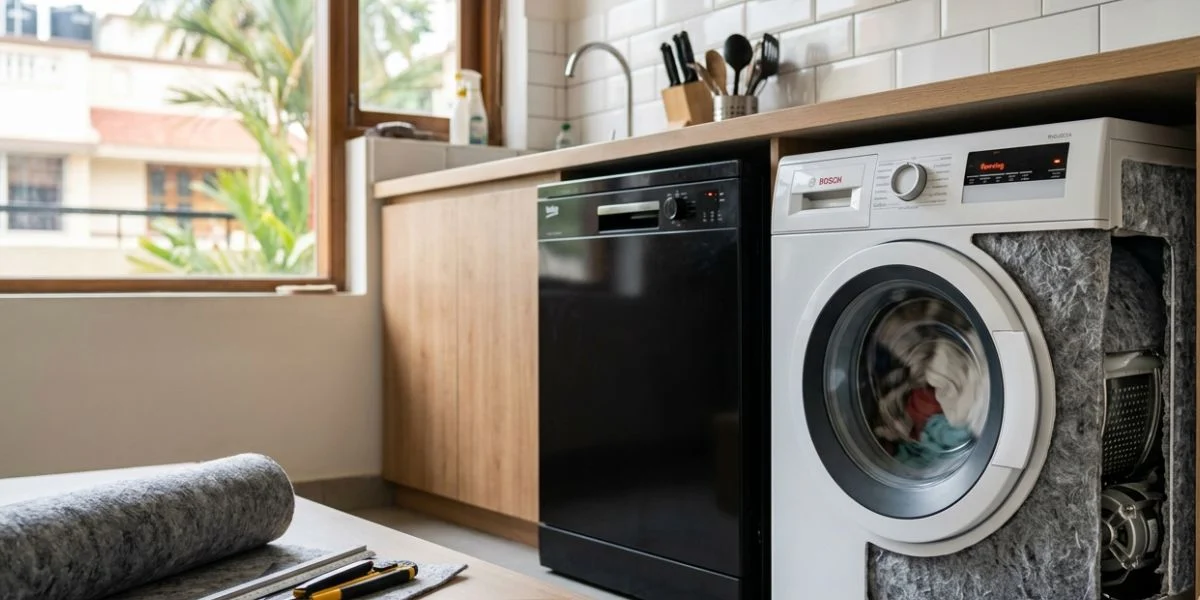
Home Appliance Acoustic Nonwoven Fabric — Dishwasher & Washing Machine Insulation India
Home appliance acoustic nonwoven fabric is applied to the outer cabinet walls of dishwashers, washing machines, dryers, and refrigerators to absorb operational noise — reducing dB levels below regulatory limits and improving perceived product quality. As household appliance OEMs compete on noise performance (especially in open-plan kitchens), acoustic nonwoven has become a standard component in premium appliance construction. Favourite Fab supplies thermally bonded PET acoustic nonwoven for appliance OEMs and their component suppliers.
Browse our full range: View all nonwoven fabric products — spunlace, spunbond, SMS, bico — with GSM, width and certification options. B2B MOQ from 500 kg.
Specifications
Product: Home Textiles Non Woven
| Property | Specification |
|---|---|
| GSM | 200–500 GSM |
| Fibre | PET thermally bonded, recycled PET available |
| NRC | 0.55–0.80 (500–2,000 Hz) |
| Temperature resistance | 120°C continuous (dishwasher compatible) |
| Moisture resistance | Hydrophobic treatment available |
| Width | 160–260 cm |
| MOQ | 500 kg |
FAQ
Product: Nonwovens For Home Textiles
What NRC is required for dishwasher acoustic insulation?
Premium dishwashers target <44 dB(A) noise rating. Acoustic nonwoven typically contributes 3–8 dB reduction at 200–400 GSM. Multiple layers or high-density grades used for quietest models. NRC 0.6–0.8 at 500–2,000 Hz is the typical target range for appliance acoustic insulation.
Can rPET nonwoven be used for appliance acoustics?
Yes — GRS-certified rPET thermally bonded nonwoven at equivalent GSM delivers the same acoustic performance as virgin PET, with 30–50% CO₂ reduction. Many European appliance brands now specify recycled content for sustainability targets.
Full range: spunbond nonwoven fabric manufacturer India. Related: automotive acoustic insulation nonwoven fabric India.
B2B Applications & End-Uses
Sound insulation nonwoven fabric for white goods is a precision acoustic substrate where material selection directly impacts the end-consumer noise experience and, consequently, the OEM’s product rating in independent appliance review publications that influence retail purchasing decisions. Dishwashers operating below 42 dB(A), washing machines rated under 70 dB(A) during spin cycle, and refrigerators achieving noise floors below 38 dB(A) all rely in part on strategically placed acoustic nonwoven components to achieve these performance thresholds.
Thermally bonded PET nonwoven at 200–500 GSM is the dominant acoustic insulation substrate in white goods manufacturing for several interconnected reasons: PET fibre’s inherent viscoelastic damping properties, the design flexibility of varying loft and density to tune NRC (Noise Reduction Coefficient) across target frequency bands, and the material’s compliance with appliance-operating temperature ranges without binder migration or VOC emission.
Key B2B end-use applications for Favourite Fab’s acoustic nonwoven:
- Dishwasher inner panel insulation — The primary acoustic nonwoven application in dishwashers. Moulded or die-cut acoustic pads are applied to the inner door panel, side walls, and base of the wash chamber, attenuating both airborne noise from the spray arm and water jet system and structure-borne vibration from the circulation pump motor.
- Washing machine drum housing insulation — High-loft acoustic nonwoven wraps the outer drum housing, reducing transmission of mechanical vibration from the drum bearing and motor to the external cabinet panels. Critical for achieving low spin-cycle dB ratings in front-loader designs.
- Refrigerator compressor compartment — Acoustic pads surrounding the compressor and condenser fan motor in the machine room compartment attenuate the dominant low-frequency noise sources in refrigeration appliances.
- Tier-2 and Tier-3 component suppliers — White goods OEMs including Samsung, Whirlpool, LG India, Haier India, and Godrej typically source acoustic components through tier-2 moulding and fabrication suppliers who purchase nonwoven substrate from Favourite Fab and convert it to the OEM’s die-cut specifications.
- Air conditioner and microwave oven OEMs — Secondary markets where acoustic nonwoven is used for compressor insulation (room AC) and transformer/magnetron noise attenuation (microwave ovens).
Certifications & Quality Assurance
Acoustic nonwoven for white goods operates at the intersection of thermal, acoustic, and chemical performance requirements. Favourite Fab’s quality assurance for this product category covers:
- Noise Reduction Coefficient (NRC) Characterisation: NRC values across the standard octave bands (250 Hz, 500 Hz, 1000 Hz, 2000 Hz) are measured for each GSM and density variant in our acoustic nonwoven range. NRC data sheets are provided to allow OEM acoustic engineers to model insulation performance at the design stage before physical prototype testing.
- Sound Transmission Loss (STC Rating): For applications targeting airborne sound isolation (dishwasher panels, washing machine cabinet liners), STC values are documented alongside NRC to provide a complete acoustic performance profile.
- Thermal Resistance to 60°C: Dishwasher inner door applications are exposed to sustained operating temperatures up to 70°C during heated dry cycles. Our acoustic nonwoven is validated for dimensional and property stability across this thermal envelope with no binder migration to internal surfaces.
- VOC Emission Testing: White goods installed in residential kitchens and laundry rooms require VOC-free internal components. Our thermally bonded PET acoustic grades use no chemical binder — thermal bonding uses the PET bicomponent fibre’s own low-melt sheath — eliminating VOC emission risk entirely.
- Basis Weight and Thickness Uniformity: Die-cut acoustic components cut from nonwoven sheet stock require consistent thickness (±0.5 mm) and GSM to achieve consistent assembly fitment. Our process controls maintain these tolerances across full roll width.
- ISO 9001:2015 QMS: Production, testing, and dispatch documentation maintained under our certified quality management system.
More Questions Answered
How do white goods OEM tier-2 suppliers specify acoustic nonwoven requirements when sourcing from Favourite Fab?
Tier-2 white goods component suppliers typically receive an acoustic performance specification from the OEM in the form of a target NRC value at defined frequency bands, a maximum thickness dimension constrained by the appliance housing cavity, a GSM or density target derived from the OEM’s existing qualified material, and a VOC/chemical emission restriction aligned with the OEM’s internal material standard. When placing an initial inquiry with Favourite Fab, providing this OEM-sourced specification — even as a preliminary target — allows our technical team to identify the closest matching grade from our standard range and prepare sample rolls for your physical prototype testing. Where the OEM specification includes a drawing with die-cut dimensions, we can also assess converting feasibility and waste yield before you commit to a trial order.
What is the typical GSM range for dishwasher inner panel acoustic insulation versus washing machine drum housing applications?
Dishwasher inner door panel and side wall insulation typically uses acoustic nonwoven in the 300–400 GSM range, where the combination of loft and density provides effective broadband attenuation of the high-frequency water jet noise dominant in dishwasher acoustic profiles. Washing machine drum housing insulation generally requires higher mass density in the 400–500 GSM range to address the lower-frequency mechanical vibration energy generated by drum rotation and bearing loading at high spin speeds. The optimal GSM and thickness for a specific appliance model should be determined through prototype acoustic measurement rather than assumed from range alone — variables including housing cavity dimensions, panel material, and motor mounting configuration all influence the effective attenuation achieved by the insulation layer. Favourite Fab can supply trial rolls across the full 200–500 GSM range for your appliance development programme.

Gaurav Garg
I'm Gaurav Garg, CEO of Favourite Fab, a company on a mission to revolutionize the nonwoven industry with sustainable practices. We work hand-in-hand with manufacturers and suppliers who share our commitment to eco-friendly production. With a deep interest in textile innovation, I'm passionate about educating consumers about sustainable material options and their potential to transform the nonwoven landscape.


