

Browse our full range: View all nonwoven fabric products — spunlace, spunbond, SMS, bico — with GSM, width and certification options. B2B MOQ from 500 kg.
How to Increase Stiffness of Nonwoven Fabric — Technical Guide for Buyers
Stiffness (rigidity/bending resistance) is occasionally required in nonwoven applications — such as filtration media that must maintain pleated shape, medical drape panels that should lay flat, and technical application where floppy fabric causes converting problems. Here are the main methods to increase nonwoven fabric stiffness.
Methods to Increase Stiffness
| Method | How It Works | Effect on Other Properties | Cost Impact |
|---|---|---|---|
| Increase GSM | More fibre mass per area = stiffer | Heavier, less soft, more expensive/m² | Proportional to GSM increase |
| Higher thermal bond area | More bond points in spunbond = stiffer, less stretchy | Reduced softness, reduced elongation | Minor |
| Stiffer fibre type | Polyester > PP > viscose in stiffness | Changes absorbency, softness | Depends on fibre cost |
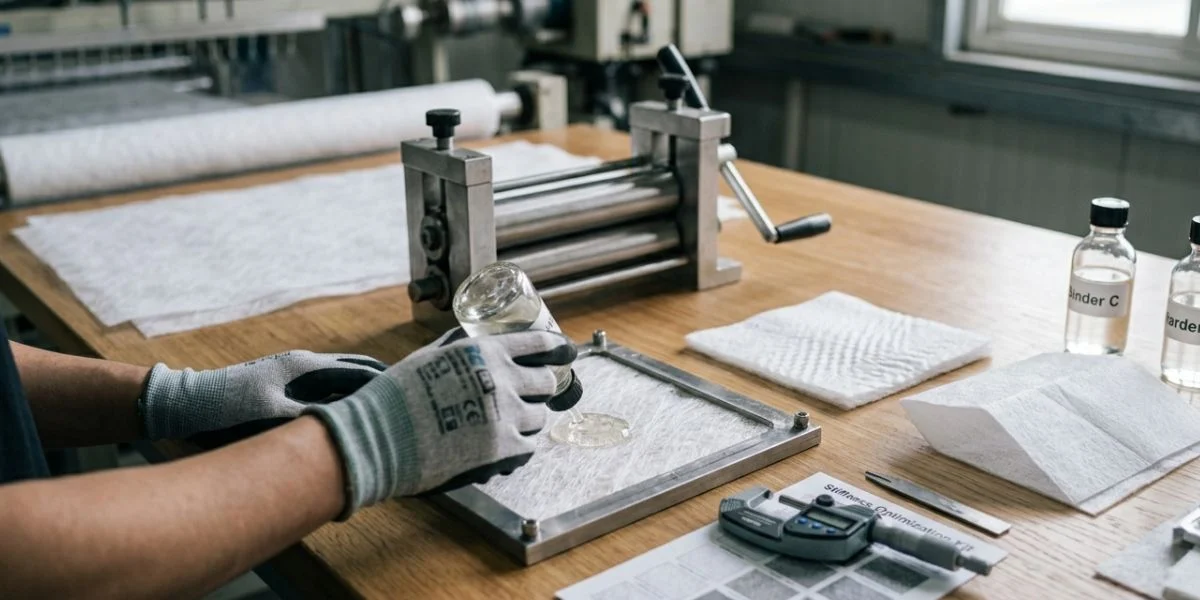
| Binder application | Acrylic or latex binder stiffens fibre bonds | Reduced breathability, binder adds extractables | +10–20% |
| Lamination | Bond nonwoven to film or scrim | Adds weight, reduces breathability | +30–60% |
| Heat calendering | Hot roller compression increases density | Reduced softness, thinner | Minor |
FAQ
Why is spunlace soft and floppy vs spunbond?
Spunlace has no rigid bond points — hydroentanglement creates flexible mechanical entanglements. Spunbond has thermally fused bond points from calendar roller — creating a stiffer structure. To stiffen spunlace, increase polyester content or apply light binder treatment.
What is the stiffest nonwoven fabric type?
Thermally bonded spunbond at high bond area % is the stiffest standard nonwoven. Needle-punched fabrics with resin bonding can achieve very high stiffness. Wetlaid nonwoven with binder approaches paper-like stiffness at high binder levels.
Full range: spunlace nonwoven fabric. Related: nonwoven fabric GSM guide.
B2B Applications & End-Uses
Stiffness in nonwoven fabric is a functional requirement — not an aesthetic one — across a wide range of industrial and technical applications where dimensional stability, shape retention, and resistance to buckling determine product performance. Understanding which stiffening method is appropriate for a given application requires matching the stiffness mechanism to the downstream process and end-use conditions.
Fusible interlining for garment manufacturing is the highest-volume application where nonwoven stiffness is specified precisely. Woven fabric producers and garment exporters sourcing fusible interlining require a nonwoven base with controlled Gurley stiffness (TAPPI T543) that delivers predictable drape in collars, cuffs, and waistbands after fusing. Here, resin-bonded or thermally calendered nonwoven in the 30–120 GSM range with hot-melt dot coating is the standard solution. Stiffness must be isotropic (balanced MD/CD) or deliberately directional depending on the garment component.
Filtration media manufacturers select stiffness method based on downstream pleating requirements. Filter boards for HVAC cassette filters and rigid industrial filter cartridges require nonwoven that holds pleat geometry under airflow pressure drop without pleat collapse — typically achieved through resin saturation or high-density needle-punch followed by thermal calendering. Pleat-ability (ability to crease sharply without fibre fracture) must be balanced against stiffness, making fibre selection and bonding method interdependent engineering decisions.
Shoe component manufacturers (insole, toe puff, counter) source thermally bonded or resin-impregnated nonwoven where stiffness determines shoe shape retention across the product’s wear life. High-shrinkage bico fibre formulations that develop stiffness during thermoforming are used in moulded shoe components where the stiffening step occurs during the hot-press moulding operation on the shoe production line. Automotive trim and headliner substrate, luggage shell, and packaging insert are further segments where procurement teams specify nonwoven stiffness by Gurley or cantilever bending rigidity values rather than by GSM alone.
Certifications & Quality Assurance
Stiffness is characterised using two primary test methods depending on the application standard required: Gurley Stiffness (TAPPI T543 / EDANA ERT 90.1) for interlining and filtration media applications, and cantilever bending length (ISO 9073-7) for general technical nonwoven. Both measurements are directional — MD and CD values are reported separately since manufacturing process anisotropy consistently produces higher MD stiffness in spunbond and needle-punched grades.
For resin-bonded grades, add-on weight (% resin by dry mass) and cure uniformity are controlled parameters verified by LOI (Loss on Ignition) testing per lot. Thermal calendering parameters (roll temperature, nip pressure, speed) are locked by grade specification and recorded on the batch production record. Dimensional stability after conditioning — critical for interlining applications where post-fusing shrinkage must be below 1.5% — is tested per ISO 5077 thermal stability protocol.
Customers in the filtration sector can receive nonwoven samples pre-characterised for pressure drop (Frazier air permeability, ASTM D737) alongside stiffness data, enabling combined filter media selection without requiring in-house raw material characterisation. Our technical team supports application-specific stiffness specification development for new product development programmes.
More Questions Answered
Can nonwoven stiffness be increased without adding resin, to preserve breathability for medical coverall applications?
Yes — thermal calendering (point-bond or flat calendar) increases stiffness by localised fibre fusion without any chemical add-on, preserving the open fibre structure between bond points and maintaining air permeability. Increasing GSM through additional fibre layers also adds stiffness while keeping the fabric binder-free. For medical coveralls requiring both stiffness and breathability, an SMS construction with a calendered S layer provides the best balance — the outer spunbond contributes stiffness while the meltblown core maintains filtration and the inner spunbond preserves softness.
What Gurley stiffness range is standard for fusible interlining nonwoven used in shirt collar applications?
Shirt collar interlining typically requires Gurley stiffness in the range of 800–2,500 mg (milligrams force in TAPPI T543 method), with the precise value determined by the fabric weight of the shell fabric and the desired hand in the finished garment. Heavier suiting fabrics require stiffer interlining to prevent puckering, while lightweight shirting requires lower stiffness to avoid a rigid hand. Favourite Fab provides stiffness data sheets and can produce reference samples across the stiffness range for customer evaluation before finalising the interlining specification.

Gaurav Garg
I'm Gaurav Garg, CEO of Favourite Fab, a company on a mission to revolutionize the nonwoven industry with sustainable practices. We work hand-in-hand with manufacturers and suppliers who share our commitment to eco-friendly production. With a deep interest in textile innovation, I'm passionate about educating consumers about sustainable material options and their potential to transform the nonwoven landscape.


