

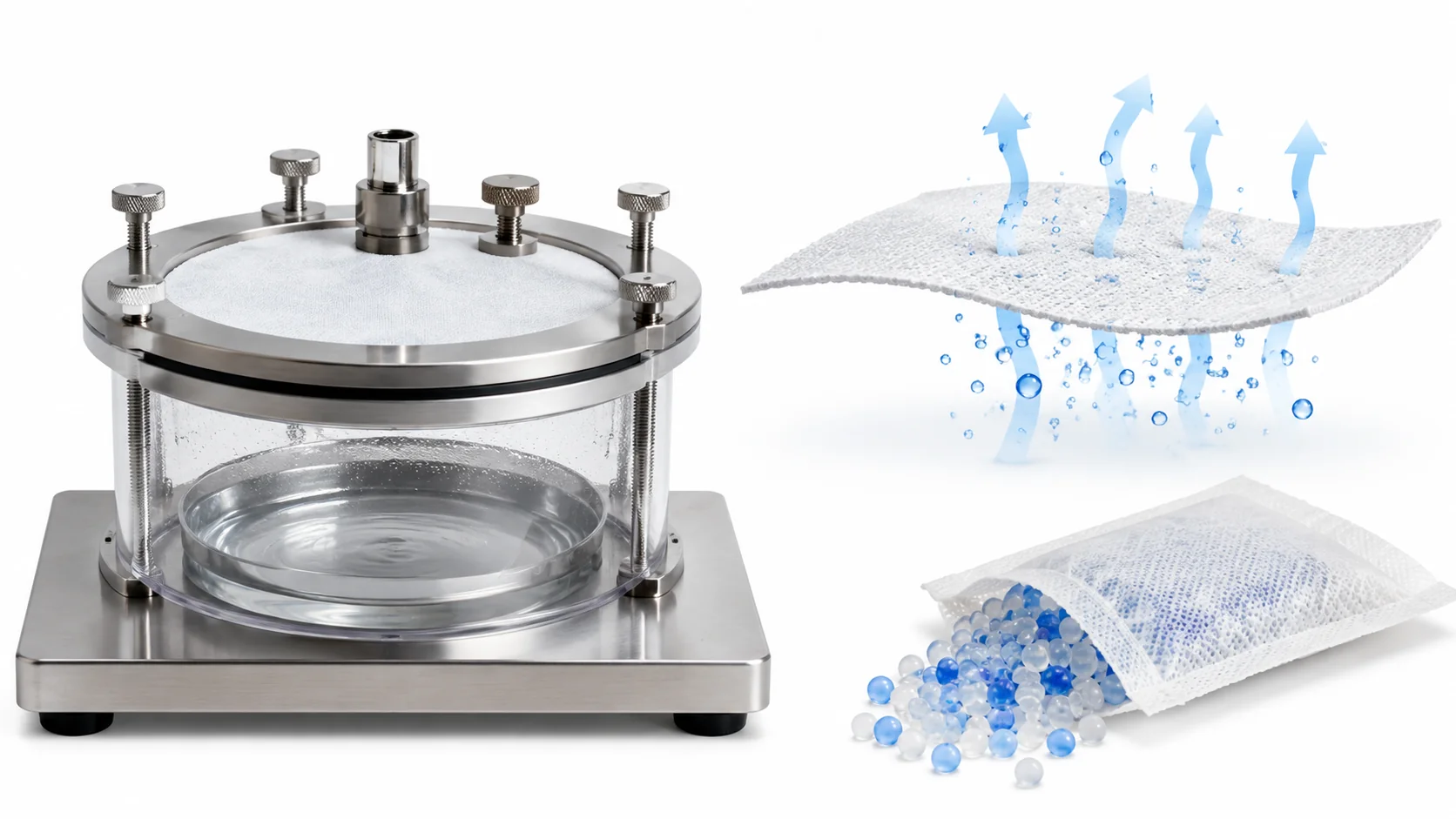
Improve MVTR in Breathable Desiccant Nonwoven Fabric for Moisture Permeability
Low MVTR (Moisture Vapour Transmission Rate) in desiccant nonwoven fabric means your silica gel or molecular sieve packets absorb moisture too slowly. The desiccant performance fails not because the active agent is wrong — it fails because the nonwoven cover fabric is blocking vapour flux. Favourite Fab supplies breathable desiccant nonwoven in specific GSM and fibre grades that maximise MVTR without sacrificing particle retention. This guide identifies the root causes of poor MVTR and specifies the correct fabric parameters to fix them.
Favourite Fab is a B2B raw material supplier in Agra, India. We supply the nonwoven cover fabric used in desiccant packets — not the desiccant itself. Our desiccant nonwoven fabric range is engineered for high MVTR with low particle bleed-through. Every grade ships with MVTR test data (ASTM E96 Method B or equivalent). See our full range at nonwoven fabric for desiccant manufacturers.
Understanding the Problem: What Controls MVTR in Desiccant Nonwoven
MVTR measures grams of water vapour that pass through one square metre of fabric in 24 hours. For desiccant packets, high MVTR means the desiccant can absorb ambient moisture quickly. Low MVTR creates a diffusion bottleneck — the desiccant is saturated at the surface but dry in the centre. This slows equilibration time and reduces effective capacity per packet.
Four fabric parameters directly control MVTR: GSM, fibre diameter, bonding density, and hydrophilic finish. Lower GSM means less material to diffuse through — MVTR rises. Finer fibres create a more tortuous path but also more surface area — the net effect depends on pore size distribution. Higher thermal bonding density compresses pores and reduces MVTR. Hydrophilic finish accelerates moisture pickup at the surface but can reduce vapour-phase transmission if the finish fills pore openings.
The critical design point is balancing high MVTR against particle retention. Increasing pore size raises MVTR but risks desiccant powder bleed-through. Favourite Fab engineers this balance through GSM selection and controlled bonding patterns — not by compromising on either property.
Root Causes and Diagnostic Checklist
- GSM too high: Are you using 30+ GSM fabric for standard desiccant packets? This is the most common cause of low MVTR.
- Bonding density too high: Has the fabric been over-calendered or thermally bonded at excessive point density? Compressed pores reduce vapour transmission.
- Hydrophilic finish blocking pores: Is the finish application rate correct? Over-application fills pore openings and reduces gas-phase transmission.
- Fibre diameter too large: Coarser fibres (>3 denier) produce fewer pores per unit area. Fine fibre fabrics (1.5–2 denier) have higher pore counts and better MVTR at the same GSM.
- Pore size below moisture vapour molecule threshold: Very dense bonding can create pores too small for efficient vapour flux — run a pore size distribution test.
- Wrong MVTR test method: ASTM E96 Method A (desiccant) and Method B (water) give different results. Are you comparing like-for-like data from your supplier?
- Packaging humidity mismatch: Is your desiccant packet specification designed for the actual end-use humidity range? Confirm target MVTR at the relevant relative humidity.
Material-Side Fixes — Specifications That Resolve the Issue
| Root Cause | Correct Specification | Why It Fixes the Problem |
|---|---|---|
| GSM too high — fabric too thick for vapour diffusion | Switch to 18–22 GSM spunbond or SMS for standard desiccant packets | Less material to diffuse through; pore path length decreases; MVTR rises proportionally |
| Over-calendered fabric compressing pores | Specify bonding point density ≤18% bonding area ratio | Open bonding pattern preserves free-fibre zones with high vapour transmission |
| Hydrophilic finish over-application | Specify finish add-on ≤0.5% by weight for vapour-phase applications | Minimal finish maintains capillary wetting without blocking pore openings |
| Coarse fibre diameter reducing pore count | 1.5–2.0 denier fibre (fine grade) instead of 3.0 denier | More fibres per unit area; smaller but more numerous pores; better aggregate MVTR |
| Low MVTR + particle bleed-through simultaneously | SMS or SMMS laminate: spunbond face for retention, meltblown core for barrier | Meltblown core provides particle filtration without reducing overall MVTR significantly |
| MVTR acceptable but equilibration time too slow | Add mild hydrophilic finish (0.3% add-on) to accelerate surface moisture uptake | Surface wetting accelerates vapour-to-liquid transition at the fabric face; faster packet equilibration |
| MVTR varies batch to batch | Specify GSM CV% ≤3% and request MVTR data per batch on certificate | Consistent GSM and bonding density gives consistent MVTR across production batches |
How Favourite Fab Supplies the Right Grade
Favourite Fab stocks desiccant-grade nonwoven fabric in GSM ranges from 15 to 40 gsm. We supply spunbond and SMS constructions with MVTR data tested to ASTM E96. Our application engineers can recommend the correct grade based on your desiccant type, packet size, and target equilibration rate. For technical data sheets, see our nonwoven fabric technical data sheets page.
- Grade-specific MVTR test certificates available on request
- Sample dispatch within 48 hours for trial runs
- Technical support from application engineers with desiccant packaging experience
- Custom GSM / width / finish to match your sealing and dispensing equipment
- ISO certified — batch-to-batch consistency guaranteed
Pricing and MOQ
Favourite Fab offers competitive wholesale pricing for breathable desiccant nonwoven fabric. Pricing depends on GSM, construction (spunbond vs SMS), roll width, and order volume. MOQ is typically 500 kg per grade. Contact our sales team with your MVTR target, packet dimensions, and monthly volume for a tailored quotation. We do not publish fixed price lists — quotes are issued by our sales engineers after reviewing your requirements.
How to Order
- Send your current fabric spec, MVTR target (g/m²/24h), desiccant type, and packet size to sale@favouritehub.com
- Receive recommended grade + MVTR test data + sample within 48 hours
- Run desiccant packet trial — measure equilibration time and particle retention
- Confirm order with agreed GSM and MVTR specification on purchase order
Frequently Asked Questions
Q: What MVTR value do I need for standard silica gel desiccant packets?
A: Most standard silica gel packet applications target MVTR of 500–1,200 g/m²/24h (ASTM E96 Method B at 23°C, 50% RH). Higher-performance pharmaceutical desiccant packaging may require 1,500+ g/m²/24h. Favourite Fab can supply fabrics across this range — share your target and we will match the grade.
Q: Does SMS nonwoven give better MVTR than spunbond for desiccant applications?
A: Not inherently. SMS has a meltblown core that adds filtration but can slightly reduce MVTR compared to a pure spunbond at the same total GSM. For maximum MVTR with minimal particle bleed, a fine-fibre spunbond at 18–22 GSM typically outperforms SMS. SMS is preferred when particle retention is the primary concern.
Q: Can poor MVTR cause desiccant packets to fail humidity control targets in sealed packaging?
A: Yes. If the nonwoven cover has insufficient MVTR, moisture vapour cannot reach the active desiccant fast enough. The packet may appear functional but equilibrium humidity inside the sealed package rises above target. This is a common cause of unexpected product degradation in pharmaceutical or electronic packaging.
Q: How does Favourite Fab measure MVTR on desiccant nonwoven fabric?
A: We test to ASTM E96 Method B (upright cup, water method) at 23°C and 50% RH. We can also provide data at 38°C and 90% RH on request for tropical climate applications. Test certificates are included with every shipment.
Q: Is there a relationship between tensile strength and MVTR in nonwoven desiccant fabric?
A: There is a trade-off. Higher bonding density increases tensile strength but reduces MVTR by compressing pores. We optimise bonding patterns to achieve the minimum tensile needed for your sealing process while preserving maximum MVTR. Share your tensile requirement and MVTR target simultaneously for the best recommendation.
Q: We are also experiencing wipes absorbency issues — do you supply fabrics for wet wipes?
A: Yes. See our guide on troubleshooting poor absorbency in wipes nonwoven for related diagnostics. We supply hydrophilic spunlace and carded nonwoven for wet wipes applications separately from our desiccant range.
Contact Favourite Fab
Favourite Fab — B2B desiccant and breathable nonwoven fabric supplier, Agra, India.
Email: sale@favouritehub.com
WhatsApp: +91-8800775462
Describe your MVTR requirement and current production issue today — our team responds within 4 hours.
Related: SMS non woven fabric for desiccant bags and non woven fabric vs tyvek for desiccant packaging.

Gaurav Garg
I'm Gaurav Garg, CEO of Favourite Fab, a company on a mission to revolutionize the nonwoven industry with sustainable practices. We work hand-in-hand with manufacturers and suppliers who share our commitment to eco-friendly production. With a deep interest in textile innovation, I'm passionate about educating consumers about sustainable material options and their potential to transform the nonwoven landscape.


