

Nonwoven CD/MD Ratio Optimization — Technical Guide India
Nonwoven Cross Direction Machine Direction Ratio Optimization is a critical B2B raw material supplied by Favourite Fab — a manufacturer-direct nonwoven fabric source serving industrial OEMs, hygiene converters, and export buyers across 50+ countries from Agra, India.
What Is Nonwoven Cross Direction Machine Direction Ratio Optimization
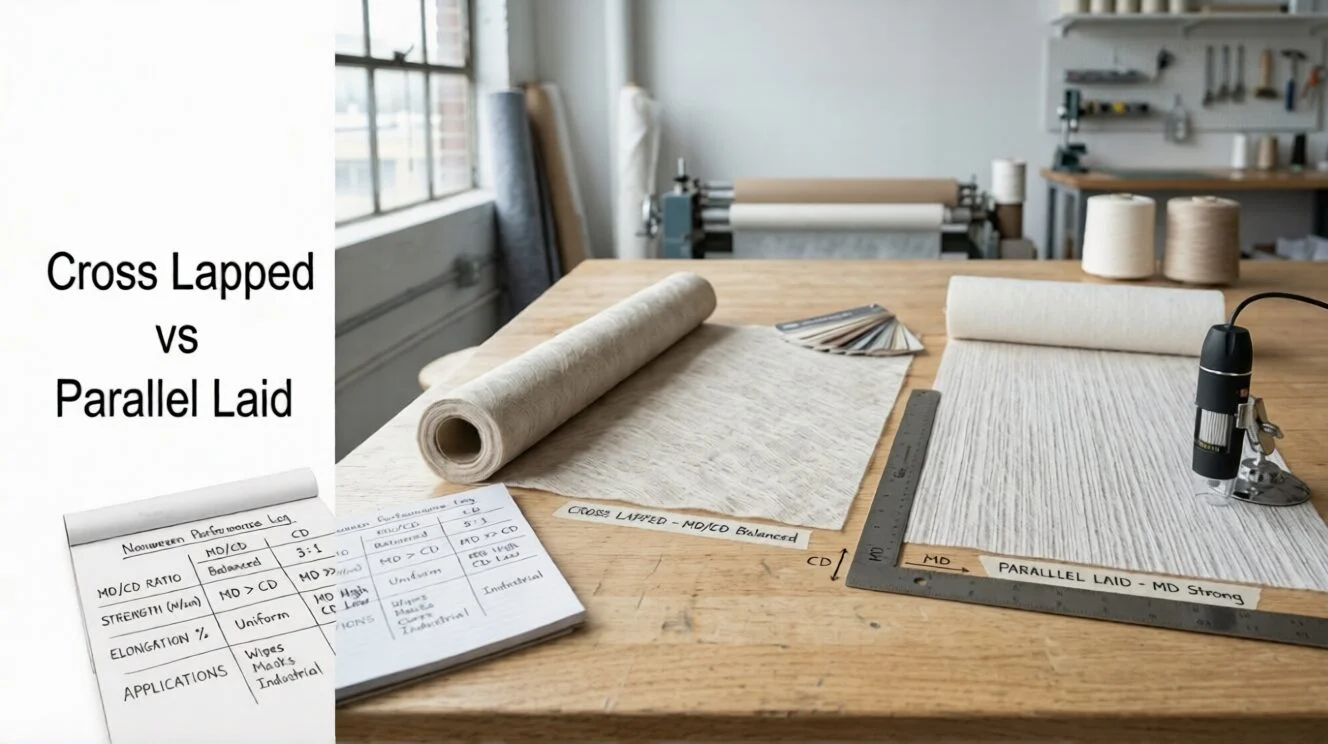
CD/MD ratio is the proportion of fibre orientation in cross-direction (CD) versus machine-direction (MD) of a nonwoven web. A 1:1 isotropic ratio gives balanced strength in all directions; high MD ratios (3:1) suit converting lines but tear easily across width. Optimisation depends on end-use — wet wipes, medical gowns, geotextile, or automotive each have ideal targets.
Nonwoven Cross Direction Machine Direction Ratio Optimization — Specifications and Options
| Material / Property | Specification | Detail |
|---|---|---|
| Web-laying process | Parallel / cross-lap / random | Determines CD/MD ratio |
| Isotropic (1:1) | Spunlace cross-lapped | Best for medical, wipes |
| Anisotropic MD-dominant | 3:1 to 5:1 | Suits high-speed converting |
| Tensile balance MD/CD | Ratio 1.0–1.5 | Premium hygiene topsheet |
| Elongation balance | MD≥CD ×0.7 | Drape and conformability |
| Test method | EDANA 110.1 | Tensile MD + CD |
| Typical industry targets | Wipes 1:1, geotextile 1.5:1 | Application-specific |
Why Source From Favourite Fab
- MOQ-friendly — suitable for small and large OEM manufacturers
- Export-ready — ships raw materials to 50+ countries from Agra, India
- ISO 9001 certified manufacturing facility
- 10+ years supplying nonwoven raw materials to industrial and hygiene OEMs
- Custom GSM, width, and treatment available on request
Pricing and MOQ
Favourite Fab offers competitive wholesale pricing structured for B2B procurement. Minimum order quantity is 500 kg per specification, with sample rolls of 10–20 kg available for machine trials. Volume pricing available for orders above 5,000 kg per month — send your specifications for a same-day FOB quote.
How to Order
- Send material specifications to sale@favouritehub.com — fabric type, GSM, width, monthly volume, treatments required
- Receive FOB or CIF quote and dispatched sample within 48 hours
- Confirm order — production starts and dispatch within 21–30 days
Frequently Asked Questions
Q: Why does CD/MD ratio matter in converting?
A: Converting machines apply stress in machine-direction during slitting, embossing, and packaging. High MD strength prevents breakage. But excessive MD bias causes tearing during cross-cutting — balance is the goal.
Q: How is CD/MD ratio controlled in spunlace?
A: Cross-lapping camel-back layer angle (5°–45°) directly controls the ratio. 0° = pure MD orientation, 90° cross-lap = strongly CD-biased. Most converters tune to 30°–45° for 1.2:1 MD/CD.
Q: What CD/MD ratio for surgical gowns?
A: Surgical gown topsheet targets 1.1:1 MD/CD for balanced drape and seam strength. Excessive MD bias causes shoulder-seam splitting during patient handling.
Q: Can Favourite Fab supply custom CD/MD ratios?
A: Yes. Our spunlace cross-lap angle is adjustable per order — quote your MD/CD target tensile and elongation values, we tune the line accordingly.
Q: How does CD/MD impact wet-wipe pack opening force?
A: Pop-up wipe stacks require balanced 1:1 to peel cleanly without inter-wipe tearing. MD-biased webs cause wipes to rip during automated pack-opening, leading to consumer complaint.
Q: Where in the TDS is CD/MD ratio shown?
A: Our TDS section 4 (Mechanical Properties) shows MD and CD tensile + elongation. Ratio calculated as MD-value ÷ CD-value, target ratio noted per grade.
Contact Favourite Fab
Email: sale@favouritehub.com
WhatsApp: +91-8800775462
Send your nonwoven fabric specifications today — fabric type, GSM, width, treatments, monthly volume. Receive a same-day quote and 10–20 kg sample dispatch within 48 hours for machine trials.
Technical Specifications — CD/MD Ratio by Fabric Type
| Fabric Formation | Typical CD/MD Ratio | Tensile Balance | Best For |
|---|---|---|---|
| Parallel-lay (parallel-lapped) | 1:5 – 1:10 (MD dominant) | High MD, low CD | Filter media, conveyor belts, geotextile strips |
| Cross-lapped (cross-laid) | 1:1.5 – 1:3 (near-balanced) | Good biaxial strength | Roofing membrane, automotive liners, wipes |
| Random-lay (air-laid / spunbond) | ~1:1 (isotropic) | Uniform all directions | Hygiene topsheet, medical nonwoven, wipes |
| Needle-punch (cross-lapped base) | 1:2 – 1:4 | Improved Z-direction | Geotextile, felt, carpet underlay |
| Spunlace (hydroentangled) | 1:1 – 1:2 | Soft, flexible | Wipes, medical drapes, cosmetic pads |
B2B Applications & OEM Use-Cases
- Filter Media OEMs: Manufacturers of pleated filter cartridges specify high MD-dominant fabric (CD/MD 1:8–1:10) to ensure the media resists tearing along the pleat fold direction during pleating and pulse-jet cleaning cycles, where machine-direction tensile strength is the primary failure mode.
- Geotextile and Civil Engineering Suppliers: Companies supplying needle-punch geotextile for road base separation and slope stabilisation require controlled CD/MD ratios (typically 1:2–1:3) to ensure the geotextile distributes load equally in both directions when installed in bidirectional stress fields.
- Hygiene and Medical Product Manufacturers: Sanitary napkin and medical drape OEMs require near-isotropic (1:1–1:1.5) spunbond or spunlace nonwoven to ensure consistent product performance and converting behaviour on high-speed production lines regardless of machine feed direction.
Sourcing from Favourite Fab — MOQ, Lead Time & Customisation
- MOQ: 500 kg per specification
- Lead Time: 7–14 days domestic India / 21–30 days export
- Custom Options: CD/MD ratio targeting by formation type, GSM, width 1.6 m–3.2 m, fibre type (PP/PET/viscose), tensile balance certification
- Certification: ISO 9001 certified manufacturing facility, Agra, India
- Pricing: Competitive wholesale pricing — contact our B2B sales team for volume quotations
Frequently Asked Questions
Why does CD/MD ratio matter when selecting nonwoven fabric for OEM manufacturing?
CD/MD ratio directly affects how a nonwoven performs during converting (cutting, pleating, laminating) and in end-use. A highly MD-dominant fabric (1:8 ratio) will tear easily in the cross direction — acceptable in pleated filters but problematic in roofing membranes or geotextiles under biaxial load. Understanding the CD/MD ratio of your incoming nonwoven prevents line breakdowns, product defects, and field failures. Favourite Fab provides CD/MD test data with every shipment.
How can I improve the CD/MD ratio of a nonwoven fabric I currently source?
CD/MD ratio is set during the web-formation stage — it cannot be altered post-production. If your current supplier’s fabric has an imbalanced ratio, you need to change the fabric specification. Options include switching from parallel-lay to cross-lap formation, requesting a higher GSM (heavier fabric improves CD strength), or switching to a random-lay (spunbond) construction for near-isotropic properties. Favourite Fab can produce the same GSM in different formations — contact us with your current test data for a targeted recommendation.
What test method is used to measure CD and MD tensile strength?
CD and MD tensile strength are measured using ISO 9073-3 (nonwoven tensile properties) or ASTM D5034 (grab tensile). Test specimens are cut in both the machine direction (parallel to the winding axis) and the cross direction (perpendicular to winding), then pulled to failure on a universal testing machine. The resulting peak force values give the CD/MD ratio. Favourite Fab’s QC laboratory performs this test on every production batch and provides the data in the Certificate of Analysis.
Related B2B Resources

Gaurav Garg
I'm Gaurav Garg, CEO of Favourite Fab, a company on a mission to revolutionize the nonwoven industry with sustainable practices. We work hand-in-hand with manufacturers and suppliers who share our commitment to eco-friendly production. With a deep interest in textile innovation, I'm passionate about educating consumers about sustainable material options and their potential to transform the nonwoven landscape.


