

Nonwoven Fabric for EO & Gamma Sterilisation — Medical Grade Supplier India
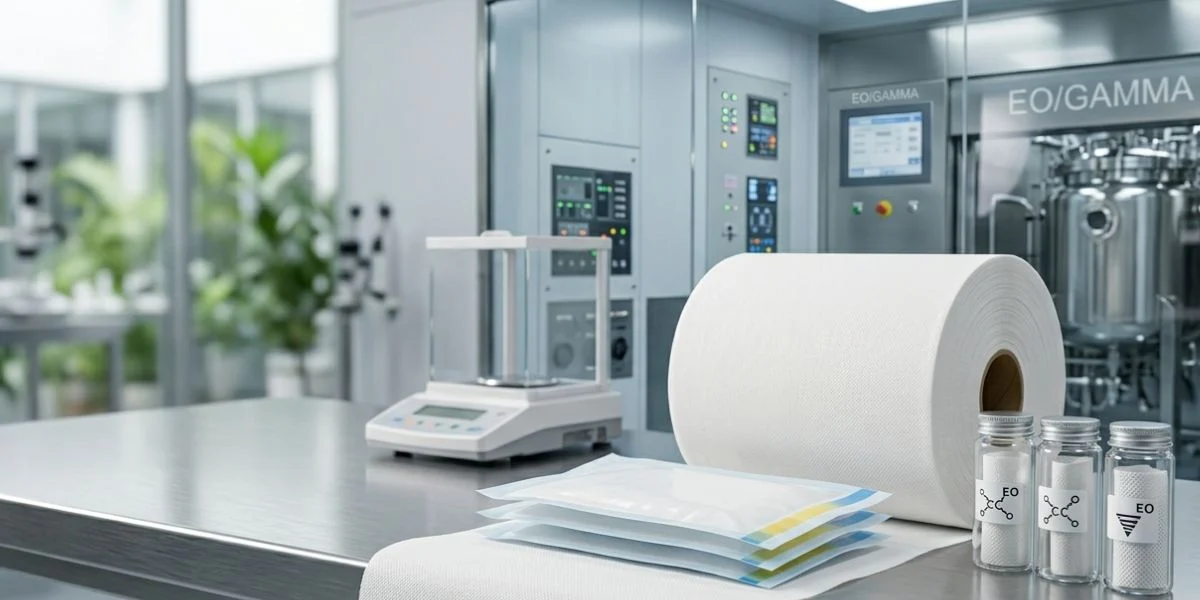
Nonwoven fabric used in medical devices, surgical consumables, and sterile packaging must be compatible with the sterilisation method used by the device manufacturer. Ethylene oxide (EO) and gamma irradiation are the two most common sterilisation methods for nonwoven-based medical products. Favourite Fab’s SMS, SSMMS, and spunlace grades have been validated for EO sterilisation at 54–60°C and gamma sterilisation at 25–40 kGy — with no significant strength degradation, colour change, or extractable contamination after sterilisation.
Browse our full range: View all nonwoven fabric products — spunlace, spunbond, SMS, bico — with GSM, width and certification options. B2B MOQ from 500 kg.
Technical Specifications
| Parameter | Specification |
|---|---|
| EO compatible grades | PP SMS, SSMMS, viscose spunlace, PP spunbond |
| Gamma compatible grades | PP SMS, SSMMS, viscose/PET spunlace, PP spunbond |
| Steam autoclave | PET spunlace only (121–134°C) |
| E-beam | PP SMS, SSMMS, spunlace |
| Post-sterilisation strength | ≥85% of pre-sterilisation tensile (ASTM F2638) |
| MOQ | 500 kg |
Applications
Surgical gowns, wound dressings, sterile drapes, medical packaging pouches, procedure packs, surgical instrument wraps.
Why Source from Favourite Fab
Direct manufacturer, Agra India. Full range: medical nonwoven fabric. Related: spunlace nonwoven fabric.
- Factory direct — no distributor margin
- Custom slit widths 10 mm–260 cm, ±1 mm tolerance
- COA per batch — MVTR, tensile, heat seal, GSM
- Sample rolls dispatched 3–5 working days
- Export ready — FOB Nhava Sheva / ICD Tughlakabad
Frequently Asked Questions
Which nonwoven fabrics are compatible with EO sterilisation?
PP spunbond (SMS, SSMMS), viscose spunlace, and PP/viscose blends are all EO-compatible at 54–60°C processing temperature. EO penetrates the fabric easily. Residual EO degasses within 24–48 hours aeration per ISO 11135. Avoid EO for fabrics with moisture-sensitive coatings.
Does gamma sterilisation affect nonwoven tensile strength?
PP-based fabrics (SMS, spunbond) experience slight yellowing and up to 10–15% tensile reduction at 25 kGy. This is accounted for in design — post-gamma tensile still exceeds performance requirements. Viscose spunlace has excellent gamma stability with <5% tensile change at 25 kGy.
What documentation does Favourite Fab provide for sterilisation validation?
We provide: material composition declaration, sterilisation compatibility test reports (pre/post tensile, colour, extractables), recommended sterilisation parameters, and ISO 10993 biocompatibility data. Sufficient for inclusion in medical device technical files for CE/FDA submissions.
B2B Applications & End-Uses
Nonwoven fabric for EO and gamma sterilisation applications is a precision procurement decision that directly affects the sterility assurance level (SAL) of the finished medical device or sterile barrier system. Sterile barrier pouch manufacturers producing peelable pouches per ISO 11607-1 specify nonwoven lid-stock or pouch body materials that maintain seal integrity and microbial barrier performance post-sterilisation across the validated number of cycles — typically 1 cycle for disposable devices, up to 3 cycles for some reprocessable configurations. Surgical kit packagers use nonwoven wrap or formed tray lidding as the primary sterile barrier around instrument sets processed through hospital CSSD (Central Sterile Supply Department) EO cycles.
Wound dressing and advanced wound care OEMs packaging contact layers, foam dressings, and antimicrobial dressings in peelable pouches require nonwoven pouch substrate that withstands 25 kGy gamma irradiation — the ISO 11137 minimum dose for SAL 10⁻⁶ — without yellowing, tensile degradation, or off-gassing that could affect enclosed product biocompatibility. Radiation-stable nonwoven formulations using low-MFI PP grades and UV-stabiliser-free resin systems are specified for gamma applications. Medical device OEMs in the EU must demonstrate sterilisation method compatibility as part of their technical file under Annex I of EU MDR — Favourite Fab provides sterilisation stability test data to support this documentation requirement.
Single-use surgical drape, gown, and pack manufacturers source EO-compatible nonwoven for SMS outer layers and internal wrap sheets. Hospital distribution networks supplying pre-assembled procedure packs to operating theatre departments require consistent sterile barrier performance across all nonwoven components. Dental device manufacturers packaging impression materials, orthodontic instruments, and biopsy tools use EO-sterilised peelable pouches where nonwoven lid-stock must allow gas ingress and evacuation uniformly across the pouch area during the sterilisation cycle.
Certifications & Quality Assurance
Nonwoven fabric supplied for sterilisation applications undergoes validation testing per ISO 11607-1 (sterile barrier systems) and ISO 11135 (EO sterilisation validation) or ISO 11137 (radiation sterilisation validation). EO-grade nonwoven is tested for EO residual levels per ANSI/AAMI/ISO 10993-7 protocols, confirming that residual EO and ethylene chlorohydrin levels in the nonwoven material following a standard 600 mg/L, 54°C, 60% RH cycle remain below ISO-specified biocompatibility limits without extended aeration requirements that would slow your sterilisation cycle throughput.
Gamma-grade nonwoven is subjected to accelerated ageing and real-time ageing per ISO 11607-2 and ASTM F1980 to validate that tensile strength, elongation, seal peel force, and microbial barrier (MBR per ASTM F1608) are maintained post-irradiation at 25 kGy and 50 kGy dose levels. ISO 13485:2016 quality system controls govern production of sterilisation-grade nonwoven, with full batch traceability and retention of production records for a minimum of 10 years. Biocompatibility screening per ISO 10993-1 (cytotoxicity, sensitisation) is available for medical device OEMs requiring biological evaluation data for technical file submission. Certificates of conformance and full sterilisation compatibility test data packs are issued per production lot.
More Questions Answered
Why does EO sterilisation-compatible nonwoven require specific resin grades compared to standard medical nonwoven?
EO sterilisation cycles expose nonwoven fabric to elevated temperature (54–60°C), high relative humidity (60–80% RH), and ethylene oxide gas at concentrations up to 600 mg/L. Standard PP nonwoven produced from general-purpose resin may absorb residual EO into the polymer matrix, resulting in residual levels above ISO 10993-7 limits that require extended aeration periods of 12–24 hours or more before the packaged device can be released. EO-compatible nonwoven grades are produced from low-residue PP resin with minimal plasticiser or antistatic additive content — these additives are the primary reservoir for EO absorption. Resin selection is validated as part of the sterilisation process validation, not assumed from standard medical-grade certification. Always request EO compatibility data specific to the nonwoven grade, not a generic medical-grade certificate.
What is the minimum nonwoven GSM required to achieve ISO 11607 microbial barrier performance for sterile barrier pouches?
ISO 11607-1 does not prescribe a minimum GSM — it requires demonstrated microbial barrier performance per test methods such as ASTM F1608 (bacterial filtration efficiency) or equivalent, with the barrier performance validated as part of the sterile barrier system design. In practice, medical pouch lid-stock nonwoven in the 55–70 GSM range achieves bacterial filtration efficiency of ≥98% (ASTM F2101 / EN 14683 equivalent) consistently, while 40–55 GSM grades are used in applications where peelability and package presentation are prioritised over maximum barrier redundancy. Favourite Fab provides MBR test data for each GSM grade — procurement teams should specify the required BFE threshold in their RFQ rather than GSM alone.
B2B Applications & End-Uses
Nonwoven fabric for EO and gamma sterilisation applications is a precision procurement decision that directly affects the sterility assurance level (SAL) of the finished medical device or sterile barrier system. Sterile barrier pouch manufacturers producing peelable pouches per ISO 11607-1 specify nonwoven lid-stock or pouch body materials that maintain seal integrity and microbial barrier performance post-sterilisation across the validated number of cycles — typically 1 cycle for disposable devices, up to 3 cycles for some reprocessable configurations. Surgical kit packagers use nonwoven wrap or formed tray lidding as the primary sterile barrier around instrument sets processed through hospital CSSD (Central Sterile Supply Department) EO cycles.
Wound dressing and advanced wound care OEMs packaging contact layers, foam dressings, and antimicrobial dressings in peelable pouches require nonwoven pouch substrate that withstands 25 kGy gamma irradiation — the ISO 11137 minimum dose for SAL 10⁻⁶ — without yellowing, tensile degradation, or off-gassing that could affect enclosed product biocompatibility. Radiation-stable nonwoven formulations using low-MFI PP grades and UV-stabiliser-free resin systems are specified for gamma applications. Medical device OEMs in the EU must demonstrate sterilisation method compatibility as part of their technical file under Annex I of EU MDR — Favourite Fab provides sterilisation stability test data to support this documentation requirement.
Single-use surgical drape, gown, and pack manufacturers source EO-compatible nonwoven for SMS outer layers and internal wrap sheets. Hospital distribution networks supplying pre-assembled procedure packs to operating theatre departments require consistent sterile barrier performance across all nonwoven components. Dental device manufacturers packaging impression materials, orthodontic instruments, and biopsy tools use EO-sterilised peelable pouches where nonwoven lid-stock must allow gas ingress and evacuation uniformly across the pouch area during the sterilisation cycle.
Certifications & Quality Assurance
Nonwoven fabric supplied for sterilisation applications undergoes validation testing per ISO 11607-1 (sterile barrier systems) and ISO 11135 (EO sterilisation validation) or ISO 11137 (radiation sterilisation validation). EO-grade nonwoven is tested for EO residual levels per ANSI/AAMI/ISO 10993-7 protocols, confirming that residual EO and ethylene chlorohydrin levels in the nonwoven material following a standard 600 mg/L, 54°C, 60% RH cycle remain below ISO-specified biocompatibility limits without extended aeration requirements that would slow your sterilisation cycle throughput.
Gamma-grade nonwoven is subjected to accelerated ageing and real-time ageing per ISO 11607-2 and ASTM F1980 to validate that tensile strength, elongation, seal peel force, and microbial barrier (MBR per ASTM F1608) are maintained post-irradiation at 25 kGy and 50 kGy dose levels. ISO 13485:2016 quality system controls govern production of sterilisation-grade nonwoven, with full batch traceability and retention of production records for a minimum of 10 years. Biocompatibility screening per ISO 10993-1 (cytotoxicity, sensitisation) is available for medical device OEMs requiring biological evaluation data for technical file submission. Certificates of conformance and full sterilisation compatibility test data packs are issued per production lot.
More Questions Answered
Why does EO sterilisation-compatible nonwoven require specific resin grades compared to standard medical nonwoven?
EO sterilisation cycles expose nonwoven fabric to elevated temperature (54–60°C), high relative humidity (60–80% RH), and ethylene oxide gas at concentrations up to 600 mg/L. Standard PP nonwoven produced from general-purpose resin may absorb residual EO into the polymer matrix, resulting in residual levels above ISO 10993-7 limits that require extended aeration periods of 12–24 hours or more before the packaged device can be released. EO-compatible nonwoven grades are produced from low-residue PP resin with minimal plasticiser or antistatic additive content — these additives are the primary reservoir for EO absorption. Resin selection is validated as part of the sterilisation process validation, not assumed from standard medical-grade certification. Always request EO compatibility data specific to the nonwoven grade, not a generic medical-grade certificate.
What is the minimum nonwoven GSM required to achieve ISO 11607 microbial barrier performance for sterile barrier pouches?
ISO 11607-1 does not prescribe a minimum GSM — it requires demonstrated microbial barrier performance per test methods such as ASTM F1608 (bacterial filtration efficiency) or equivalent, with the barrier performance validated as part of the sterile barrier system design. In practice, medical pouch lid-stock nonwoven in the 55–70 GSM range achieves bacterial filtration efficiency of ≥98% (ASTM F2101 / EN 14683 equivalent) consistently, while 40–55 GSM grades are used in applications where peelability and package presentation are prioritised over maximum barrier redundancy. Favourite Fab provides MBR test data for each GSM grade — procurement teams should specify the required BFE threshold in their RFQ rather than GSM alone.

Gaurav Garg
I'm Gaurav Garg, CEO of Favourite Fab, a company on a mission to revolutionize the nonwoven industry with sustainable practices. We work hand-in-hand with manufacturers and suppliers who share our commitment to eco-friendly production. With a deep interest in textile innovation, I'm passionate about educating consumers about sustainable material options and their potential to transform the nonwoven landscape.


