

Nonwoven Fabric for Electronics Cleanroom Low Lint Antistatic India
Nonwoven fabric for electronics cleanroom low lint antistatic India is a precision raw material category where particle shedding, surface resistivity, and liquid absorption performance determine product suitability. Favourite Fab supplies spunlace and thermally bonded nonwoven fabrics to cleanroom wipe manufacturers, electronics packaging producers, and ESD-sensitive assembly line suppliers. We are an upstream B2B raw material supplier — not a finished wipe or packaging manufacturer.
What Is Electronics Cleanroom Nonwoven Fabric
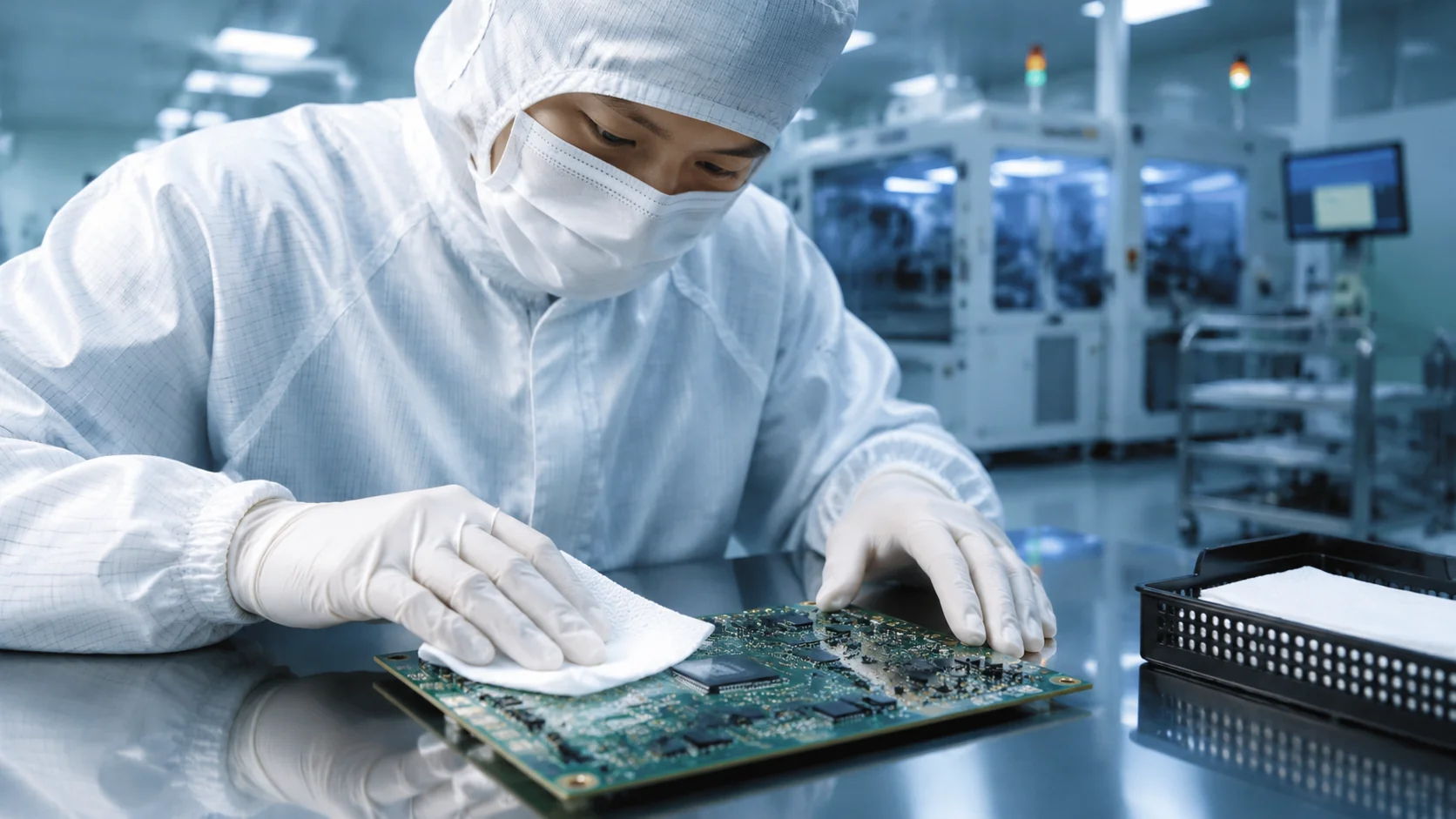
Electronics cleanroom nonwoven fabric is engineered to generate minimal airborne particles during use. In ISO Class 4–7 cleanrooms, any particle above 0.5 µm is a potential defect source. Cleanroom wipes, garments, and packaging must therefore be made from fabrics with documented low particle generation rates.
Spunlace (hydroentangled) nonwoven is the dominant substrate for cleanroom wipes. The hydroentanglement process locks fibres mechanically without adhesives or binders that could shed particles or outgas in sensitive environments. Polyester spunlace is preferred over cellulose blends for semiconductor and hard disk drive (HDD) applications because polyester has lower ionic contamination and better solvent resistance.
Antistatic (ESD dissipative) treatment is applied to fabrics used near electrostatic discharge-sensitive components. Conductive carbon fibre blends or topical ESD treatments reduce surface resistivity to the 10⁶–10⁹ Ω range, meeting ANSI/ESD S20.20 requirements for personnel and equipment protection.
Specifications and Grade Options
| Parameter | Specification | Detail |
|---|---|---|
| Fabric Type | Spunlace (hydroentangled) | No binder — minimal particle and extractable contribution |
| GSM Range | 40–120 gsm | 50–70 gsm standard wipe; 100–120 gsm heavy-duty wipe |
| Fibre Composition | 100% PET, PET/PP blend | 100% PET preferred for low ionic contamination |
| Surface Resistivity | 10⁶–10⁹ Ω (ESD grades) | Compliant with ANSI/ESD S20.20 and IEC 61340 |
| Cleanroom Class | ISO 4–7 | Particle generation per IEST-RP-CC004 test method |
| Absorbency | 400–800% of fabric weight | Critical for solvent wipe-down and spill control |
| Width | 1.6 m standard; slit on request | Pre-slit rolls for automated wipe cutting lines |
Why Nonwoven Fabric Is Used in Electronics Cleanrooms
Electronics manufacturing — semiconductors, PCBs, flat panel displays, hard drives — requires controlled environments where airborne particles and electrostatic discharge cause defects and yield loss. Nonwoven spunlace fabric meets both requirements in a single substrate. It generates fewer particles than cellulose-blend or woven wipers. It can carry permanent or durable antistatic treatments.
During cleanroom wiping operations, ESD dissipative fabric prevents charge build-up on operators and surfaces. This protects MOSFETs, DRAM chips, and other ESD-sensitive components from latent damage that appears as field failure rather than immediate defect — making it harder to trace and more costly to warranty.
Cleanroom garment inner liners and packaging materials also use low-lint spunlace. These ensure that personnel entering ISO Class 5 or 6 zones do not introduce particle contamination from their clothing. Our spunlace nonwoven fabric page details the full range of available grades. For defense and PPE applications using similar barrier fabrics, see our defense PPE nonwoven page. Filtration-grade nonwoven related to cleanroom air handling is covered on our filtration industry nonwoven page.
Why Source From Favourite Fab
- MOQ-friendly — suitable for small and large manufacturers
- Export-ready — ships raw materials to 50+ countries
- ISO certified manufacturing facility
- 10+ years supplying the hygiene and medical industry
- Custom specifications available on request
- ESD and low-lint grades with full particle generation test documentation
Pricing and MOQ
Cleanroom spunlace nonwoven is priced per kg. ESD-treated grades carry a premium of 15–25% over untreated equivalents. MOQ is 300 kg per SKU. Pre-slit rolls and pre-washed (ultra-clean) grades are available at higher MOQ. All cleanroom-grade shipments include COA, particle generation test report, and ESD compliance certificate where applicable.
Our spunbond nonwoven for face masks is also relevant to cleanroom face covering and garment components. Contact us for a multi-grade quotation.
How to Order
- Send your material requirements to sale@favouritehub.com
- Receive a quote and sample within 48 hours
- Confirm order and production begins
Frequently Asked Questions
Q: What is the difference between low-lint and lint-free nonwoven for cleanrooms?
A: “Lint-free” is a marketing term — all fabrics shed some particles. “Low-lint” is measurable per IEST-RP-CC004. Spunlace polyester nonwoven from Favourite Fab is tested to confirm particle generation counts below cleanroom class thresholds. We supply test reports with every batch, not marketing claims.
Q: What surface resistivity is required for ESD cleanroom wipes?
A: ANSI/ESD S20.20 specifies worksurface resistance of 10⁶–10⁹ Ω. ESD wipes used to clean surfaces in EPA (ESD Protected Areas) should fall in the same range. Our ESD spunlace grades are tested to IEC 61340-4-1 and supplied with resistivity certificates.
Q: Can you supply pre-washed cleanroom nonwoven for ISO Class 5 applications?
A: Yes. Ultra-clean washed and double-bagged rolls are available for ISO Class 5 (Class 100) applications. These are laundered in DI water and packaged in a controlled environment. Lead time is longer than standard grades — allow 4–6 weeks. MOQ 500 kg.
Q: Is 100% polyester or PET/cellulose blend better for semiconductor wipes?
A: 100% polyester is strongly preferred for semiconductor applications. Cellulose fibres introduce ionic contamination (potassium, sodium) that degrades oxide layer quality. PET also has better solvent resistance to IPA, acetone, and NMP used in photolithography cleaning steps.
Q: Do you supply cleanroom nonwoven for electronics packaging — not just wipes?
A: Yes. Low-lint spunlace and thermally bonded nonwoven is used for component interleaving, tray liners, and inner bag materials in electronics packaging. These applications require controlled particle generation and often ESD dissipative properties. Contact us with your packaging specification for a tailored quote.
Contact Favourite Fab
Email: sale@favouritehub.com
WhatsApp: +91-8800775462
Send your material specifications today for a same-day quote.
Related B2B Resources

Gaurav Garg
I'm Gaurav Garg, CEO of Favourite Fab, a company on a mission to revolutionize the nonwoven industry with sustainable practices. We work hand-in-hand with manufacturers and suppliers who share our commitment to eco-friendly production. With a deep interest in textile innovation, I'm passionate about educating consumers about sustainable material options and their potential to transform the nonwoven landscape.


