

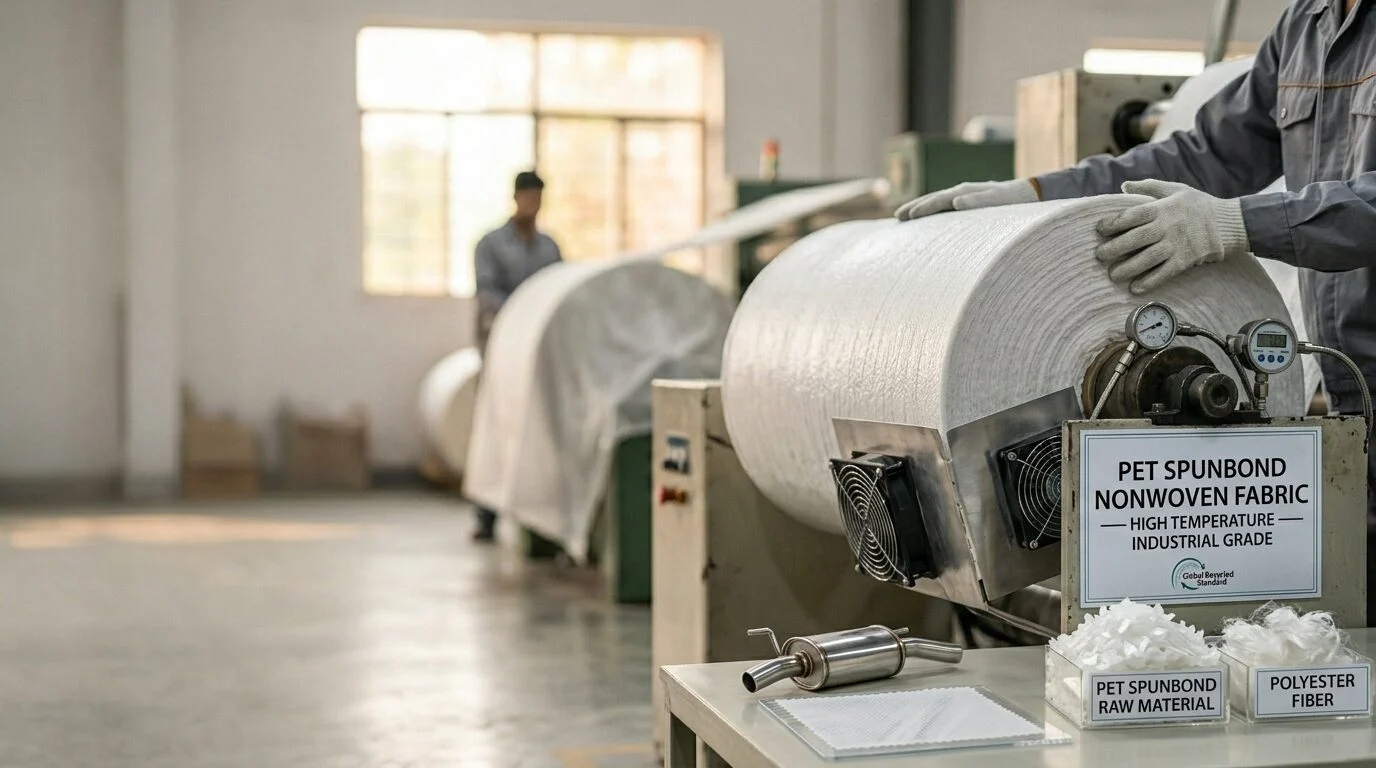
PET Spunbond Nonwoven Fabric — High Temperature Industrial Grade India
PET spunbond nonwoven fabric — Favourite Fab manufactures 100% polyester spunbond in 30–300 GSM for geotextile, automotive, filtration, and roofing applications. PET spunbond nonwoven fabric withstands continuous temperatures up to 200°C, inherently resists UV degradation, and delivers tensile strength up to 800 N/5cm — properties that PP spunbond cannot match. B2B manufacturers sourcing high-temperature industrial nonwoven choose PET spunbond for reliability in demanding end-use environments.
What Is PET Spunbond Nonwoven Fabric
PET spunbond nonwoven is produced by extruding continuous polyester (PET) filaments, drawing them to orient the polymer chains, then thermally bonding the laid web under heat and pressure. The result is a dimensionally stable, uniform fabric with bonded filament-to-filament structure — no adhesives, no binders, no weaving.
The continuous filament structure gives PET spunbond its high tensile-to-weight ratio and dimensional stability under mechanical load. A 100 GSM PET spunbond typically delivers 300–400 N/5cm tensile strength MD — sufficient for geotextile separation and drainage filtration without heavy weight penalty.
PET polymer structure gives inherent UV resistance without additives — critical for outdoor geotextile and roofing applications where PP spunbond would require UV stabilisers that degrade over time. For road construction, slope erosion control, and roofing underlayment — PET spunbond nonwoven fabric is the specification-grade choice.
PET Spunbond Nonwoven — Technical Specifications
| Parameter | Specification |
|---|---|
| GSM range | 30–300 GSM |
| Fibre type | 100% PET (polyethylene terephthalate) continuous filament |
| Continuous use temperature | Up to 200°C |
| Softening point | ~220°C (vs PP spunbond at ~130°C) |
| Tensile strength MD | 100–800 N/5cm (ASTM D4595) |
| Tensile strength CD | 80–600 N/5cm |
| UV resistance | Inherent — no stabiliser additives required |
| Chemical resistance | Resists acids, alkalis, most solvents |
| Width | 160–260 cm |
| Colour | White standard; custom colour on request |
| MOQ | 500 kg |
| rPET grade | GRS-certified available 80–200 GSM |
GSM Selection Guide by Application
| Application | Recommended GSM | Key Requirement |
|---|---|---|
| Road separation geotextile | 100–150 GSM | Tensile ≥300 N/5cm, CBR puncture |
| Drainage filtration geotextile | 80–120 GSM | AOS 0.075–0.25 mm, permittivity |
| Slope erosion control | 150–300 GSM | High tensile, flow rate |
| Roofing underlayment | 100–180 GSM | UV resistance, dimensional stability |
| Automotive trunk liner | 80–150 GSM | Heat resistance, surface uniformity |
| Liquid filtration support | 50–100 GSM | Chemical resistance, pore uniformity |
| Bonnet insulation backing | 100–200 GSM | Thermal stability >150°C |
Applications
PET spunbond nonwoven fabric serves four primary industrial sectors where temperature resistance and mechanical performance are critical:
- Geotextile and civil engineering: PET spunbond is the specification material for road construction separation layers, drainage blankets, and erosion control mats. Tensile up to 800 N/5cm, conforming to IS 14324 and ASTM D6707 geotextile standards. Widely used by NHAI contractors and state highway departments.
- Automotive: 100–200 GSM PET spunbond for trunk liners, parcel shelf backing, door panel substrate, and bonnet insulation. PET handles underbonnet temperatures (150–200°C) that deform PP-based materials. Accepted by Tier-1 automotive suppliers.
- Industrial filtration: 50–120 GSM PET spunbond as filter support fabric and pre-filter media in liquid filtration systems. Chemical resistance allows exposure to process acids, alkalis, and organic solvents without fibre degradation.
- Roofing and waterproofing: 100–180 GSM PET spunbond as reinforcement carrier for bituminous waterproofing membranes and breathable roofing underlayment. Inherent UV resistance eliminates additive-related long-term degradation.
rPET Spunbond — GRS Certified Grade
Favourite Fab supplies GRS-certified recycled PET spunbond nonwoven from 80–200 GSM. Produced from post-consumer PET bottles, traceable through the supply chain per Global Recycled Standard requirements. GRS certificate issued per batch for ESG audit and sustainability reporting.
rPET spunbond delivers identical tensile, temperature, and chemical resistance to virgin PET at equivalent GSM. CO₂ reduction: 30–50% vs virgin PET production. For construction and automotive buyers with sustainability mandates or scope 3 reporting — rPET spunbond provides full GRS documentation chain.
Why Source From Favourite Fab
- Direct manufacturer — no trader markup, competitive wholesale pricing
- Custom GSM (30–300) and width (160–260 cm) available
- IS 14324 compliant geotextile grades in stock
- GRS-certified rPET available for ESG procurement
- COA per batch — GSM, tensile MD/CD, elongation, uniformity
- Sample dispatch in 3–5 working days
- Export-ready — 50+ countries, complete documentation
Pricing and MOQ
PET spunbond nonwoven pricing depends on GSM, order quantity, and grade (virgin PET or GRS rPET). Competitive wholesale pricing for B2B manufacturers. MOQ 500 kg per grade. Container-load pricing available for 40ft HC (typically 8–12 MT for 100–150 GSM rolls). Contact sales for a volume price schedule.
How to Order
- Share material specifications — GSM, width, quantity, application — via sale@favouritehub.com
- Receive quotation and sample availability within 48 hours
- Approve sample, confirm order — production lead time 10–15 working days
- Receive shipment with COA and GRS certificate (rPET grade)
Frequently Asked Questions
What is the maximum temperature for PET spunbond nonwoven?
PET spunbond maintains structural integrity up to 200°C continuous. It softens at approximately 220°C. PP spunbond softens at 130°C — PET spunbond nonwoven fabric is the correct choice for automotive underbonnet, geotextile, and high-temperature filtration applications where fabric temperature regularly exceeds 120°C.
What GSM of PET spunbond is required for road geotextile?
Road separation layers use 100–150 GSM PET spunbond conforming to IS 14324. Drainage filtration geotextile uses 80–120 GSM with appropriate AOS for the site soil particle distribution. Slope erosion control uses 150–300 GSM. Geotechnical specification matching available on request.
Is GRS-certified rPET spunbond available?
Yes. GRS-certified recycled PET spunbond is available from 80–200 GSM. GRS certificate documents post-consumer recycled content and supply chain traceability. Certificate per production batch for sustainability reporting. rPET spunbond performs identically to virgin PET at equivalent GSM.
Can PET spunbond be used for automotive interior components?
Yes. 100–200 GSM PET spunbond is widely used for automotive trunk liners, parcel shelves, door panel backing, and bonnet insulation. Thermal stability up to 200°C continuous makes it suitable for underbonnet environments. Surface can be needle-punched post-process for pile or texture on request.
What is the difference between PET spunbond and PP spunbond?
PET spunbond withstands up to 200°C (vs PP at 120°C), resists UV inherently (PP requires UV stabiliser additives), and has higher tensile modulus for stiffer, more dimensionally stable fabrics. PP spunbond is lower cost — preferred for hygiene, medical, and agriculture. Choose PET spunbond when temperature, UV exposure, or mechanical load exceeds PP capability.
What is the MOQ for PET spunbond nonwoven from Favourite Fab?
MOQ is 500 kg per grade and GSM. Sample orders of 5–10 kg for qualification trials — dispatch within 3–5 working days. Container-load pricing (40ft HC, 8–12 MT) available for high-volume orders.
Is PET spunbond recyclable, and how does it fit into circular economy procurement commitments?
PET spunbond is fully recyclable within the standard PET mechanical recycling stream — the same infrastructure that processes PET bottles and PET film. Single-component PET spunbond without lamination or chemical binder add-ons is particularly clean for recycling, achieving high regrind quality suitable for fibre or film re-extrusion. For buyers with EPR (Extended Producer Responsibility) obligations under India’s Plastic Waste Management Rules (where applicable to nonwoven) or EU Packaging and Packaging Waste Regulation targets, PET spunbond’s established recycling pathway provides a documentable end-of-life management option. GRS-certified PCR-PET grades close the loop further by incorporating pre-consumer or post-consumer recycled PET as the raw material input.
At what GSM does PET spunbond become cost-competitive versus woven polyester technical fabric?
PET spunbond is generally cost-competitive versus woven polyester technical fabric at equivalent functional performance for geotextile and filtration media applications in the 80–200 GSM range. Below 80 GSM, woven fabrics of equivalent strength are difficult to produce economically; above 200 GSM, needle-punched PET becomes competitive with spunbond. The correct comparison is always performance-per-unit-cost rather than GSM-per-cost: for applications requiring high in-plane uniformity, consistent pore size, and isotropic mechanical properties, PET spunbond often delivers better performance per rupee than woven alternatives even where the fabric unit price is higher. Request a formal technical comparison with your performance specification for a quantified analysis.
Contact Favourite Fab
PET spunbond nonwoven fabric manufacturer India — send your specifications for a same-day quote.
Email: sale@favouritehub.com
WhatsApp: +91-8800775462
Favourite Fab, Agra, Uttar Pradesh, India — direct manufacturer supplying PET spunbond nonwoven to 50+ countries. Send your material specifications today for a same-day quote.
PET spunbond nonwoven fabric Supplier & Wholesaler India — Bulk Sourcing
Favourite Fab is a direct PET spunbond nonwoven fabric manufacturer, B2B supplier, and wholesale distributor based in Agra, India — serving manufacturers across India and 50+ export countries. We sell at factory-direct wholesale prices with no trader markup.
Direct Manufacturer — Agra Factory
ISO-certified production facility, 10+ years specialised in PET spunbond nonwoven fabric. In-house QC lab with COA per batch (GSM, tensile, elongation, uniformity). Production capacity scales from 500 kg sample lots to full container loads.
Bulk Supplier — Custom Specifications
Custom GSM, width, finish, and colour available on request. Production lead time 10–15 working days after specification approval. Sample dispatch in 3–5 working days for qualification trials. Hydrophilic/hydrophobic finish and special treatments on request.
Wholesaler India — Container-Load Pricing
Wholesale pricing for B2B manufacturers, distributors, and importers. MOQ 500 kg per grade. Container-load pricing for 40ft HC orders (typically 8–15 MT depending on GSM and roll dimensions). Pan-India delivery via road and rail. Export shipping documentation included (Invoice, Packing List, COO, MTC, GSP).
Why Choose Favourite Fab as Your PET spunbond nonwoven fabric Manufacturer + Supplier + Wholesaler
- Direct factory pricing — no middleman markup
- MOQ-friendly — supports small to large manufacturers
- Export-ready to 50+ countries with full shipping docs
- COA per batch + GRS certification where applicable
- Sample dispatch 3–5 working days
- Custom GSM, width, finish on request
- Pan-India delivery + container-load exports
Contact for wholesale price list 2026: sale@favouritehub.com | WhatsApp +91-8800775462 | Focus: PET spunbond nonwoven manufacturer supplier wholesaler India
PET vs PP Spunbond — Application Engineering
Polyester (PET) spunbond nonwoven occupies a technically distinct position from polypropylene spunbond across multiple performance dimensions — and the procurement decision between the two is fundamentally an engineering specification choice rather than simply a cost comparison. In applications where temperature resistance, dimensional stability under load, UV durability, or specific tensile requirements exceed PP spunbond’s capability envelope, PET spunbond is the correct technical selection regardless of the cost differential.
Roofing underlayment and breather membrane is the highest-volume technical application for PET spunbond. Under metal roof decking that routinely reaches 70–80°C surface temperature in Indian and GCC climates, PP spunbond begins to creep and dimensionally distort — PET spunbond, with a continuous service temperature to 200°C, maintains dimensional integrity under sustained thermal loading. This is not a marginal advantage; it determines whether the underlayment remains bonded and sealed across the full roof service life. PET spunbond at 60–150 GSM is the substrate of choice for membrane laminate roofing products in demanding thermal environments.
Geotextile applications requiring long-term in-ground performance — permanent retaining walls, landfill liner protection, railway sub-ballast — favour PET over PP because PET’s hydrolytic stability in wet soil environments (particularly at neutral-to-acidic pH) and resistance to soil-borne chemical degradation provides a longer service life. ASTM D4759 long-term design strength reduction factors for PET geotextile are more favourable than for PP, supporting higher design loads and longer design life calculations in civil engineering specifications.
Automotive headliner base substrate, parcel shelf facing, door panel backing, and trunk liner are applications where PET spunbond’s stiffness, temperature resistance, and ability to accept thermoforming in matched-die moulding tools makes it preferable to PP. Carpet primary backing, needle-punch filtration base fabric, and air filtration pleat support are further segments where PET spunbond’s mechanical properties at elevated temperature, superior adhesion to hot-melt adhesives, and recyclability into the PET stream are procurement decision factors. PET spunbond at 30–300 GSM is available from Favourite Fab across standard widths for all of these application categories.
Certifications & Test Standards
PET spunbond quality is verified against EDANA standard test methods aligned to specific application markets. Tensile strength and elongation at break (MD and CD) is tested per EDANA ERT 20.2, with minimum values at 80 GSM of MD ≥100 N/5cm and CD ≥60 N/5cm for standard engineering grades. Tear resistance (trapezoid method, ASTM D4533) and burst strength (ASTM D3786 / ISO 13938) complete the mechanical property suite for filtration and geotextile grades.
Thermal dimensional stability is a critical differentiating test for PET spunbond — verified by measuring shrinkage per ISO 5077 after oven exposure at 150°C (30 min) to confirm that the PET polymer molecular weight and crystallinity profile is consistent with the declared temperature resistance specification. UV stabilisation (for grades without inherent UV resistance) is validated by accelerated weathering per ISO 4892-2 (Xenon arc) or ASTM G155, with tensile retention after defined UV dose reported.
OEKO-TEX Standard 100 certification is available for PET spunbond grades used in automotive interior, carpet, and insulation applications where occupant exposure warrants restricted substance compliance documentation. Post-consumer recycled (PCR) PET fibre content grades are available for customers with sustainability procurement mandates requiring declared recycled content — supply chain traceability documentation supporting GRS (Global Recycled Standard) is provided on request for applicable lots.
Related B2B Resources

Gaurav Garg
I'm Gaurav Garg, CEO of Favourite Fab, a company on a mission to revolutionize the nonwoven industry with sustainable practices. We work hand-in-hand with manufacturers and suppliers who share our commitment to eco-friendly production. With a deep interest in textile innovation, I'm passionate about educating consumers about sustainable material options and their potential to transform the nonwoven landscape.


