

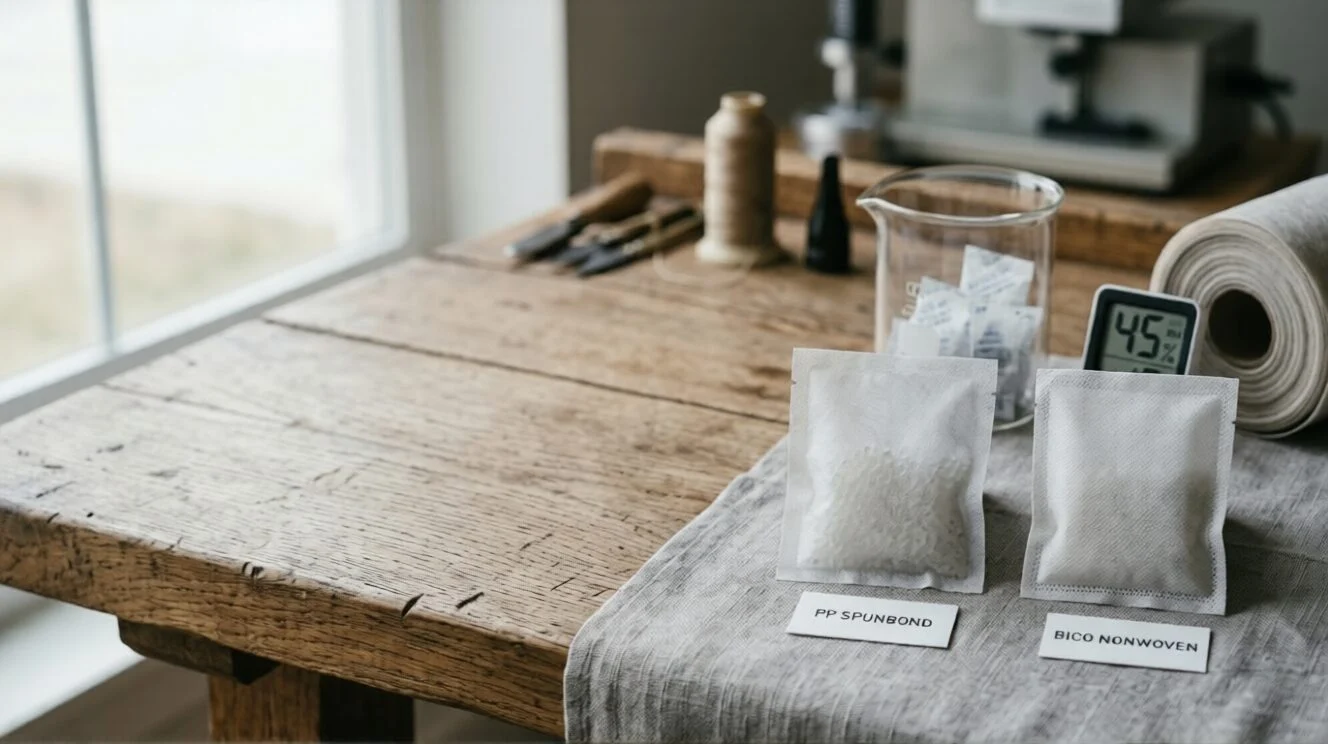
PP Spunbond vs Bico Nonwoven for Desiccant Pouches — Which is Better?
Both PP spunbond and PE/PP bico spunbond are used for desiccant sachet manufacturing. The key differences are sealing temperature and line speed. This comparison helps sachet manufacturers choose the right substrate for their filling equipment.
Browse our full range: View all nonwoven fabric products — spunlace, spunbond, SMS, bico — with GSM, width and certification options. B2B MOQ from 500 kg.
Comparison Table
| Property | PP Spunbond | PE/PP Bico Spunbond |
|---|---|---|
| Seal temperature | 150–165°C | 120–135°C |
| Seal strength | 10–15 N/25mm | 12–18 N/25mm |
| MVTR | Equivalent | Equivalent |
| Hand feel | Standard | Softer (PE sheath) |
| Cost | Lower | 5–15% higher |
| Best for | Standard desiccant sachets | Pharma, premium, high-speed lines |
FAQ
Why would I pay more for bico in desiccant sachets?
Lower sealing temperature means 20–30% faster line speed on sachet sealing machines. For pharma applications, lower heat prevents indicator silica gel from activating prematurely. Premium consumer-facing sachets benefit from softer hand feel.
Is MVTR different between PP and bico?
No significant difference at equivalent GSM. Both achieve 500–2,000 g/m²/day MVTR depending on GSM. Choose based on sealing temperature requirements, not MVTR.
Full range: desiccant nonwoven fabric. Related: breathable nonwoven fabric for sachets.
B2B Applications & End-Uses
Desiccant sachet packaging OEMs face a specific material selection problem: the nonwoven sachet fabric must allow moisture vapour to pass freely into the desiccant fill while maintaining sufficient mechanical strength to survive automated filling, sealing, and downstream handling — including vibration in transit and humidity cycling in storage. PP spunbond and bicomponent (bico) nonwovens are the two dominant substrate choices, each with distinct process and performance trade-offs that directly affect sachet line efficiency and product shelf life.
PP spunbond nonwoven (typically 30–80 GSM) is the cost-baseline substrate for standard silica gel and molecular sieve sachets destined for general cargo moisture protection, pharmaceutical bottle inserts, and electronics packaging. Its moisture vapour transmission rate (MVTR), measured by ASTM E96 Method B or JIS Z 0208, ranges from 1,500 to 3,500 g/m²/24h depending on GSM and bonding pattern. The open spunbond structure allows rapid desiccant activation. Heat-seal integrity on standard rotary sachet machines is adequate for PP spunbond when seal bar temperature is held at 160–180°C, though the usable sealing window is narrower than bico alternatives.
Bicomponent nonwoven (PE/PP or PE/PET core-sheath construction, typically 40–80 GSM) was developed specifically to address sealing reliability on high-speed automated sachet lines. The PE sheath component melts at approximately 130°C — well below the PP core melt point of 165°C — creating a wide, forgiving seal window that reduces seal failure rates on multi-lane sachet equipment running at 200+ sachets per minute. This wider sealing window is the primary commercial driver for bico adoption in industrial and pharmaceutical desiccant packaging despite the higher per-kilogram fabric cost.
For pharmaceutical and medical device packaging OEMs operating under 21 CFR Part 211 or EU GMP Annex 1, desiccant sachet integrity is a validated process parameter. Bico nonwoven’s consistent seal strength — measured by ASTM F88 peel test — provides a more reproducible validation baseline than PP spunbond, reducing the frequency of seal integrity failures during process validation and routine in-process checks. This makes bico the preferred specification in regulated manufacturing environments regardless of cost differential.
Certifications & Quality Assurance
PP spunbond and bico nonwoven for desiccant sachet applications are tested for MVTR (ASTM E96 / JIS Z 0208), basis weight uniformity (ISO 9073-1), tensile strength (ISO 9073-3), and heat-seal strength (ASTM F88). For pharmaceutical-grade supply, material safety data sheets, FDA indirect food contact status (21 CFR), and absence of restricted substances under REACH are documented per production lot.
Bico nonwoven seal strength COA is issued per lot with peel force data (N/25mm) at reference seal conditions. Customers running automated validation on sachet lines can request process capability data (Cpk) from reference sealing trials. OEKO-TEX Standard 100 certification is available for grades used in consumer product packaging with indirect human contact. All export shipments carry material composition declarations and HS code documentation.
More Questions Answered
What MVTR values should desiccant sachet OEMs specify for PP spunbond vs bico?
PP spunbond at 40 GSM typically achieves 2,500–3,500 g/m²/24h MVTR under ASTM E96 Method B conditions. Bico nonwoven at equivalent GSM achieves similar or slightly lower MVTR due to the PE sheath’s denser surface, typically 1,800–2,800 g/m²/24h. For applications where desiccant activation speed is critical, PP spunbond is marginally preferred; where sealing reliability dominates, bico is the standard choice regardless of MVTR difference.
Can Favourite Fab supply sachet fabric pre-printed with product identification?
Flexographic printing on both PP spunbond and bico nonwoven is available for customers requiring batch code, product name, or compliance markings on the sachet fabric. Print registration and ink adhesion specifications are confirmed prior to production. Minimum print run quantities apply and are disclosed at quotation stage.
Is bico nonwoven compatible with ultrasonic sealing as well as heat sealing?
Yes. PE/PP bico nonwoven is compatible with both rotary heat sealing and ultrasonic sealing systems. The PE sheath’s lower melting point facilitates ultrasonic bonding at standard anvil frequencies (20–40 kHz) with reduced energy input compared to PP spunbond. Customers converting to ultrasonic sealing lines should validate bico seal parameters against their specific equipment before full production.
Related: SMS non woven fabric for desiccant bags and non woven rolls for automatic desiccant pouch packing machine.

Gaurav Garg
I'm Gaurav Garg, CEO of Favourite Fab, a company on a mission to revolutionize the nonwoven industry with sustainable practices. We work hand-in-hand with manufacturers and suppliers who share our commitment to eco-friendly production. With a deep interest in textile innovation, I'm passionate about educating consumers about sustainable material options and their potential to transform the nonwoven landscape.


