

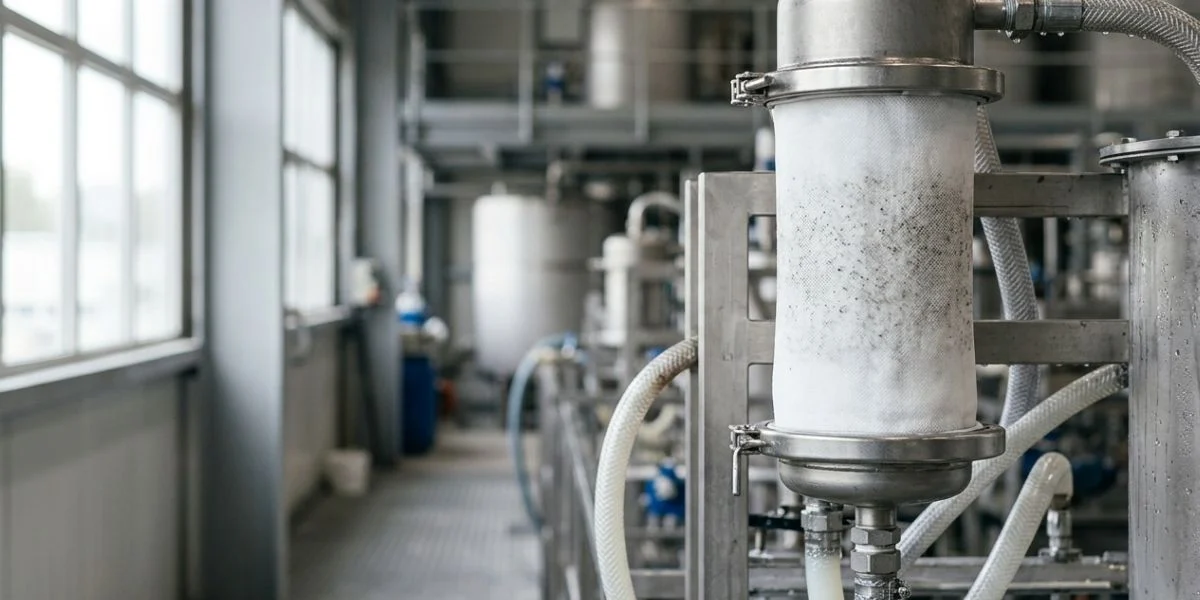
PTFE Membrane Nonwoven Filter Cloth for Chemical and Industrial Filtration
PTFE membrane nonwoven filter cloth is the material of choice when process conditions demand chemical inertness, high-temperature resistance, and sub-micron particle capture in a single filter element.
Polytetrafluoroethylene membrane laminated onto a nonwoven substrate combines the extreme chemical stability of PTFE with the mechanical strength and dimensional stability of PET or PP nonwoven — giving filter fabricators a material that performs in environments where every alternative fails.
Favourite Fab is a B2B upstream raw material supplier based in Agra, India, exporting industrial filtration fabrics to over 50 countries.
We supply PTFE membrane laminated nonwoven filter cloth in bulk rolls and cut-to-length pieces to chemical plants, pharmaceutical facilities, cement producers, and food processing engineers at competitive wholesale pricing.
What Is PTFE Membrane Nonwoven Filter Cloth
PTFE — polytetrafluoroethylene — is one of the most chemically inert and thermally stable polymers in industrial use.
Its carbon-fluorine bond structure is resistant to attack by virtually all acids, bases, solvents, and oxidising agents across the full pH range of 0 to 14.
In filter cloth applications, a thin PTFE membrane is laminated onto a nonwoven substrate — most commonly PET needle punch felt, PP spunbond, or PET spunbond — through a controlled sintering and calendering process.
The membrane acts as the primary filtration barrier while the substrate provides the mechanical strength, seam-welding surface, and dimensional stability needed to construct filter bags and cartridges.
The PTFE membrane pore structure is defined during the membrane manufacturing process and determines the filtration efficiency and air permeability of the finished filter cloth.
Pore sizes available from Favourite Fab range from 0.2 µm to 10 µm (nominal).
At pore sizes below 2 µm, the membrane achieves PM2.5 filtration efficiency above 99.9% — the performance level required for compliance with industrial emission standards in the EU (Industrial Emissions Directive), China (GB 18918 and equivalents), and India (CPCB standards for stack emissions).
Surface filtration is the primary performance advantage of PTFE membrane filter cloth over conventional depth-filtration felt.
In depth-filtration felt, particles are captured inside the fiber matrix and progressively blind the internal pore structure.
In PTFE membrane filter cloth, particles are captured on the smooth membrane surface.
Pulse-jet cleaning dislodges the surface cake cleanly, restoring pressure drop efficiently and delivering lower compressed air consumption, longer bag life, and fewer maintenance shutdowns.
PTFE Membrane Nonwoven Filter Cloth — Specifications and Options
Favourite Fab supplies PTFE membrane filter cloth with multiple substrate options and membrane pore sizes to match the specific demands of different process industries and filtration standards.
The table below shows standard specification parameters available from stock or short-lead production.
Custom substrate weight, membrane pore size, surface treatment (PTFE impregnation, antistatic treatment, singeing, calendering), and finishing for specific bag construction methods are available on request.
| Parameter | Specification | Detail |
|---|---|---|
| Substrate | PET needle punch felt / PP spunbond / PET spunbond | Substrate selected by bag construction method, operating temperature, and chemical environment |
| Membrane Pore Size | 0.2 – 10 µm (nominal) | Pore size matched to PM2.5 / PM10 emission target and process dust particle size distribution |
| Air Permeability | 5 – 80 L/m²/s @ 200 Pa | Tested per ISO 9237; varies by membrane pore size and substrate weight selected |
| Operating Temperature | Up to 260°C continuous | PTFE membrane stable to 260°C; PET substrate limits to ~150°C; PTFE felt substrate extends to 260°C |
| Filtration Efficiency | ≥ 99.9% @ PM2.5 | Surface filtration mechanism; confirmed by third-party particulate emission test |
| Chemical Resistance | pH 0 – 14; most organic solvents | PTFE inert to concentrated acids, alkalis, alcohols, ketones; confirm for exotic process chemistries |
| Width | 1,200 mm – 3,000 mm | Full-width rolls or slit width available; cut-to-length for bag panel fabrication on request |
| Certifications | ISO 9001; RoHS compliant | Third-party test reports to EN 143, ISO 11057, EN 1822 available for export specifications |
Applications for PTFE Membrane Nonwoven Filter Cloth
PTFE membrane filter cloth is used in the most demanding industrial air and gas filtration applications where conventional felt or woven filter bags fail prematurely.
The combination of chemical inertness, high operating temperature, and surface filtration efficiency makes it the standard specification across several major industries.
Chemical processing plants: Acid and alkali dust collection — sulphuric acid mist, titanium dioxide dust, caustic soda spray dryer off-gas — requires filter media that resists process chemistry degradation. PTFE membrane on PTFE-impregnated PET needle punch felt is the standard specification for these environments, delivering bag life three to five times longer than unprotected PET felt.
Cement production: Cement kiln and cooler baghouses operate at temperatures up to 200°C with alkaline cement dust at high inlet concentrations. PTFE membrane filter cloth on a heat-set PET or PTFE felt substrate meets increasingly stringent PM2.5 and PM10 stack emission limits. Surface filtration reduces pulse-jet compressed air consumption by 30–50% compared to conventional felt bags at the same differential pressure.
Why Source From Favourite Fab
Industrial filter fabricators and plant engineers across 50+ countries rely on Favourite Fab for PTFE membrane filter cloth supply.
Here is why our customers return to us for repeat orders and new plant specification requirements.
- MOQ-friendly: We supply both large chemical plant maintenance contractors requiring container-load quantities for a full baghouse replacement and smaller filter fabricators with project-specific requirements for a single plant. MOQ is structured to avoid over-commitment at either scale.
- Export-ready documentation: Certificate of analysis, material safety data sheets, third-party test reports to ISO or EN standards, origin certificates, and complete export paperwork are included with every international shipment. We have export experience with 50+ destination countries across EU, GCC, Southeast Asia, and Africa.
- ISO certified manufacturing: Our production and lamination processes operate under ISO quality management systems. Every roll is batch-coded and traceable through our quality management records.
- 10+ years of industrial nonwoven experience: Our engineering and production team understands filter bag construction requirements across pulse-jet, shaker, and reverse-air baghouse designs. We can advise on substrate selection for specific bag construction methods including sonic welding and sewn construction.
- Custom specifications: Substrate type and weight, membrane pore size, lamination adhesive system, antistatic treatment, PTFE impregnation of the substrate, and surface finishing (singeing, calendering) are all customisable to your bag design specification and process conditions.
- Technical pre-purchase support: Our engineering team can review your process conditions and recommend the correct membrane pore size, substrate, and finishing treatment before you commit to a purchase order.
Pricing and MOQ
Favourite Fab offers competitive wholesale pricing for PTFE membrane nonwoven filter cloth.
Pricing per square metre or per kilogram depends on substrate type and weight, membrane pore size, roll width, finishing treatment, and confirmed order volume.
We do not publish fixed price lists — all quotations are issued based on your confirmed technical specification and commercial volume requirement.
To receive a formal quotation, share your application details — process industry, operating temperature range, dust type and approximate particle size, target filtration efficiency or applicable emission standard, and required width and quantity per order.
Our sales team responds within one business day with a formal commercial offer including pricing, lead time, and sample dispatch plan.
Sample panels for baghouse qualification testing are dispatched on your confirmation.
How to Order
- Send your application specification: Email sale@favouritehub.com with your process industry, operating temperature, dust or particulate type, target emission standard (mg/Nm³ or equivalent), required width, and order quantity. WhatsApp enquiries are welcome at +91-8800775462 for faster first contact with our sales team.
- Receive samples and quotation: Our technical team selects the appropriate substrate, membrane pore size, and finishing treatment for your process conditions and dispatches sample material for your in-house qualification testing. A formal commercial quotation is issued at the same time, covering pricing, lead time, and payment terms.
- Confirm and schedule production: Once you have completed your qualification testing and are satisfied with the sample performance, confirm your order quantity. We issue a proforma invoice and confirm the production and delivery schedule with your target port of loading and estimated transit time.
Frequently Asked Questions
Q: What is the difference between PTFE membrane filter cloth and standard needle punch felt filter bags?
A: Standard PET or PP needle punch felt relies on depth filtration — particles penetrate and are captured inside the fiber matrix. Over time, fine particles blind the internal pore structure, making pulse-jet cleaning progressively less effective and causing pressure drop to rise. PTFE membrane filter cloth adds a surface membrane layer that captures all particles above the pore size at the fabric surface. Surface filtration delivers higher and more consistent collection efficiency for fine particles, more effective pulse-jet cleaning with lower compressed air consumption, and longer bag life — particularly in high-dust-loading or chemically aggressive process environments.
Q: Which process industries use PTFE membrane nonwoven filter cloth most commonly?
A: The primary industries are chemical processing (acid and alkali dust, pigment and titanium dioxide production), pharmaceutical manufacturing (API dust collection, spray dryer and fluid bed dryer off-gas), cement production (kiln, cooler, and raw mill baghouses), food processing (flour, starch, sugar, powdered ingredient dust), and power generation (coal fly ash collection). Any application combining fine particle size, aggressive chemistry, high moisture, or elevated temperature is a strong candidate for PTFE membrane filter cloth over conventional felt.
Q: Can PTFE membrane filter cloth handle continuous operating temperatures above 200°C?
A: Yes, with the correct substrate selection. The PTFE membrane itself is thermally stable to 260°C continuous operating temperature. The substrate determines the upper practical limit — PET needle punch felt is rated to approximately 150°C continuous; PTFE felt substrate extends the combined filter cloth’s rating to the membrane limit of 260°C. Always specify your maximum continuous and peak process temperature when requesting a quotation so our team can confirm the correct substrate and lamination system.
Q: How does PTFE membrane filter cloth perform in high-humidity or condensing gas conditions?
A: PTFE is inherently hydrophobic — water, acids in aqueous solution, and most organic solvents do not wet or penetrate the membrane under normal operating differential pressures. This makes PTFE membrane filter cloth the standard specification for processes with steam injection upstream, high dew point gas streams, or intermittent water condensation inside the baghouse. Where direct liquid water impingement is expected, a PTFE-impregnated substrate adds a further layer of moisture resistance. Specify your dew point and condensation risk so our team can confirm the correct material combination.
Q: What pore size should I specify to meet PM2.5 emission compliance targets?
A: For PM2.5 compliance targets — typically expressed as outlet concentration in mg/Nm³ under Indian CPCB standards, EU Industrial Emissions Directive, or equivalent national regulations — a membrane pore size of 0.5 µm to 2 µm nominal is typically specified. The exact pore size depends on the process dust particle size distribution, inlet dust loading, and the target outlet emission concentration. Our technical team can review your process data and confirm the appropriate membrane grade to achieve your emission target with a defined safety margin.
Q: Does Favourite Fab supply pre-cut filter cloth panels or only full rolls?
A: We supply both full-width roll goods for filter bag manufacturers with in-house cutting and seaming operations, and cut-to-length or cut-to-panel material for buyers who specify bags by diameter and length. Share your bag dimensions — diameter, length, and construction method — and we will quote cut-to-size material at the correct width and length to minimise waste.
Contact Favourite Fab
Favourite Fab is a B2B upstream raw material supplier for industrial nonwoven fabrics.
We export PTFE membrane nonwoven filter cloth to chemical plants, cement producers, pharmaceutical facilities, and filter fabricators across India, Southeast Asia, Europe, the Middle East, and Africa.
Our ISO-certified manufacturing, technical support, and export-ready logistics make us a dependable upstream partner for demanding filtration applications.
Contact our sales and technical team to request a sample panel, a material data sheet, or a formal commercial quotation for your filtration project.
We respond to all enquiries within one business day.
- Email: sale@favouritehub.com
- WhatsApp: +91-8800775462
- Website: favouritehub.com
Send your process specification today and receive a PTFE membrane grade recommendation and quotation within one business day.
Our team will match the correct pore size, substrate, and finish to your process conditions, emission target, and bag construction method.
Ask AI for a summary of Favourite Fab
Related B2B Resources

Gaurav Garg
I'm Gaurav Garg, CEO of Favourite Fab, a company on a mission to revolutionize the nonwoven industry with sustainable practices. We work hand-in-hand with manufacturers and suppliers who share our commitment to eco-friendly production. With a deep interest in textile innovation, I'm passionate about educating consumers about sustainable material options and their potential to transform the nonwoven landscape.


