

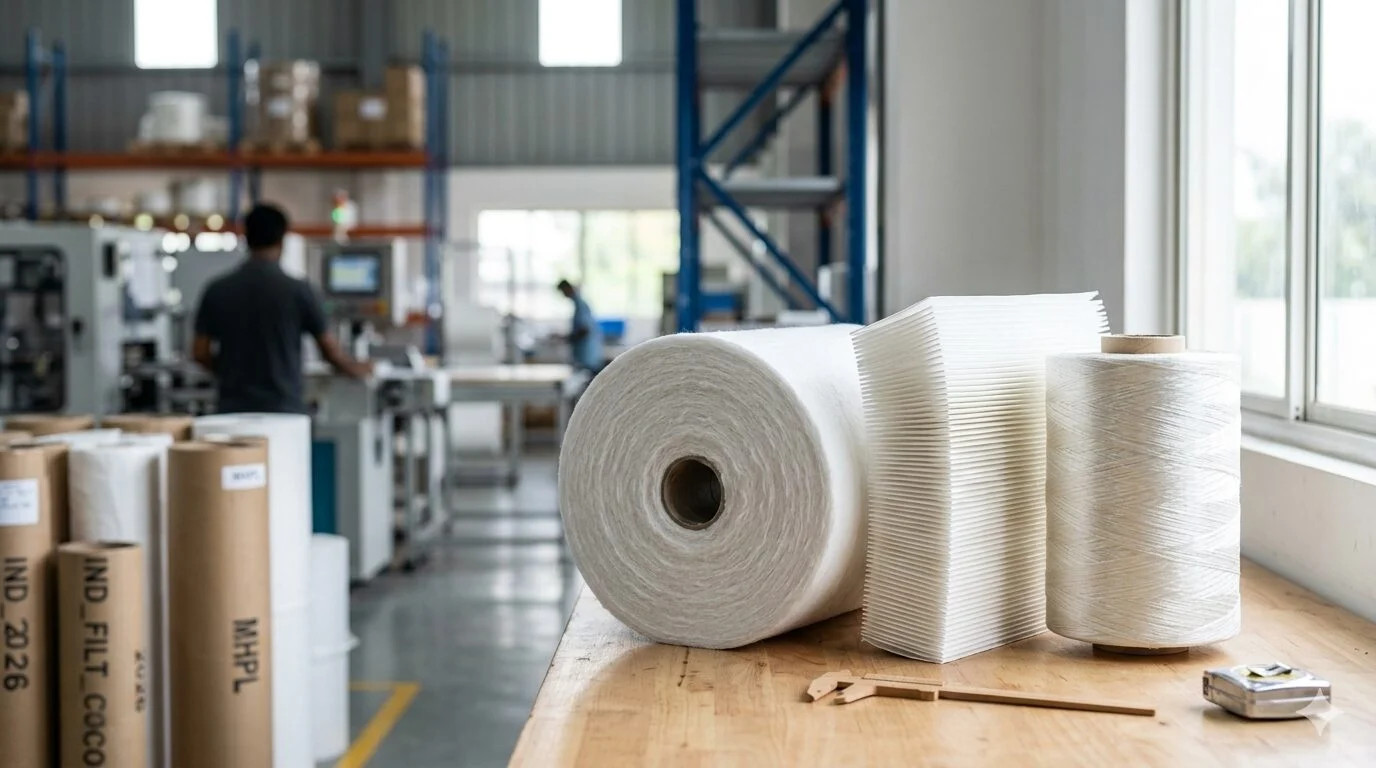
Air Filter Raw Material — Meltblown, HEPA & Glass Fibre Supplier India 2026
Air filters are everywhere — HVAC systems, automotive cabins, industrial dust extraction, vacuum cleaners, hospital ventilation, and now consumer air purifiers driven by India’s air-quality concerns. The market for filter media has grown sharply over the past 5 years, and the raw materials behind every filter — meltblown nonwoven, HEPA glass fibre, electret-charged media, and spunbond pre-filters — are the unsung heroes.
This guide covers all major air filter media types, their MERV/HEPA/ULPA classifications, GSM and efficiency targets, and supply options for filter manufacturers in India.
Air Filter Classification Standards
| Class | Particle Size | Efficiency | Standard | Typical Media |
|---|---|---|---|---|
| MERV 6–8 | 3–10 μm | 20–35% | ASHRAE 52.2 | Spunbond pre-filter |
| MERV 9–12 | 1–3 μm | 40–80% | ASHRAE 52.2 | Meltblown standard |
| MERV 13–16 | 0.3–1 μm | 85–95% | ASHRAE 52.2 | Electret meltblown |
| HEPA H13 | 0.3 μm | ≥99.95% | EN 1822 | Glass fibre |
| HEPA H14 | 0.3 μm | ≥99.995% | EN 1822 | Glass fibre |
| ULPA U15 | 0.12 μm (MPPS) | ≥99.9995% | EN 1822 | Borosilicate glass |
Filter Media Type 1 — Spunbond Pre-Filter
Coarse pre-filter for the first stage of multi-stage filtration. Captures dust, hair, lint before they reach the fine filter.
- Material: PP spunbond, often resin-coated or impregnated
- GSM: 50–150 GSM
- Efficiency: MERV 5–8
- Cost: ₹100–160/kg
- Use: HVAC, automotive cabin, industrial dust collector pre-stage
Filter Media Type 2 — Meltblown Filter Media
The workhorse of fine filtration. Same material as surgical mask filter, but engineered to higher GSM and tighter fibre diameter for air filtration.
Standard meltblown
- GSM: 25–80
- Fibre diameter: 1–3 μm
- Efficiency: MERV 11–14
- Cost: ₹450–700/kg
Electret-charged meltblown (PFE grade)
- GSM: 25–60
- Fibre diameter: 1–2 μm + corona discharge charge
- Efficiency: MERV 14–16, PFE 95%+
- Cost: ₹650–1,100/kg
Electret meltblown uses electrostatic forces in addition to mechanical filtration — captures sub-micron particles without high pressure drop. Used in:
- Air purifier filters (Indian residential market)
- Automotive cabin air filter (premium grade)
- N95 respirator filter media
- HVAC final filter stage
Filter Media Type 3 — Glass Fibre HEPA Media
Glass fibre is the gold standard for HEPA and ULPA filtration. Microfine borosilicate glass fibres (0.5–5 μm diameter) are randomly entangled into a thin paper-like sheet that captures sub-micron particles.
- Basis weight: 60–95 g/m²
- Fibre diameter: 0.3–5 μm borosilicate glass
- Efficiency: H13 (≥99.95%) or H14 (≥99.995%)
- Cost: ₹450–800/m²
- Use: Hospital HEPA, cleanroom, biosafety cabinet, premium air purifier
Most HEPA glass media is imported (Hollingsworth & Vose, Lydall, Ahlstrom). Domestic Indian production exists but is limited. Favourite Fab can source HEPA media on indent for orders ≥1,000 m², lead time 30–45 days.
Filter Media Type 4 — PTFE Membrane Filter
For ULPA and ultra-low-pressure-drop applications, PTFE (polytetrafluoroethylene) membrane on a spunbond support layer delivers ≥99.9999% efficiency at very low pressure drop. Used in semiconductor cleanrooms, pharma sterile filling, and premium consumer air purifiers.
- Membrane thickness: 5–25 μm
- Pore size: 0.1–1 μm
- Cost: ₹1,200–2,500/m²
Application-Specific Material Selection
| End Use | Filter Media | Typical GSM/Spec |
|---|---|---|
| HVAC pre-filter (commercial) | PP spunbond | 80–120 GSM |
| HVAC bag filter (F7-F9) | Meltblown laminate | 40 GSM meltblown + 30 GSM spunbond |
| Automotive cabin filter (standard) | Meltblown | 30–50 GSM |
| Automotive cabin filter (HEPA / activated carbon) | Electret meltblown + carbon | 50–70 GSM with carbon |
| Air purifier (consumer) | Electret meltblown | 40–60 GSM |
| Air purifier (HEPA) | Glass fibre HEPA | H13 / H14 |
| Vacuum cleaner bag | Spunbond + meltblown laminate | 50 GSM spunbond + 30 GSM meltblown |
| Industrial dust collector | Needle punch felt | 300–500 GSM |
| Cleanroom HEPA | Glass fibre H14 | Specific to cleanroom class |
Key Performance Metrics for Buyers
- Filtration efficiency: Tested at MPPS (Most Penetrating Particle Size, ~0.3 μm) per EN 1822
- Pressure drop (delta-P): Lower is better — affects HVAC fan power and filter life
- Dust holding capacity: Total dust before reaching limit pressure drop — affects filter life
- Pleat-ability: For pleated panel filters — media must hold pleat shape
- Tensile strength: Resists pleating stress and operational handling
Why Source Filter Media from Favourite Fab
- Spunbond pre-filter: Standard 80–150 GSM grade in stock
- Meltblown filter media: Both standard and electret-charged grades — partner production with COA
- Needle punch felt: 300–500 GSM for industrial dust collection
- HEPA glass media: Indent supply (30–45 day lead time)
- Test reports: Efficiency, delta-P, basis weight, breaking strength included
- ISO 9001:2015 certified
Related: Needle punch nonwoven manufacturer | Nonwoven price list
Frequently Asked Questions
What is the difference between MERV and HEPA?
MERV is a rating scale 1–16 used in HVAC for medium-efficiency filters. HEPA is a strict standard requiring ≥99.95% efficiency at 0.3 μm. HEPA is essentially MERV 17+. Most HVAC systems can’t accept true HEPA without major fan upgrades — they use MERV 13–14 instead.
Is electret meltblown the same as HEPA?
No. Electret meltblown achieves MERV 14–16 efficiency at sub-micron filtration via electrostatic charge. True HEPA (H13/H14) uses glass fibre and depends on pure mechanical filtration. Electret media loses charge over time (especially when wet); HEPA glass does not.
How long do air filter electret charges last?
Under normal indoor conditions, electret charge holds at 80%+ effective for 6–12 months. Humidity, temperature, and high dust loading reduce charge faster. For continuous performance, replace electret-based filters every 3–6 months in heavy-use applications.
Can I make N95 masks with HVAC filter media?
No. N95 respirators require specific corona-charged meltblown engineered for breathable resistance and 0.3 μm filtration efficiency. HVAC filter media is too dense (high pressure drop) and too fluffy (poor face seal). The two filter media types are not interchangeable.
Where is HEPA glass fibre produced?
Major global producers: H&V (US), Lydall (US), Ahlstrom (Finland), Hokuetsu (Japan). Some Chinese production exists but quality is variable. Indian domestic HEPA glass production is limited — most premium HEPA media is imported.
What’s the typical filter media cost as % of finished filter?
For HVAC and consumer filters, the media is 25–45% of total finished filter BOM. Frame, gasket, separator, and packaging make up the rest. For HEPA filters, media can be 60–70% of cost.
Get Filter Media Quote
Share your filter type, target efficiency rating, monthly volume, and end-application. Receive media samples and quote within 7 days.
- 📞 +91 88007 75462 / +91 88007 75462
- ✉️ sale@favouritehub.com
- 🌐 Send specifications
Related B2B Resources

Gaurav Garg
I'm Gaurav Garg, CEO of Favourite Fab, a company on a mission to revolutionize the nonwoven industry with sustainable practices. We work hand-in-hand with manufacturers and suppliers who share our commitment to eco-friendly production. With a deep interest in textile innovation, I'm passionate about educating consumers about sustainable material options and their potential to transform the nonwoven landscape.


