

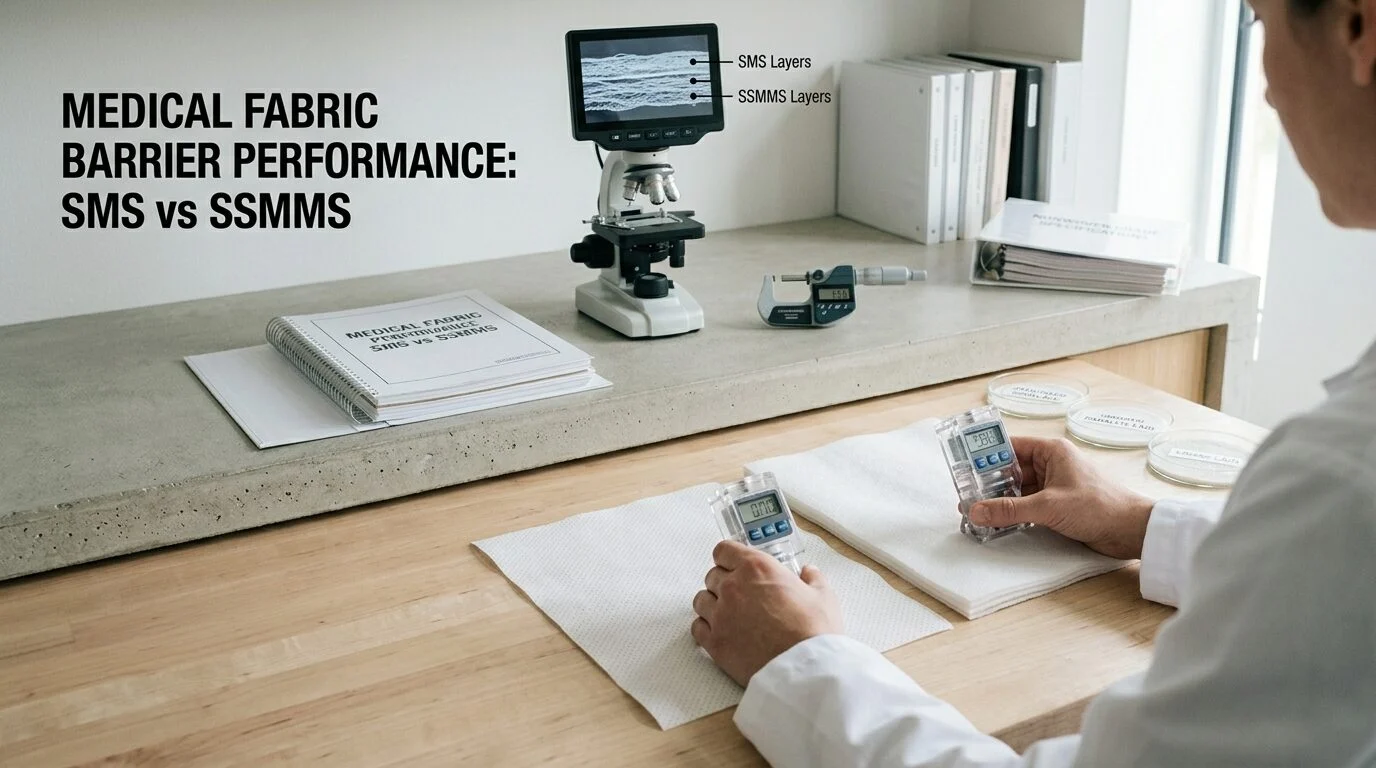
SMS vs SSMMS Nonwoven Fabric — Medical Barrier Performance Comparison
SMS and SSMMS are both composite nonwovens used in medical protection — but SSMMS’s additional meltblown layer significantly increases barrier performance. Choosing between them depends on the AAMI PB70 level required for your application.
Browse our full range: View all nonwoven fabric products — spunlace, spunbond, SMS, bico — with GSM, width and certification options. B2B MOQ from 500 kg.
Comparison Table
| Property | SMS (3-layer) | SSMMS (5-layer) |
|---|---|---|
| Structure | S + M + S | S + S + M + M + S |
| Meltblown layers | 1 | 2 |
| BFE | 98–99% | ≥99.9% |
| Hydrostatic head | 20–70 cmH₂O | 70–120 cmH₂O |
| AAMI PB70 level | Level 1–3 | Level 3–4 |
| Cost | Lower | 15–25% higher |
| GSM range | 20–60 GSM | 45–70 GSM |
FAQ
When is SSMMS required instead of SMS?
SSMMS required for AAMI PB70 Level 3–4 surgical gowns used in high-fluid-exposure surgeries: cardiovascular, orthopaedic, trauma. SMS sufficient for Level 1–2 low-splash procedures.
Can SMS achieve AAMI Level 3?
Yes — high-performance SMS at 50–60 GSM with optimised meltblown can achieve Level 3. But SSMMS more reliably meets Level 3–4 specifications. Specify required hydrostatic head (cmH₂O) when ordering — we confirm achievable level.
Full range: spunbond nonwoven fabric manufacturer India. Related: medical nonwoven fabric.
B2B Applications & End-Uses
SMS and SSMMS nonwovens serve distinct tiers in the medical textile supply chain, and selecting the wrong barrier level creates either regulatory non-compliance or unnecessary cost burden for OEM manufacturers. SMS (Spunbond-Meltblown-Spunbond, 3-layer) is the workhorse for AAMI PB70 Level 1 and Level 2 surgical gowns, disposable coveralls, and hygiene product backsheets where moderate liquid repellency is sufficient. Typical GSM range for SMS in these applications is 20–60 GSM, balancing breathability with adequate hydrostatic head resistance.
SSMMS (5-layer: Spunbond + Spunbond + Meltblown + Meltblown + Spunbond) is the specification-grade choice for AAMI PB70 Level 3 and Level 4 surgical gowns, sterile field drapes, and high-risk infection-control apparel. The dual meltblown core substantially increases particulate filtration efficiency and achieves hydrostatic head values that SMS cannot match. Operating room procurement teams and hospital group purchasing organisations (GPOs) increasingly mandate SSMMS for procedures involving bloodborne pathogen exposure, making SSMMS qualification a commercial necessity for gown converters targeting institutional healthcare accounts.
For face mask manufacturers, the barrier layer choice depends on end-product certification target. SMS outer layers are standard for EN 14683 Type I/IIR surgical masks. SSMMS is specified where additional particulate and splash resistance is required in the outer shell. Industrial safety apparel OEMs — particularly those producing Type 5 and Type 6 chemical protective coveralls — use SSMMS for its superior resistance to fine particulate penetration versus standard SMS construction.
Comparative specification table for B2B procurement decisions:
| Parameter | SMS (3-layer) | SSMMS (5-layer) |
|---|---|---|
| Layer count | 3 | 5 |
| Typical GSM range | 20–60 GSM | 25–100 GSM |
| Hydrostatic head | 20–40 cm H₂O | 50–100+ cm H₂O |
| AAMI PB70 rating | Level 1–2 | Level 3–4 |
| Particulate filtration | Moderate | High |
| Primary end-use | Hygiene, Level 1–2 gowns, coveralls | Level 3–4 gowns, sterile packaging |
| Cost index | Base | +20–35% over SMS |
Certifications & Quality Assurance
All SMS and SSMMS fabric produced at Favourite Fab is benchmarked against AAMI PB70 (American National Standard for Liquid Barrier Performance and Classification of Protective Apparel and Drapes Intended for Use in Health Care Facilities). Third-party testing against AAMI PB70 Levels 1–4 using the AAMI PB70 Impact Penetration Test and Hydrostatic Pressure Test is conducted on each production lot. Certificates of Analysis (COA) documenting hydrostatic head, tensile strength, and GSM uniformity are issued per batch and available for customer audit.
For European medical device and surgical apparel markets, EN 13795 (Surgical drapes, gowns, and clean air suits) compliance documentation is maintained. ASTM F2100 (Standard Specification for Performance of Materials Used in Medical Face Masks) testing data is available for mask converter customers. Export shipments to regulated markets are accompanied by full test reports, material safety data sheets, and country-of-origin declarations.
Internal quality assurance follows ISO 9001-aligned procedures: incoming raw polymer verification, in-line GSM monitoring at ±2% tolerance, hydrostatic head sampling per production reel, and final visual inspection for pinholes and web defects. Retained samples from each production lot are archived for 24 months to support customer audit and regulatory traceability requirements.
More Questions Answered
Can Favourite Fab supply both SMS and SSMMS from the same production facility?
Yes. Both constructions are produced on the same line with configuration changeovers between 3-layer SMS and 5-layer SSMMS runs. This means customers sourcing multiple barrier levels can consolidate vendor relationships, simplify incoming inspection protocols, and benefit from consistent base polymer quality across both SKUs. Lead times and MOQ apply per construction.
What is the minimum order quantity for SSMMS nonwoven in custom GSM?
Custom GSM specifications for SSMMS typically require a minimum production run to justify line setup and quality validation. Exact MOQ depends on width, GSM target, and colour requirements. Contact our B2B procurement team with your full technical specification for a quote and lead time confirmation.
Is SSMMS available in colours other than white for surgical gown differentiation?
SSMMS is available in standard white and select masterbatch colours (blue, green) used in surgical gown applications for procedure-type differentiation. Colour availability depends on order volume and lead time. All coloured variants undergo the same hydrostatic head and barrier testing as white production, with COA issued per colour lot.

Gaurav Garg
I'm Gaurav Garg, CEO of Favourite Fab, a company on a mission to revolutionize the nonwoven industry with sustainable practices. We work hand-in-hand with manufacturers and suppliers who share our commitment to eco-friendly production. With a deep interest in textile innovation, I'm passionate about educating consumers about sustainable material options and their potential to transform the nonwoven landscape.


