

What Is Spunlace Nonwoven Fabric? — Complete Guide for B2B Buyers
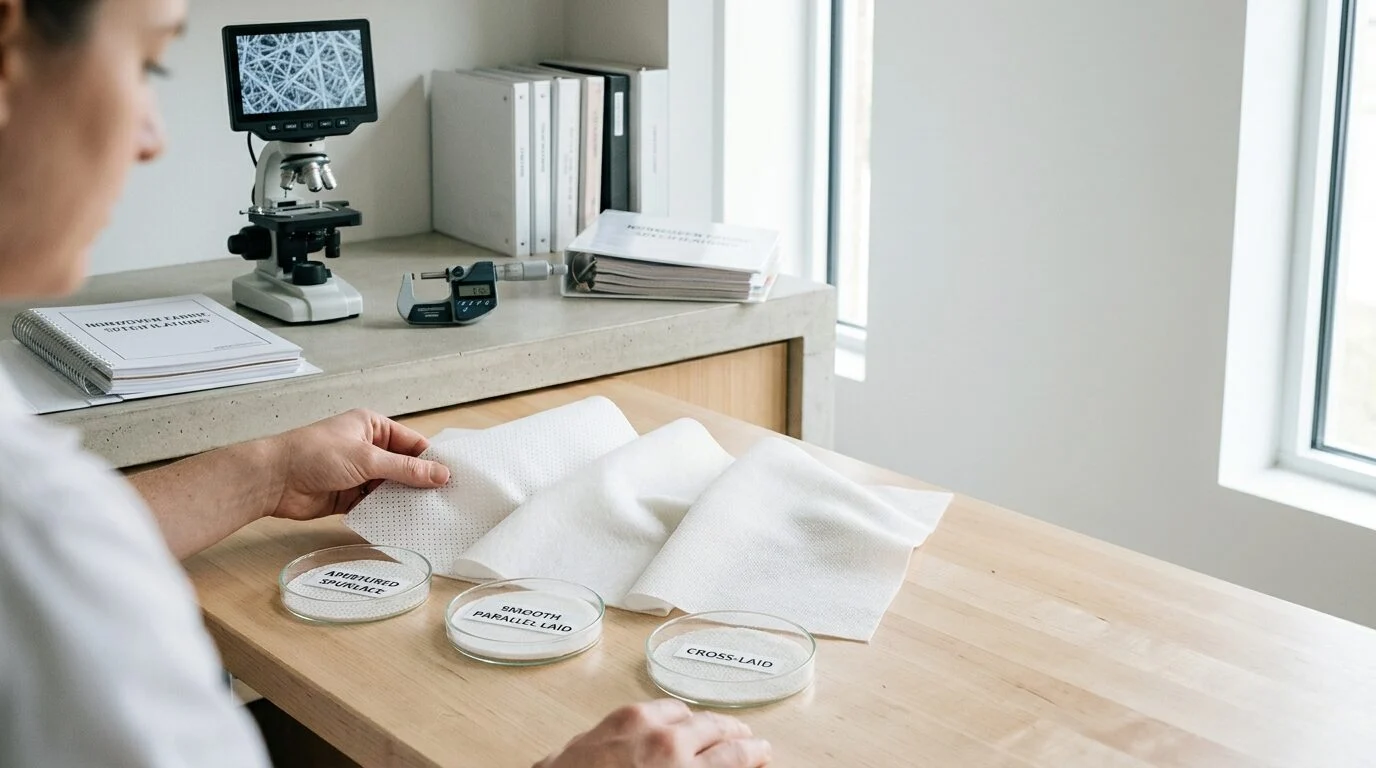
Spunlace nonwoven fabric (also called hydroentangled nonwoven) is a soft, strong sheet material produced by entangling fibres using high-pressure water jets — without weaving, knitting, or chemical binders. The result is a fabric with cloth-like softness, high absorbency, and controlled strength used globally in wet wipes, hygiene products, medical applications, and industrial wipes.
Browse our full range: View all nonwoven fabric products — spunlace, spunbond, SMS, bico — with GSM, width and certification options. B2B MOQ from 500 kg.
How Is Spunlace Made?
1. Fibre opening and blending — viscose, polyester, cotton, or wood pulp fibres opened and blended. 2. Carding or airlaid web formation — fibres formed into a uniform web. 3. Pre-wetting — web moistened to remove air. 4. Hydroentanglement — high-pressure water jets (50–250 bar) fire through the web on a perforated conveyor, entangling fibres mechanically. 5. Drying — through-air dryers remove water. 6. Winding — fabric wound into jumbo rolls.
Key Properties
| Property | Typical Range |
|---|---|
| GSM | 20–150 GSM |
| Fibre blends | Viscose/polyester, 100% viscose, cotton, wood pulp blends |
| Absorbency | 600–1,400% of fabric weight |
| Tensile MD | 40–500 N/5cm |
| Softness | Highest among nonwovens (no thermal bond points) |
| Binders | None — mechanical bonding only |
Applications
Wet wipes (baby, facial, household, industrial), sanitary pad topsheets, cosmetic pads, wound dressings, surgical swabs, medical drapes, automotive wipes, and agricultural fabrics.
FAQ
Is spunlace the same as nonwoven?
Spunlace is a type of nonwoven — specifically, nonwoven fabric produced by hydroentanglement. Other nonwoven types include spunbond (thermally bonded), needle punch (mechanically needled), and airlaid. All are nonwovens but made by different bonding methods.
Why is spunlace used for wipes instead of spunbond?
Spunlace is softer (no thermal bond hardness), more absorbent, and has a cloth-like drape that consumers prefer for skin-contact wipes. Spunbond is firmer and less absorbent — better for structural layers (bags, gown outer layers) than skin-contact wipes.
What fibres are used in spunlace nonwoven?
Viscose (most common), polyester, cotton, lyocell, bamboo, wood pulp, and blends. Fibre choice determines softness, absorbency, biodegradability, and cost. See our full range: viscose polyester, cotton, bamboo, lyocell spunlace.
Full range: spunlace nonwoven fabric. Related: spunlace nonwoven manufacturing process.
B2B Applications & End-Uses
Spunlace nonwoven fabric serves as the primary substrate across a broad range of B2B converting operations where the end product requires a combination of softness, absorbency, low-lint performance, and freedom from chemical binder residue. Wet wipes manufacturers \u2014 producing baby wipes, household wipes, industrial cleaning wipes, and personal care wipes \u2014 specify spunlace as the substrate because its binder-free construction ensures that no chemical release occurs into the wetting formulation during shelf life or use.
Medical and surgical products converters use spunlace for wound dressing components, surgical swabs, and sterile drape reinforcement where lint control and dimensional stability under saline or antiseptic fluid exposure are critical. Cosmetics and personal care sheet mask manufacturers in South and Southeast Asia specify spunlace \u2014 particularly viscose/PET blend and lyocell grades \u2014 as the sheet substrate for facial treatment masks, where drape, skin conformability, and serum-holding capacity are the governing product attributes.
Industrial cleaning and maintenance operations source spunlace wipe rolls for controlled-environment wiping, oil absorption, and surface preparation where the no-binder construction prevents contamination of sensitive surfaces. Hygiene product converters producing feminine care, adult incontinence, and reusable hygiene articles use spunlace topsheet and backsheet components where both softness and the visual premium of a textile-like surface are product differentiation attributes. Minimum order quantities, width options, and fibre blend customisation make Favourite Fab’s spunlace range accessible for mid-scale converters as well as large-volume industrial buyers.
Certifications & Quality Assurance
Spunlace nonwoven from Favourite Fab is manufactured through a fully documented production process in which carded fibre webs are hydroentangled using high-pressure water jets \u2014 with jet pressure, jet spacing, and line speed controlled to target specifications for each product grade. No chemical binder, latex, or adhesive is applied at any stage of production, and this binder-free status is confirmed on the COA and material safety data sheet for each grade.
GSM is measured per ASTM D3776 across the roll width, with lot-level average and tolerance band reported on the COA. Tensile and elongation are tested per ASTM D5035 (strip method) in both machine direction and cross direction, as MD/CD ratio is a critical converting parameter for wipe folding and dispensing equipment setup. Hydrophilicity \u2014 absorption rate and liquid retention capacity \u2014 is tested for grades specified as hydrophilic. Roll width is verified with a calibrated gauge and confirmed against the purchase order specification before shipment release. MOQ for standard catalogue grades is 500 kg; custom fibre blends and non-standard widths are available subject to minimum run quantity confirmation at the inquiry stage.
More Questions Answered
What fibres are available for spunlace nonwoven, and how does fibre choice affect end-use performance?
The most commonly specified fibres for spunlace nonwoven are viscose (rayon), polyester (PET), cotton, lyocell, and blends of these in varying ratios. Viscose provides high absorbency and a soft, textile-like hand \u2014 the standard choice for wet wipes and facial care. Polyester adds tensile strength, dimensional stability under wet conditions, and resistance to degradation \u2014 useful for industrial wipes and medical applications requiring durability. Cotton provides natural-origin positioning and compatibility with food-contact or sensitive-skin applications. Lyocell (Tencel) offers high absorbency with a premium-soft hand and biodegradability credentials valued in sustainably positioned wipe products. Blended constructions \u2014 most commonly 70/30 viscose/PET \u2014 balance the absorbency of viscose with the wet tensile of polyester for converting line performance.
How should a B2B buyer specify spunlace nonwoven when requesting a quote from a manufacturer?
A complete spunlace specification for a quotation request should include: target GSM (e.g., 40, 50, 70 g/m\u00b2), fibre blend and ratio (e.g., 70% viscose / 30% PET), roll width in millimetres, surface finish (hydrophilic or hydrophobic), MD/CD tensile ratio requirement if known, roll length or roll weight per roll, core diameter (3-inch or 6-inch), and intended end-use application. Stating the end-use helps the manufacturer recommend the appropriate entanglement pattern and fibre grade for your converting process. Minimum order quantity for standard grades at Favourite Fab is 500 kg, and samples are available for qualification testing before order placement.
📋 Related: Spunlace Nonwoven Fabric — Full Range & Specs | All Nonwoven Products from Favourite Fab

Gaurav Garg
I'm Gaurav Garg, CEO of Favourite Fab, a company on a mission to revolutionize the nonwoven industry with sustainable practices. We work hand-in-hand with manufacturers and suppliers who share our commitment to eco-friendly production. With a deep interest in textile innovation, I'm passionate about educating consumers about sustainable material options and their potential to transform the nonwoven landscape.


