

Through-Air Bonded Bico Nonwoven Fabric — TAB Soft Hygiene Layer Manufacturer India
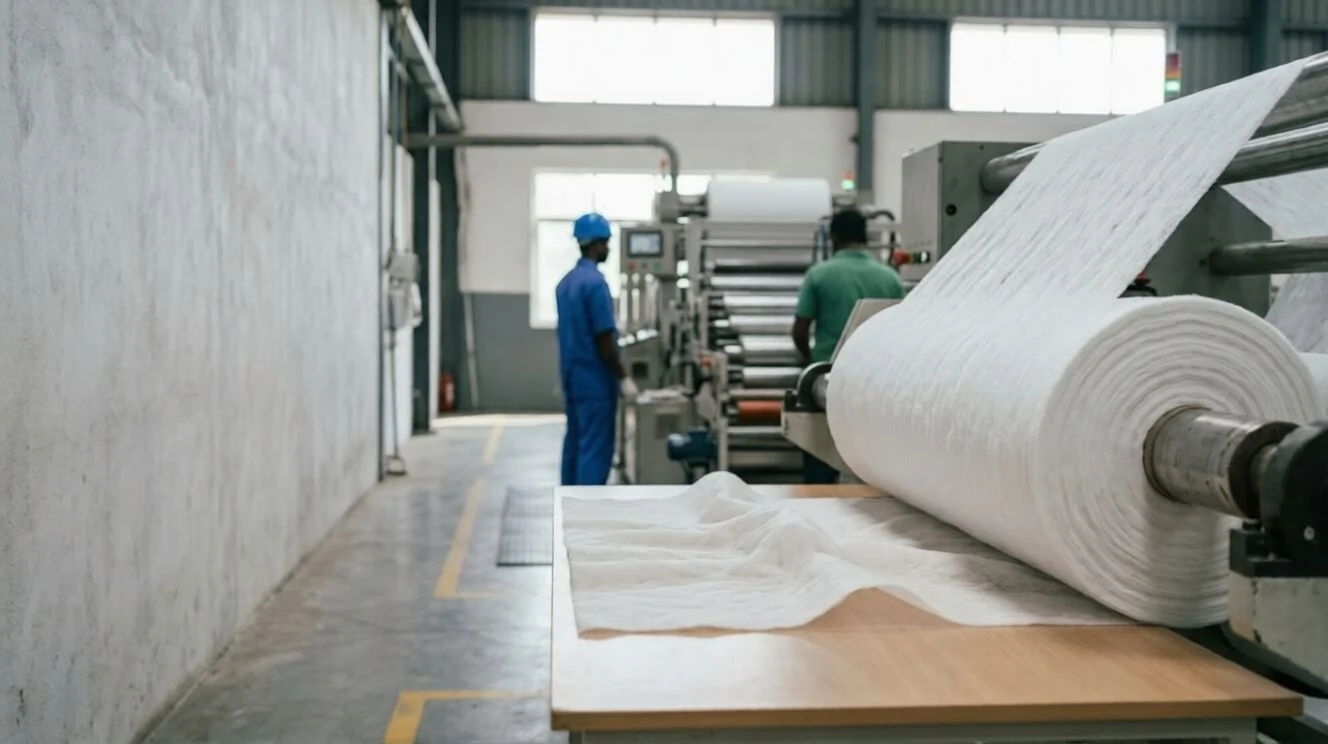
Through-air bonded (TAB) bico nonwoven is produced by passing hot air (120–130°C) through a loosely formed PE/PP bico web — the PE sheath melts and bonds fibre crossovers without the compression of calendar roller bonding. The result is an ultra-lofty, three-dimensional fabric with exceptional softness, bulk, and liquid distribution performance. TAB bico is primarily used as the acquisition distribution layer (ADL) in premium baby diapers and adult incontinence products — rapidly spreading liquid horizontally across the SAP core to prevent localised saturation.
Browse our full range: View all nonwoven fabric products — spunlace, spunbond, SMS, bico — with GSM, width and certification options. B2B MOQ from 500 kg.
Technical Specifications
Product: Hot Air Through Nonwoven
| Parameter | Specification |
|---|---|
| GSM | 30–80 GSM |
| Bonding | Through-air (TAB) — no calendar compression |
| Bulk/loft | 3–8 mm at 50 GSM (vs 0.5mm for calendar-bonded) |
| Liquid distribution | Rapid horizontal spreading |
| Fibre | PE/PP bicomponent |
| Width | 160–260 cm |
| MOQ | 500 kg |
Applications
Acquisition distribution layer (ADL) in baby diapers, adult incontinence ADL, feminine hygiene secondary topsheet, high-loft pillow fill layer.
Source from Favourite Fab
Direct manufacturer Agra, India. Custom GSM and width. COA per batch. Sample 3–5 days. See: nonwoven fabric for hygiene products. Related: bicomponent nonwoven fabric manufacturer India.
Frequently Asked Questions
Product: Hydrophilic Hot Air Through Nonwoven Fabric
What is through-air bonded bico nonwoven?
TAB bico uses hot air (not calendar rollers) to bond PE/PP bicomponent fibres. Hot air melts only the PE sheath — PE bonds at fibre crossovers without crushing the web. Result: 3D lofty structure with high bulk, high porosity, and rapid liquid distribution impossible with calendar-bonded fabrics.
What is the difference between TAB bico and standard calendar-bonded spunbond?
Calendar bonding compresses the web to 0.3–0.8mm thickness with distinct bond points. TAB bico retains 3–8mm bulk with uniform fibre distribution. TAB fabrics are softer, bulkier, and distribute liquid faster — critical for ADL performance in premium diapers.
What GSM TAB bico is used as ADL in diapers?
30–50 GSM for standard baby diaper ADL. 50–80 GSM for adult incontinence ADL (higher liquid volume requires more distribution capacity). ADL layer is distinct from coverstock — it sits between topsheet and SAP core to prevent gel blocking.
B2B Applications & End-Uses
Through-air bonded (TAB) bicomponent nonwoven occupies a specific and non-substitutable functional role in absorbent hygiene product design: the acquisition and distribution layer (ADL). Diaper manufacturers, feminine hygiene pad producers, and adult incontinence product converters specify TAB bico nonwoven as the ADL component because its high loft and open pore structure allows rapid fluid intake and lateral spreading \u2014 moving liquid away from the topsheet and into the absorbent core faster than calendered spunbond or thermally bonded staple fibre can achieve.
The lofty structure created by the through-air bonding process \u2014 where hot air melts only the PE sheath of PE/PP bicomponent fibres at fibre crossover points without compressing the web \u2014 produces a fabric caliper of 0.8\u20132.5 mm at equivalent GSM to calendered alternatives. This high caliper-to-weight ratio creates the void volume needed for fluid acquisition speed. Rewet performance \u2014 the measure of how much previously absorbed fluid returns to the surface under pressure \u2014 is directly governed by the ADL’s ability to retain fluid within the core structure, and TAB bico’s loft assists this retention function.
Sanitary napkin manufacturers sourcing ADL for ultra-thin constructions specify TAB bico in the 30\u201350 GSM range; diaper ADL for infant products typically ranges 40\u201380 GSM. Adult incontinence products with higher void volume requirements and multi-gush performance criteria specify heavier TAB bico grades, sometimes in combination with airlaid pulp components.
Certifications & Quality Assurance
TAB bicomponent nonwoven supplied by Favourite Fab is tested per production lot for caliper (thickness under defined load per EDANA ERT 30.5 or equivalent), rewet (simulated fluid strike-through and rewet measurement), and fluid acquisition rate (time-to-absorption for defined fluid volume). These parameters are the functional specifications that hygiene product R&D teams use in ADL qualification, and COA data is structured to match standard ADL qualification report formats used by hygiene product manufacturers.
PE/PP bico fibre sourcing is documented with fibre producer lot references, denier and staple length specification, and melt flow index data. GSM across the roll width is monitored continuously during TAB processing, with roll-level averages and tolerance bands recorded. Width consistency and edge straightness are verified before roll packaging \u2014 critical for high-speed hygiene converting lines where web tracking accuracy directly affects lane registration and cut accuracy.
More Questions Answered
How does through-air bonding produce a higher-loft fabric than thermal calendering at the same GSM?
In thermal calendering, the fibre web passes between heated calender rolls under mechanical pressure \u2014 the compression that bonds the fabric simultaneously reduces its thickness and void volume. Through-air bonding passes hot air through the fibre web without applying pressure, so the PE sheath component of the bicomponent fibres melts and forms bonds at natural fibre crossover points while the web retains its original lofted structure. The result is a fabric with significantly higher caliper and void volume at equivalent GSM \u2014 properties that directly translate to faster fluid acquisition and higher fluid retention capacity in hygiene ADL applications.
What specifications should a hygiene product manufacturer request when qualifying TAB bico nonwoven for a diaper ADL?
A standard diaper ADL qualification for TAB bico nonwoven should include: nominal and measured GSM, caliper under 0.5 kPa load, fluid acquisition time for a defined strikethrough test (typically 5 ml saline), rewet value after defined pressure loading, tensile strength in machine and cross directions, and width tolerance. Fibre content (PE/PP bicomponent ratio and denier) and bonding temperature documentation are required for process FMEA records. Favourite Fab provides all of these parameters on the COA and can supply development sample rolls for internal qualification testing before purchase order placement.
Related Hydrophilic Cluster Resources
- Master Pillar: Hydrophilic Non Woven Fabric Manufacturer India — production, grades (SS / SSS / SMS / HATB / spunlace), GSM matrix, B2B ordering.
- Application Pillar: Hydrophilic Top Sheet for Diapers and Hygiene Products — topsheet selection logic for baby diaper, sanitary napkin, adult incontinence, underpad.
- Process Pillar: Hydrophilic Hot Air Through Nonwoven Fabric — HATB / TAB lofty topsheet + ADL grades, bicomponent fibers, premium hygiene applications.

Gaurav Garg
I'm Gaurav Garg, CEO of Favourite Fab, a company on a mission to revolutionize the nonwoven industry with sustainable practices. We work hand-in-hand with manufacturers and suppliers who share our commitment to eco-friendly production. With a deep interest in textile innovation, I'm passionate about educating consumers about sustainable material options and their potential to transform the nonwoven landscape.


