

Ultrasonic Bonded Nonwoven Fabric — Medical Sealing Process Guide India
Ultrasonic bonded nonwoven fabric for medical sealing — Favourite Fab supplies ultrasonic-grade nonwoven raw material to medical device manufacturers, surgical pack producers, and hygiene OEMs across India and 50+ export markets. Our nonwoven fabrics are engineered for consistent ultrasonic weldability, enabling clean seam seals without adhesives or heat sealing tape. Buyers sourcing upstream raw material for medical sealing lines trust Favourite Fab as a specialist supplier. For comparison with related bonding technologies, see our spunbond non woven fabric range.
What Is Ultrasonic Bonded Nonwoven Fabric
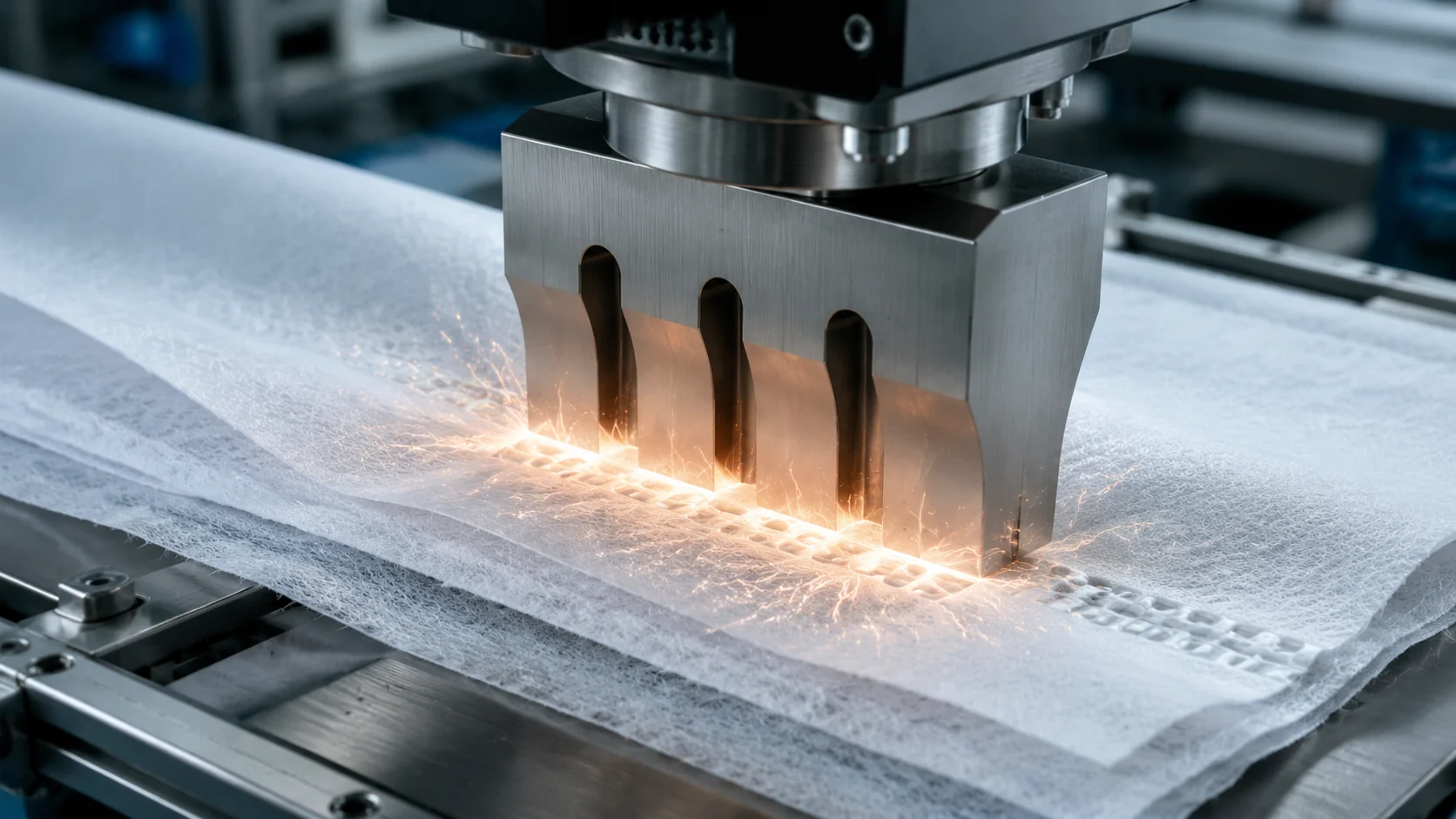
Ultrasonic bonding is a process where high-frequency sound energy — typically 20 to 40 kHz — is applied through a metal horn pressed against layered fabric. The vibration generates localised heat at fiber contact points, melting and fusing the thermoplastic fibers instantly. The result is a strong, clean bond with no external heat, adhesive, or stitching.
This process is widely used in medical device manufacturing for sealing sterilisation pouches, surgical gown seams, wound care packaging, and disposable drapes. Ultrasonic sealing produces a hermetic, particle-free bond that meets cleanroom production standards. The bond strength is consistent and repeatable — critical for sterile barrier systems validated under ISO 11607.
Not all nonwoven fabrics are suitable for ultrasonic bonding. The fabric must contain sufficient thermoplastic fiber content — typically PP, PE, or PET — and have uniform GSM to ensure even energy transfer across the horn face. Favourite Fab formulates ultrasonic-grade nonwoven to tight GSM tolerances, reducing reject rates on customer sealing lines. See also our thermal bonded nonwoven and calendar bonding nonwoven for complementary bonding technologies.
Ultrasonic Bonded Nonwoven — Specifications and Options
Favourite Fab supplies ultrasonic-grade nonwoven fabric with tight GSM tolerance and high thermoplastic fiber content. Our fabrics are tested on ultrasonic sealing equipment before dispatch to confirm consistent bond strength across the roll width.
| Parameter | Specification | Detail |
|---|---|---|
| GSM Range | 15 – 80 gsm | Tight ±2 gsm tolerance for sealing consistency |
| Width | Up to 2600 mm | Slit to customer width requirement |
| Fiber Type | PP, PE, PP/PE bicomponent | Minimum 80% thermoplastic content required |
| Ultrasonic Frequency Range | 20 – 40 kHz compatible | Tested on standard medical sealing equipment |
| Seal Strength | >15 N/15mm | Per EN 868-5 / ISO 11607 criteria |
| Tensile Strength MD | 20 – 90 N/5cm | ISO 9073-3 tested per batch |
| Microbial Barrier | Available | SMS and SMMS grades for sterile packaging |
| Color | White, blue, green, custom | Medical-grade white standard; custom on request |
Ultrasonic Bonded Nonwoven — Applications in Medical and Hygiene Manufacturing
Ultrasonic bonded nonwoven fabric is the material of choice for sterile barrier packaging in medical device manufacturing. Sterilisation pouches, surgical instrument wraps, and implant packaging all require a hermetic seal that maintains integrity through EtO, gamma, and steam sterilisation cycles. Our ultrasonic-grade nonwoven provides the thermoplastic content and GSM uniformity needed for reliable seam formation.
In surgical disposable manufacturing, ultrasonic sealing replaces stitching for gown seams, drape hems, and cap edges. Ultrasonic seams are particle-free — critical in cleanroom environments where fiber shedding contaminates sterile fields. Disposable protective garment manufacturers use ultrasonic bonding for side seams on coveralls and isolation gowns.
Hygiene product manufacturers use ultrasonic bonding for elastic waistband attachment in adult briefs, diaper side panel welding, and pad wing sealing. The process eliminates adhesive application steps, reducing line complexity and contamination risk. Manufacturers needing topsheet raw material for these lines can source our hot air through nonwoven for sanitary pads alongside our ultrasonic-grade fabric.
Why Source Ultrasonic-Grade Nonwoven From Favourite Fab
- MOQ-friendly — suitable for small medical device manufacturers and large hygiene OEMs
- Export-ready — ships to 50+ countries with CE-compatible test reports and CoA
- ISO certified manufacturing with batch traceability and in-line GSM monitoring
- 10+ years supplying medical and hygiene nonwoven raw material from India
- Custom specifications available — GSM, fiber blend, width, microbial barrier grade
- Pre-tested ultrasonic weldability — reduces line validation time for buyers
Ultrasonic Bonded Nonwoven — Pricing and MOQ
Favourite Fab offers competitive wholesale pricing on ultrasonic-grade nonwoven fabric for medical and hygiene manufacturers. Pricing varies by GSM, fiber specification, barrier grade, and order volume. Medical grades with microbial barrier testing carry a premium over standard grades.
Send your technical specification — GSM, width, fiber type, seal strength requirement, and target quantity — to sale@favouritehub.com for a detailed quotation. Samples for sealing line validation are available on request. Lead time for standard grades is 10–15 working days.
How to Order Ultrasonic Bonded Nonwoven Fabric
- Send your material requirements to sale@favouritehub.com including GSM, width, fiber type, and sealing application
- Receive a quote and sample within 48 hours for sealing line validation testing
- Confirm order and production begins with full batch documentation
Frequently Asked Questions — Ultrasonic Bonded Nonwoven Fabric Medical
Q: What fiber content is required for ultrasonic bonding of nonwoven fabric?
A: The fabric must contain at least 80% thermoplastic fiber by weight — typically polypropylene (PP), polyethylene (PE), or a PP/PE bicomponent blend. Higher thermoplastic content improves bond strength and reduces the energy required for sealing. Fabrics with natural fiber content above 20% are not suitable for ultrasonic bonding.
Q: Does Favourite Fab supply nonwoven fabric that meets ISO 11607 sterile barrier requirements?
A: We supply SMS and SMMS nonwoven grades with microbial barrier properties suitable for sterile barrier packaging per ISO 11607. Our fabrics carry test reports for microbial penetration resistance, seal strength, and GSM uniformity. Buyers are responsible for validating the complete package system.
Q: What is the difference between ultrasonic bonding and heat sealing for nonwoven fabrics?
A: Heat sealing applies external heat through heated jaws or rollers. Ultrasonic bonding generates heat internally through acoustic vibration — only at fiber contact points. Ultrasonic bonding is faster, produces cleaner seams with less thermal damage to surrounding fabric, and is preferred for thin or heat-sensitive nonwoven grades.
Q: What GSM range of ultrasonic-grade nonwoven does Favourite Fab supply?
A: We supply ultrasonic-grade nonwoven from 15 gsm to 80 gsm with ±2 gsm tolerance. Thinner grades (15–25 gsm) are used for sterilisation pouch construction. Mid-range grades (30–50 gsm) are common in surgical drapes and gown seams. Heavier grades (60–80 gsm) suit protective garment applications.
Q: Can Favourite Fab supply ultrasonic-grade nonwoven for diaper and sanitary pad manufacturing?
A: Yes. We supply nonwoven fabric for ultrasonic elastic attachment, side panel sealing, and wing bonding in diapers and adult briefs. These grades are PP-dominant with uniform GSM to ensure consistent sealing at high line speeds.
Q: What countries does Favourite Fab export ultrasonic-grade nonwoven to?
A: We export to 50+ countries including UAE, Saudi Arabia, Kenya, Bangladesh, Vietnam, Indonesia, Germany, and Turkey. We provide full export documentation including Certificate of Analysis, MSDS, packing list, and Bill of Lading.
Contact Favourite Fab — Ultrasonic Grade Nonwoven Fabric Supplier
Email: sale@favouritehub.com
WhatsApp: +91-8800775462
Send your material specifications today for a same-day quote on ultrasonic bonded nonwoven fabric for medical sealing applications.

Gaurav Garg
I'm Gaurav Garg, CEO of Favourite Fab, a company on a mission to revolutionize the nonwoven industry with sustainable practices. We work hand-in-hand with manufacturers and suppliers who share our commitment to eco-friendly production. With a deep interest in textile innovation, I'm passionate about educating consumers about sustainable material options and their potential to transform the nonwoven landscape.


