

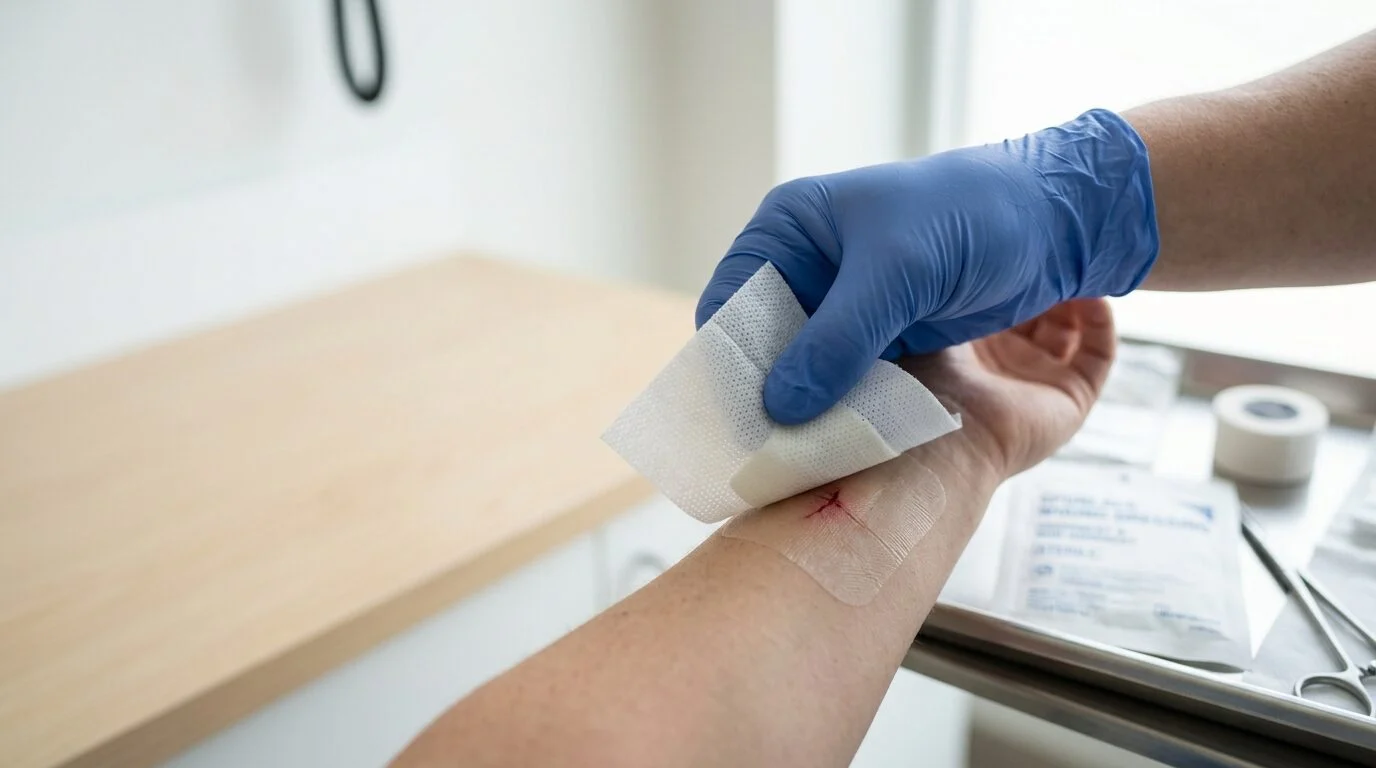
Spunlace Nonwoven Fabric for Wound Dressings — Non-Adherent, Absorbent
Spunlace Nonwoven Fabric for Wound Dressings is a critical raw material for B2B manufacturers. As India’s leading spunlace nonwoven fabric manufacturer, Favourite Fab supplies wound dressings grade spunlace in 40–100 GSM from our Agra facility — direct to OEM converters, wipe manufacturers, and hygiene brands across India and 30+ export markets.
Why Spunlace Nonwoven for Wound Dressings?
Spunlace nonwoven is produced by hydroentanglement — high-pressure water jets entangle fibres without chemical binders. The result is a soft, strong, lint-free sheet with exceptional absorbency and drape. Key advantages for wound dressings applications:
- High absorbency — viscose fibres absorb 8–12× their weight in liquid
- Softness — no thermal bonding = no hard fibre junctions = cloth-like feel
- Strength — hydroentanglement creates mechanical bonding that survives wet use
- No binder — no latex or chemical binder = clean, safe for skin and food contact
- Biodegradable option — 100% viscose grade composts within 90–180 days
Technical Specifications
| Parameter | Specification |
|---|---|
| GSM range | 40–100 GSM |
| Fibre blend | 100% viscose, viscose/polyester 80/20 |
| Width | 160–320 cm |
| Tensile strength (MD) | 80–400 N/5cm depending on GSM |
| Absorbency | 800–1,200% of fabric weight |
| pH | 6.5–7.5 (EDANA 70.2) |
| Roll length | 500–2,000m per roll |
| MOQ | 500 kg per specification |
Why Source from Favourite Fab?
- Direct manufacturer — factory in Agra, India. No middleman pricing.
- Custom slitting — any width 3–320 cm, tolerance ±1 cm
- Multiple fibre blends — viscose, polyester, cotton, organic cotton, lyocell in-house
- COA per batch — GSM, tensile, absorbency, pH test report
- Sample rolls 3–5 days — qualify on your production line before bulk order
For full product range see our medical nonwoven fabric pillar page. Related: spunlace nonwoven fabric.
Frequently Asked Questions
What makes spunlace suitable for wound dressings?
Viscose spunlace absorbs wound exudate (8–12× its weight), is non-adherent to wound tissue, and allows EO or gamma sterilisation without degradation. It does not leave fibres in the wound on removal.
What GSM wound dressing spunlace is standard?
40–60 GSM for secondary dressings and non-contact layers. 60–100 GSM for primary absorbent wound dressings requiring higher exudate capacity. Custom cuts available for specific dressing formats.
Does wound dressing spunlace need to be sterile?
The raw material supplied by Favourite Fab is non-sterile — sterilisation is performed by the medical device manufacturer (EO, gamma, or e-beam post-final packaging). We provide sterilisation compatibility data for all grades.
B2B Applications & End-Uses
Spunlace nonwoven for wound dressing applications serves OEM manufacturers of primary wound contact layers, secondary absorbent dressings, and combination dressing systems across the advanced wound care, acute care, and home health market segments. The wound contact layer is the most technically demanding position in a wound dressing construction — it must be non-adherent to prevent trauma on dressing removal, transmit exudate efficiently to the secondary absorbent layer, maintain dimensional integrity when saturated, and demonstrate ISO 10993 biocompatibility for prolonged skin or wound contact. Viscose or lyocell spunlace at 40–60 GSM provides the hydrophilic fibre base that transmits exudate while the open hydroentangled structure resists adhesion to granulation tissue.
EU MDR Class IIa wound dressing OEMs compiling technical files per IVDR/MDR Annex II require material-level documentation including ISO 10993-1 biological evaluation, sterilisation compatibility data, and substance-of-concern declarations — Favourite Fab’s wound dressing-grade spunlace is supplied with this documentation package. Medical device contract manufacturers producing private-label wound dressings for hospital procurement frameworks in the EU, UK, and GCC regions source wound contact layer spunlace from Favourite Fab to consolidate raw material supply under a single qualified vendor with traceable batch documentation.
Veterinary wound care OEMs manufacturing dressings for companion animal, equine, and livestock applications use wound contact layer spunlace identical in specification to human medical grades, where biocompatibility and non-adherence are equally critical. Research institutions and hospital pharmacy departments producing custom dressing systems for clinical studies or compassionate use applications source small-volume wound contact layer spunlace where full CoA and biocompatibility documentation must accompany each delivery for ethics committee approval. Occupational health and first-aid kit manufacturers incorporate wound contact layer spunlace in workplace dressing packs supplied to industrial facilities under health and safety compliance requirements.
Certifications & Quality Assurance
Wound dressing spunlace from Favourite Fab undergoes biocompatibility screening per ISO 10993-1, with cytotoxicity testing (ISO 10993-5) and skin sensitisation assessment (ISO 10993-10) conducted by accredited third-party laboratories. Results confirm absence of cytotoxic response at standard elution concentrations and absence of sensitisation potential for prolonged wound contact use. EO sterilisation compatibility is validated per ISO 10993-7 for EO residual levels, and gamma sterilisation stability (25 kGy and 50 kGy dose levels) is confirmed through tensile retention and colour stability testing per ISO 11137 protocols.
OEKO-TEX Standard 100 Class I certification — the most stringent substance safety category, applicable to products for babies and direct skin contact — is maintained for wound dressing-grade spunlace, providing a recognised baseline for absence of harmful substances during technical file compilation. Basis weight uniformity is controlled to ±5% per EDANA ERT 10.4-99, and water absorption capacity is tested per EDANA ERT 10.4 modified protocol to characterise exudate transmission properties. ISO 13485:2016 production controls ensure complete batch traceability from fibre source to finished roll, with 10-year document retention.
EU MDR technical file support documentation available from Favourite Fab for qualified customers includes: material specification sheet, ISO 10993-1 biological evaluation report, sterilisation compatibility data, OEKO-TEX certificate, substance of concern declaration (SVHC per REACH), and production lot CoA. MOQ 500 kg applies to standard wound contact layer grades — contact our B2B medical team to discuss sample validation quantities and qualification timelines.
More Questions Answered
What fibre type — viscose or lyocell — is preferred for wound contact layer spunlace, and why?
Both viscose and lyocell are cellulosic fibres and deliver the hydrophilic exudate-transmission properties required for wound contact layers. Lyocell (including Tencel-branded grades) is produced via a closed-loop solvent spinning process that avoids the caustic soda and carbon disulphide reagents used in viscose production — resulting in a fibre with higher purity, lower extractable content, and a cleaner toxicology profile that simplifies ISO 10993 biological evaluation. For wound dressings targeting EU MDR Class IIb or III classifications, lyocell spunlace is increasingly preferred by technical file authors to reduce substance-of-concern disclosure obligations. For standard Class IIa acute wound dressings, high-purity viscose spunlace with ECF bleaching certification remains technically acceptable and offers cost advantages at scale. Favourite Fab supplies both fibre types — specify your regulatory classification and documentation requirements at RFQ stage.
What MOQ applies to wound dressing spunlace, and can trial quantities be supplied for dressing validation programmes?
Standard production MOQ for wound dressing spunlace is 500 kg per GSM and fibre specification. For new product validation programmes, Favourite Fab can supply pre-production trial quantities of 50–100 kg accompanied by full CoA and available biocompatibility data — sufficient for ISO 10993 cytotoxicity screening, dressing construction prototyping, and initial clinical assessment. Trial quantities are priced at a premium over production rates. Following successful validation and product registration, customers commit to production MOQ for commercial supply. Lead time for trial quantities is 3–4 weeks from specification confirmation; production lead time is 6–8 weeks. Contact our B2B medical sales team with your specification and validation timeline to initiate a trial supply agreement.
📋 Related: Spunlace Nonwoven Fabric — Full Range & Specs | All Nonwoven Products from Favourite Fab

Gaurav Garg
I'm Gaurav Garg, CEO of Favourite Fab, a company on a mission to revolutionize the nonwoven industry with sustainable practices. We work hand-in-hand with manufacturers and suppliers who share our commitment to eco-friendly production. With a deep interest in textile innovation, I'm passionate about educating consumers about sustainable material options and their potential to transform the nonwoven landscape.


