

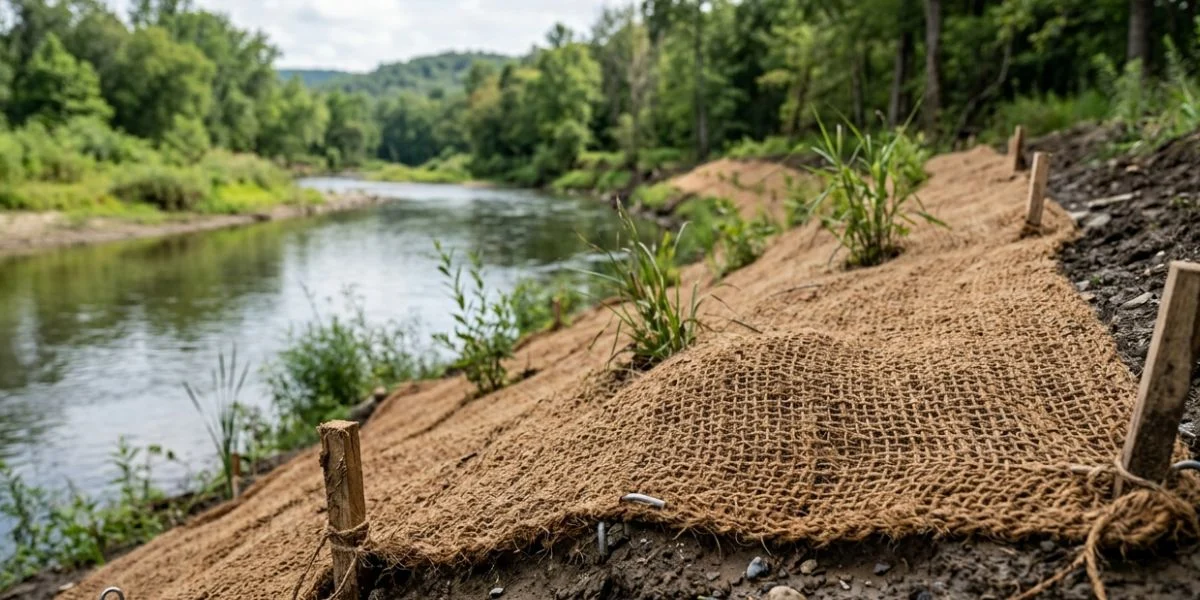
Biodegradable Jute Coir Geotextile Erosion Control Fabric
Biodegradable jute coir geotextile erosion control fabric is the sustainable choice for infrastructure engineers, landscape contractors, and environmental consultants managing slope stabilisation, riverbank protection, and road embankment projects. Favourite Fab supplies natural fibre geotextile rolls combining jute and coir for temporary and permanent erosion control applications across India and export markets.
Why Choose Jute-Coir Geotextile Over Synthetic Alternatives
Unlike polypropylene geotextiles, jute-coir blends biodegrade within 2–5 years, enriching soil with organic matter and eliminating post-project removal costs. Key advantages:
- 100% natural fibres — fully compliant with green infrastructure mandates
- High tensile strength during critical vegetation establishment phase (12–24 months)
- Excellent water retention supports seed germination
- Cost-effective vs. synthetic alternatives for temporary erosion control
- Available in open-weave and woven configurations for varying slope gradients
Technical Specifications
| Parameter | Jute Geotextile | Coir Geotextile | Jute-Coir Blend |
|---|---|---|---|
| Weight (GSM) | 400–700 | 700–900 | 500–800 |
| Tensile Strength (MD) | 8–12 kN/m | 10–15 kN/m | 10–14 kN/m |
| Degradation Period | 1–2 years | 3–5 years | 2–4 years |
| Typical Width | 1.0–2.0 m | 1.0–2.0 m | 1.0–2.0 m |
| Applications | Gentle slopes, channels | Steep slopes, coastal | Embankments, road sides |
Key Applications in Infrastructure Projects
- Road embankment stabilisation: NHAI and state highway projects specify natural geotextile for cut slopes
- Riverbank and canal lining: Prevents washout during monsoon season
- Railway track embankments: Temporary stabilisation during construction
- Landscaping and golf courses: Soil retention while grass establishes
- Mining rehabilitation: Revegetation of disturbed areas
Certifications and Standards
Favourite Fab jute-coir geotextiles are manufactured to IS 14715 (Jute Geotextile) standards and are eligible for GRIHA and IGBC green building credits. Export shipments comply with ASTM D6475 open weave geotextile test methods.
Frequently Asked Questions
- What is the difference between jute and coir geotextile?
- Jute degrades faster (1–2 years) and suits gentle slopes. Coir is coarser, stronger, and lasts 3–5 years — preferred for steep slopes and coastal erosion where longer protection is needed.
- What GSM is recommended for road embankments?
- Typically 500–700 GSM for standard embankments. Steep slopes above 30° require 700–900 GSM coir or reinforced jute-coir blends.
- Can Favourite Fab supply in custom widths?
- Yes. Standard rolls are 1.0 m and 2.0 m wide. Custom widths up to 4 m available for large infrastructure projects with minimum order quantity requirements.
- Do you export to Middle East and Southeast Asia?
- Yes. Favourite Fab exports jute-coir geotextiles to UAE, Saudi Arabia, Bangladesh, and Vietnam with standard phytosanitary certification.
Contact Favourite Fab for competitive wholesale pricing on jute coir geotextile erosion control fabric. Bulk rolls, custom widths, and project-specific specifications available. Request a sample kit or get a quote from our export team today.
Technical Specifications
Our biodegradable jute and coir geotextiles are manufactured to meet demanding erosion control and slope stabilisation requirements. Each roll is produced under strict quality controls aligned with IS 16392 (Geotextiles — Specification), ensuring consistent performance across civil and environmental applications.
| Parameter | Value |
|---|---|
| GSM Range | 200–800 GSM |
| Fibre Type | Natural Jute / Coir (coconut fibre) |
| Standard | IS 16392 — Erosion Control Grade |
| Wide-Width Tensile Strength | ≥ 15 kN/m (machine direction) |
| Biodegradation Period | 2–3 years in-situ (soil/moisture dependent) |
| Available Roll Width | 1.0 m, 1.5 m, 2.0 m (custom widths on request) |
| Roll Length | 25 m – 100 m per roll |
Jute geotextiles (200–400 GSM) are preferred for riverbank protection and shallow slope stabilisation where rapid vegetation establishment is critical. Coir geotextiles (400–800 GSM) offer higher tensile strength and slower biodegradation, making them suitable for steeper slopes, coastal erosion zones, and road embankments where a longer reinforcement window is required before vegetation cover is established.
B2B Applications & OEM Use-Cases
- Road & Highway Embankment Erosion Control: NHAI and state PWD contractors use 400–600 GSM coir geotextile rolls for embankment face protection during construction windows. The natural fibre biodegrades harmlessly once turf is established, eliminating removal costs.
- Riverbank & Canal Slope Stabilisation: Irrigation departments and river authority contractors specify IS 16392-compliant jute geotextiles for riparian buffer zones, canal lining protection, and riverbank revetment — particularly where synthetic materials are restricted by environmental clearances.
- Mine Reclamation & Green Infrastructure OEMs: Environmental engineering firms and EPC contractors sourcing geotextiles for mine slope reclamation, landfill cover revegetation, and urban green-infrastructure projects prefer certified natural-fibre grades that qualify for sustainability reporting under ESG procurement guidelines.
Sourcing from Favourite Fab — MOQ, Lead Time & Customisation
Favourite Fab supplies biodegradable jute and coir geotextiles directly from our Agra manufacturing facility to contractors, distributors, and government procurement agencies across India and export markets.
- MOQ: 500 kg per specification (GSM / fibre type / width combination)
- Domestic Lead Time: 7–14 working days from order confirmation
- Export Lead Time: 21–30 days (FOB Nhava Sheva / ICD Tughlakabad)
- Custom Options: GSM (200–800), roll width, fibre blend ratio (jute/coir), IS 16392 test certificate per batch, third-party inspection supported
- Quality Certifications: ISO 9001:2015 certified manufacturing; test reports issued per IS 16392 for every production lot
For bulk project quotations, tender specifications, or material approval submittals, contact our B2B sales team with your project details, required GSM, and delivery location.
Frequently Asked Questions
What is the difference between jute and coir geotextile for erosion control?
Jute geotextiles (200–400 GSM) biodegrade faster (12–18 months) and suit mild slopes and riverbanks where rapid vegetation is expected. Coir geotextiles (400–800 GSM) biodegrade over 2–3 years, provide higher tensile strength (≥15 kN/m), and are used for steeper slopes, coastal zones, and road embankments requiring a longer reinforcement window.
Do your jute/coir geotextiles comply with IS 16392?
Yes. All our natural-fibre geotextiles are manufactured and tested in accordance with IS 16392 (Geotextiles — Erosion Control). Batch test certificates covering tensile strength, mass per unit area, and water absorption are issued with every dispatch and can be submitted for material approval on infrastructure projects.
What is the minimum order quantity and how quickly can you dispatch?
Our MOQ is 500 kg per specification. For standard stocked GSMs, domestic dispatch is typically within 7–10 working days. Custom GSM or width orders require 10–14 working days. Export orders are shipped within 21–30 days with full documentation (invoice, packing list, COO, test certificate).
Related B2B Resources

Gaurav Garg
I'm Gaurav Garg, CEO of Favourite Fab, a company on a mission to revolutionize the nonwoven industry with sustainable practices. We work hand-in-hand with manufacturers and suppliers who share our commitment to eco-friendly production. With a deep interest in textile innovation, I'm passionate about educating consumers about sustainable material options and their potential to transform the nonwoven landscape.


